
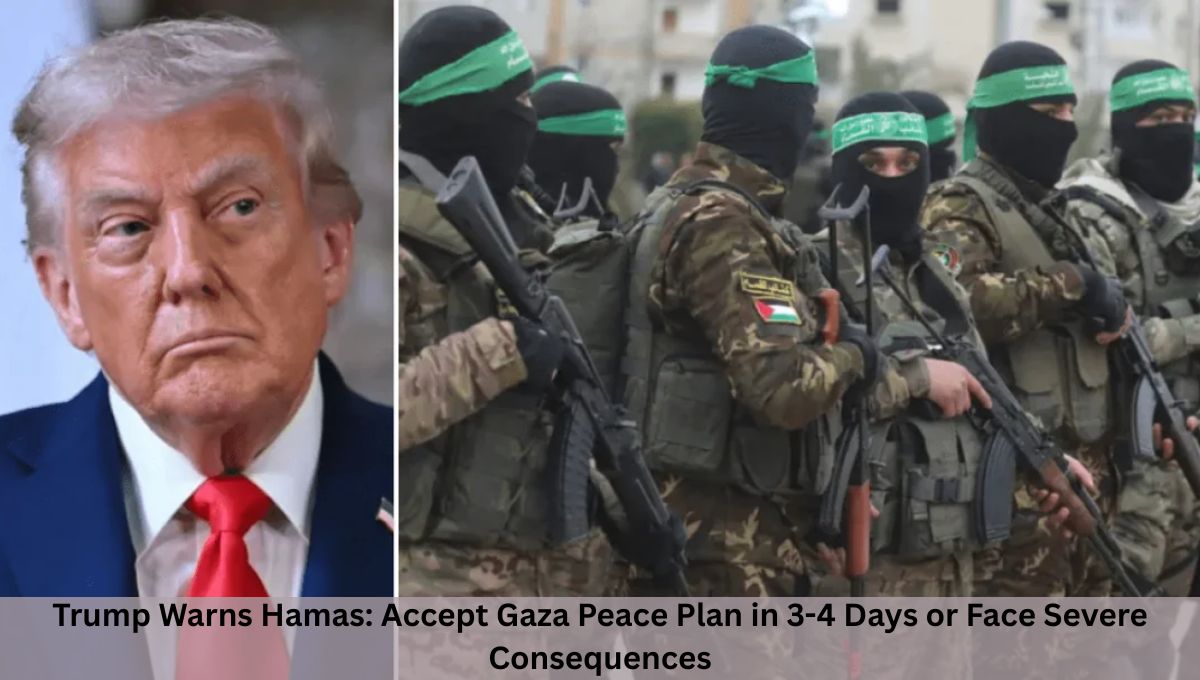
Amid calls to disarm, Trump Warns Hamas: Accept Gaza Peace Plan in 3-4 Days or Face Severe Consequences. In a move that could reshape the course of the Middle East conflict, US President Donald Trump has given the Palestinian militant group Hamas three to four days to accept his newly unveiled 20-point Gaza peace plan, warning of “severe consequences” if they refuse.
Speaking to reporters outside the White House on Tuesday, Trump declared that Israel, Arab nations, and Muslim-majority countries had already signed up to the plan. “We’re just waiting for Hamas,” he said. “And Hamas is either going to be doing it or not — and if it’s not, it’s going to be a very sad end.”
The ultimatum comes a day after Trump formally presented his administration’s most ambitious diplomatic effort yet to halt the war in Gaza.
Trump Warns Hamas: Accept Gaza Peace Plan in 3-4 Days or Face Severe Consequences
What Is Trump’s 20-Point Gaza Peace Plan?
The 20-point Gaza peace plan sets out a roadmap for ending the bloody war that erupted on October 7, 2023, following Hamas’ attack on southern Israel.
Key Proposals of Trump’s Peace Plan:
- Immediate ceasefire and cessation of hostilities in Gaza.
- Release of all remaining Israeli hostages in exchange for hundreds of Palestinian prisoners.
- Gradual withdrawal of Israeli forces from Gaza.
- Complete disarmament of Hamas and removal of its ability to govern Gaza in any form.
- Deployment of an International Stabilisation Force (ISF) to oversee transition.
- Rapid delivery of humanitarian aid to Gaza’s starving population.
- Reconstruction framework backed by international donors.
- Future pathway to Palestinian self-determination, though Israel insists it will not allow the creation of a Palestinian state.
Trump presented the plan as a historic breakthrough, telling US military commanders in Quantico that it could be “the biggest war settled in modern times.” He boasted: “Three thousand years is a long time, but we’ve got it.”
Hamas Reaction: Deliberation, Not Acceptance
Hamas leaders confirmed on Tuesday that they had received the proposal and would study it carefully with other Palestinian factions before issuing a response.
While acknowledging the immense international pressure, Hamas officials signaled strong reservations.
A senior Hamas figure told the BBC the plan “serves Israel’s interests and ignores the Palestinian people.” The group objects to:
- Mandatory disarmament
- Loss of governance in Gaza
- Deployment of an international force it views as a “new occupation”
Another sticking point: the plan demands Hamas release all 48 remaining hostages at once — a move that would strip the group of its primary bargaining chip.
Also Read: Hamas Divided Over Trump’s Gaza Ceasefire Plan as Deadline Nears
Netanyahu’s Support — with Conditions
Israeli Prime Minister Benjamin Netanyahu welcomed the plan during White House talks, describing it as consistent with Israel’s war aims: dismantling Hamas militarily and politically.
“I support your plan to end the war in Gaza, which achieves our war aims. It will bring back to Israel all our hostages, dismantle Hamas’ military capabilities, end its political rule and ensure that Gaza never again poses a threat to Israel,” Netanyahu said.
Yet within hours, Netanyahu appeared to push back on key provisions. In a video posted to X, he asserted that Israeli troops would remain in much of Gaza and vowed to “forcibly resist” the creation of a Palestinian state — contradicting Trump’s stated framework.
Global Reactions: Support and Skepticism
Trump’s plan drew significant international backing.
- India: Prime Minister Narendra Modi praised the initiative on X, calling it a “viable pathway to long-term and sustainable peace.”
- France, Canada, Russia, and others: Publicly welcomed the plan, describing it as the most detailed ceasefire proposal yet.
- Turkey and Qatar: Key mediators in Gaza diplomacy, confirmed they would join the process in Doha. Turkish President Recep Tayyip Erdoğan hailed Trump for “halting the bloodshed.”
Meanwhile, Palestinian Islamic Jihad (PIJ), a Hamas ally, rejected the plan outright on Tuesday.
Gaza’s Humanitarian Catastrophe
Since October 2023, Gaza has endured one of the deadliest conflicts in recent history.
- At least 66,097 Palestinians killed, mostly women and children, according to Gaza’s health ministry.
- Famine confirmed in Gaza City, with the UN warning of mass starvation.
- 453 deaths linked to hunger, including 150 children.
- Hospitals overwhelmed: Al-Awda, Al-Aqsa, and Al-Shifa report dozens killed daily by Israeli raids.
For many Palestinians, Trump’s plan is attractive not for its political merits but because it promises an end to the relentless violence.
“Even if the devil himself brought a plan to end this hell, I would support it,” Gaza resident Khadar Abu Kweik told the BBC.
Key Challenges Facing Trump’s Peace Push
Despite the fanfare, several obstacles loom:
1. Hamas Distrust of Israel and US
Hamas fears Israel will resume military operations after regaining hostages, particularly after its recent assassination attempt on Hamas leaders in Doha.
2. Israeli Domestic Politics
Netanyahu faces pressure from far-right coalition partners who reject any compromise and push for annexation of Gaza and the West Bank.
3. Lack of Palestinian Input
The plan was drafted largely without consultation with Palestinian leadership, fueling perceptions that it is a deal imposed from above.
4. The “Board of Peace” Proposal
Trump’s idea of an international body, possibly led by figures like Tony Blair, to govern Gaza temporarily has sparked fierce criticism. Palestinians recall Britain’s colonial history and view the concept as foreign domination.
Trump’s Diplomatic Gamble
For Trump, the Gaza peace plan is his boldest attempt yet to shape global affairs. He described the unveiling as “potentially one of the greatest days in civilization.”
The plan builds on his broader foreign policy record:
- Middle East: His Abraham Accords normalized ties between Israel and Arab states.
- Ukraine: His earlier peace claims fell apart amid intensifying war.
- Global stage: He relishes high-profile announcements but is often criticized for lacking follow-through.
Analysts warn Trump may be overpromising once again. “The Middle East has never lacked peace plans,” noted one expert. “The problem is always implementation.”
Palestinians Divided Over the Plan
Inside Gaza, reactions are deeply mixed:
- Support for ending war: “The people of Gaza cannot bear this any longer. They want a ceasefire now, at any cost,” said journalist Fathi Sabah.
- Skepticism about US intentions: Many believe the plan “serves Netanyahu’s interests” more than Palestinian aspirations.
- Fear of rejection: A Hamas refusal could trigger a massive Israeli escalation, with Trump’s blessing.
Trump and Netanyahu: A Tactical Partnership
Though publicly aligned, Trump and Netanyahu may have different calculations.
- Trump seeks a diplomatic triumph, boosting his standing internationally and at home.
- Netanyahu, facing political and legal troubles, may see prolonging the war as vital to his survival.
Some analysts believe Netanyahu endorsed Trump’s plan expecting Hamas to reject it, thereby gaining license to intensify Israel’s assault.
Also Read: Trump’s Gaza peace plan: What Hamas has accepted and what it hasn’t
Conclusion: Peace or Escalation Ahead?
Donald Trump’s 20-point Gaza peace plan represents the most comprehensive international effort yet to halt the war. It carries endorsements from Israel, Arab states, India, and global powers, but faces rejection from Hamas and skepticism among Palestinians.
The coming days will be decisive. If Hamas accepts, the plan could mark the beginning of a fragile peace process. If it refuses, Israel — with Trump’s explicit backing — is likely to escalate its campaign, deepening Gaza’s humanitarian nightmare.
“They’re the only one left,” Trump said of Hamas. “Everyone else has accepted it.” Whether that pressure results in peace or further devastation will become clear within days.
Related Posts:
- Trump’s 2025 Gaza Peace Plan Signing and Historic…

- 5 Powerful Highlights as Trump Lands Second Nobel…

- 11 Explosive Warnings as Trump Vows to ‘Knock the…

- 7 Shocking Reasons FIFA’s Peace Prize for Trump…

- 9 Explosive Revelations as Trump Declares His Health…

- Trump’s 20-Point Gaza Peace Plan Gains Urgent Global…
