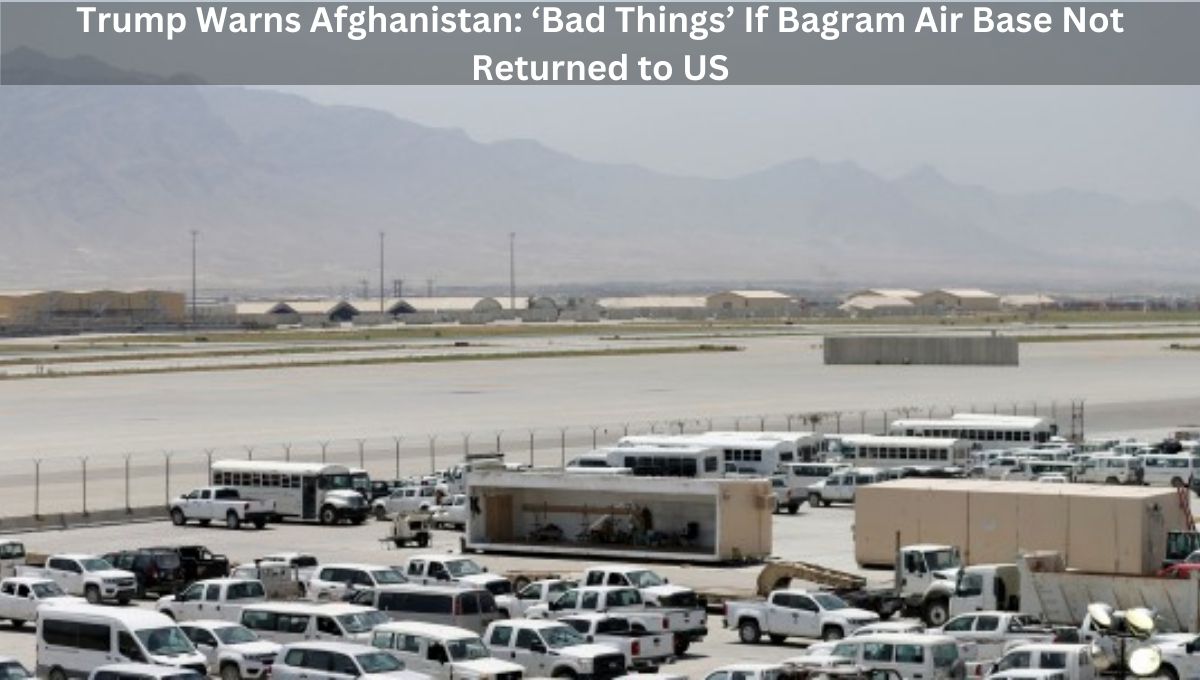
Taking to Truth Social, Trump Warns Afghanistan: ‘Bad Things’ If Bagram Air Base Not Returned to US. United States President Donald Trump has once again turned his attention to Bagram Air Base in Afghanistan, issuing a stark warning to the Taliban government: hand it back to the United States—or face “bad things.”
In his latest remarks, Trump made clear that Washington is actively discussing the future of the sprawling base with Afghan officials, while also signaling that the US has leverage to force Kabul’s hand. This development has reignited debate over the importance of Bagram, America’s hasty withdrawal in 2021, and how the base could shape the balance of power in South Asia, Central Asia, and vis-à-vis China.
Trump Warns Afghanistan: ‘Bad Things’ If Bagram Air Base Not Returned to US
Trump’s Warning to Afghanistan
On Saturday, Trump took to Truth Social, writing:
“If Afghanistan doesn’t give Bagram Airbase back to those that built it, the United States of America, BAD THINGS ARE GOING TO HAPPEN!!!”
Later, while speaking to reporters at the White House, Trump doubled down:
“We’re talking now to Afghanistan, and we want it back, and we want it back soon, right away. And if they don’t do it—you’re going to find out what I’m gonna do.”
This came after the Taliban-controlled government rejected the idea of any renewed US military presence, with Afghan officials emphasizing that relations must be built on “mutual respect and shared interests.”
Why Does Trump Want Bagram Back?
For Trump, the argument is simple: America built Bagram, and abandoning it in 2021 was, in his words, a “total disaster” by Joe Biden’s administration.
“We gave it to them for nothing. We want that base back,” Trump said.
But beneath the rhetoric lies a strategic logic. Bagram is no ordinary facility—it has long been seen as the crown jewel of America’s military infrastructure in Afghanistan.
Bagram’s Symbolic and Strategic Weight
- Symbol of US Power: The base represented America’s two-decade war in Afghanistan. At its height in 2012, over 100,000 US troops passed through its gates.
- Gateway to Counterterrorism: From 2001 to 2021, Bagram was the hub for operations against the Taliban, Al-Qaeda, and later ISIS.
- Proximity to China: Trump has repeatedly stressed that Bagram is just an hour away from where China makes its nuclear weapons.
- Regional Influence: The base sits at a crossroads—between Iran, Pakistan, Central Asia, and China’s Xinjiang province—making it a launchpad for surveillance and power projection.
What Makes Bagram So Special?
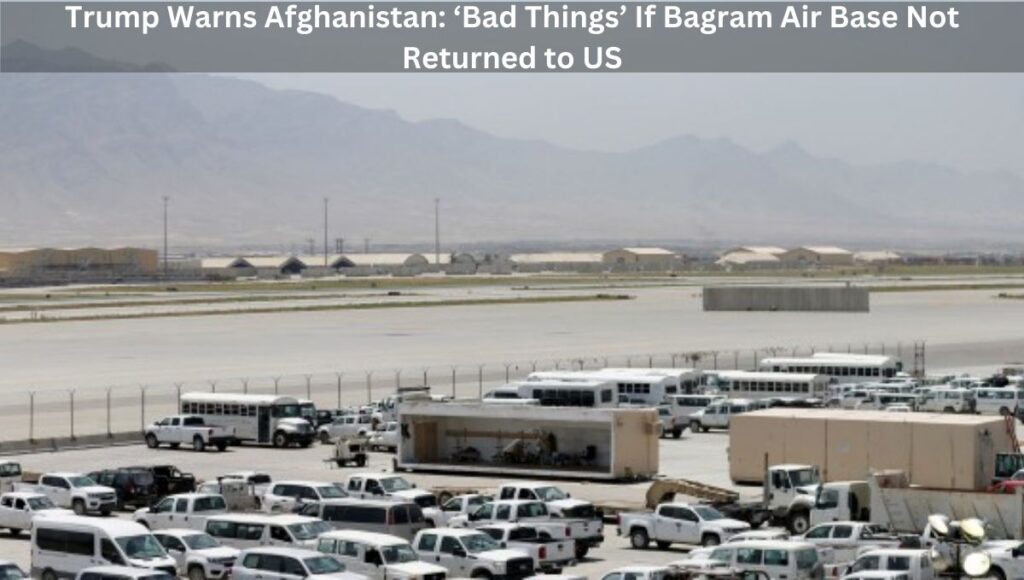
Bagram Air Base was not just another military outpost—it was practically a self-contained city.
- Massive Runways: Capable of handling everything from fighter jets to cargo aircraft.
- Infrastructure: Hardened shelters, hospitals, fuel depots, and advanced logistics networks.
- Amenities for Troops: Burger King, Pizza Hut, shops selling electronics and rugs—creating a slice of America in Afghanistan.
- Detention Facility: The base included a notorious prison complex where thousands of detainees were held.
According to Trump, it was “one of the most powerful bases in the world in terms of runway strength and length. You can land anything there.”
Trump’s Criticism of Biden’s Withdrawal
The US officially left Bagram in July 2021, weeks before Kabul fell to the Taliban. At the time, military officials destroyed nearly 16,000 pieces of equipment and airlifted thousands of tons of gear.
But the decision to abandon Bagram, leaving only Kabul airport for evacuations, has been widely criticized.
- A State Department review in 2023 concluded that the loss of Bagram contributed to the chaotic withdrawal scenes from Kabul.
- Trump has called the move “so stupid” and insists that under his administration, the US would have “kept Bagram, not because of Afghanistan but because of China.”
The China Factor
Trump has repeatedly linked Bagram to the strategic competition with China.
“It’s an hour away from where China makes its nuclear weapons,” Trump said.
This isn’t just rhetoric. From a military standpoint, Bagram could allow the US to:
- Monitor Chinese nuclear and missile sites in Xinjiang.
- Track Russian military activity in Central Asia.
- Counter Chinese influence in Afghanistan, including Beijing’s investments in rare earth mining.
China, however, has pushed back, insisting that Afghanistan’s future should be decided by its own people and calling for respect of its sovereignty.
Quiet Push to Retake Bagram
According to CNN and The Wall Street Journal, Trump has been privately pressing his national security officials for months to find a way to reestablish US control over Bagram.
The discussions reportedly include:
- Deploying a small US military force for counterterrorism operations.
- Using drones and manned aircraft from Bagram.
- Possibly reopening a diplomatic facility at the site.
- Leveraging US aid and trade to pressure the Taliban.
One source told CNN: “We’re trying to get it back because they need things from us.”
Taliban’s Firm Rejection
So far, the Taliban-controlled government has dismissed Trump’s demands.
Afghan Foreign Ministry official Zakir Jalal wrote on X:
“Afghanistan and the United States need to engage with one another … without the United States maintaining any military presence in any part of Afghanistan.”
This sets the stage for a potential diplomatic showdown between Washington and Kabul.
Also Read: Taliban rejects Donald Trump’s Bagram air base demand: ‘We do not fear any bully’
Could the US Actually Retake Bagram?
Current and former US officials have quietly warned that any attempt to retake Bagram could resemble a re-invasion of Afghanistan.
- Estimates suggest it would require 10,000+ troops and advanced air defense systems.
- Such a move could spark armed resistance from the Taliban.
- It risks plunging Afghanistan back into full-scale conflict, just as the country struggles with humanitarian crises.
For now, Trump has not specified whether he would consider military action, saying only: “We won’t talk about that.”
Why Bagram Still Matters
Even after the US withdrawal, Bagram’s strategic geography makes it too important to ignore:
- Counterterrorism – A US foothold could prevent Afghanistan from once again becoming a terror safe haven.
- China & Russia Surveillance – Proximity allows monitoring of both great powers.
- Regional Security Hub – Overlooks Iran, Pakistan, Central Asia, and routes into the Middle East.
- Symbol of American Power – Reclaiming Bagram would send a strong signal of US resolve.
Trump’s Broader Pattern
This isn’t the first time Trump has floated ambitious territorial or strategic acquisitions. He previously showed interest in:
- Purchasing Greenland from Denmark.
- Controlling strategic waterways like the Panama Canal.
Bagram fits into Trump’s vision of “Peace Through Strength” and his belief that America must dominate key global chokepoints.
What Happens Next?
With talks reportedly ongoing, several scenarios could unfold:
- Negotiated Return – The Taliban agrees to let the US use Bagram in exchange for aid or sanctions relief.
- Diplomatic Stalemate – Talks drag on with no progress, but Trump keeps the pressure up.
- Military Option – The US uses force or coercion to retake the base (though risky and costly).
- China Factor Escalates – Beijing could step in, either to support Afghanistan or to block US influence.
Conclusion
Trump’s demand for the return of Bagram Air Base is more than nostalgia—it’s about strategy, symbolism, and rivalry with China. The Taliban’s rejection sets up a tense standoff, and Trump’s warning of “bad things” suggests he is willing to raise the stakes.
As Washington explores its options, the world will be watching closely: will Bagram become the flashpoint for a new chapter in US-Afghanistan relations, or will it remain a symbol of America’s longest war?
Also Read: Trump Warns India, Pakistan, China and 20 Others of ‘Serious Consequences’ Over Drug Trafficking
Related Posts:
- Donald Trump Wants Bagram Air Base Back From Taliban…
- Taliban Rejects President Trump’s Bagram Air Base Demand
- Pakistan’s Bold Airstrikes in Kabul: Af-Pak Crisis…

- Pakistan–Afghanistan Border Conflict 2025: Ceasefire…

- Afghanistan–Pakistan Border Clashes 2025: Key Facts…

- 8 Shocking Developments in the Pakistan–Afghanistan…