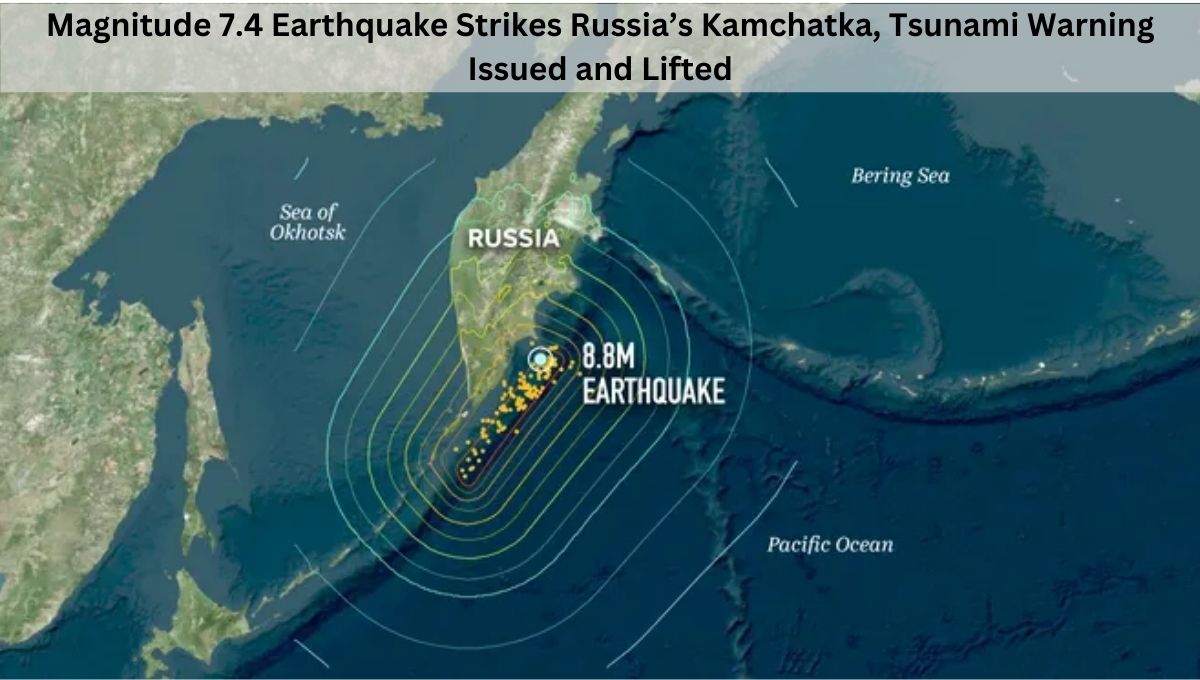
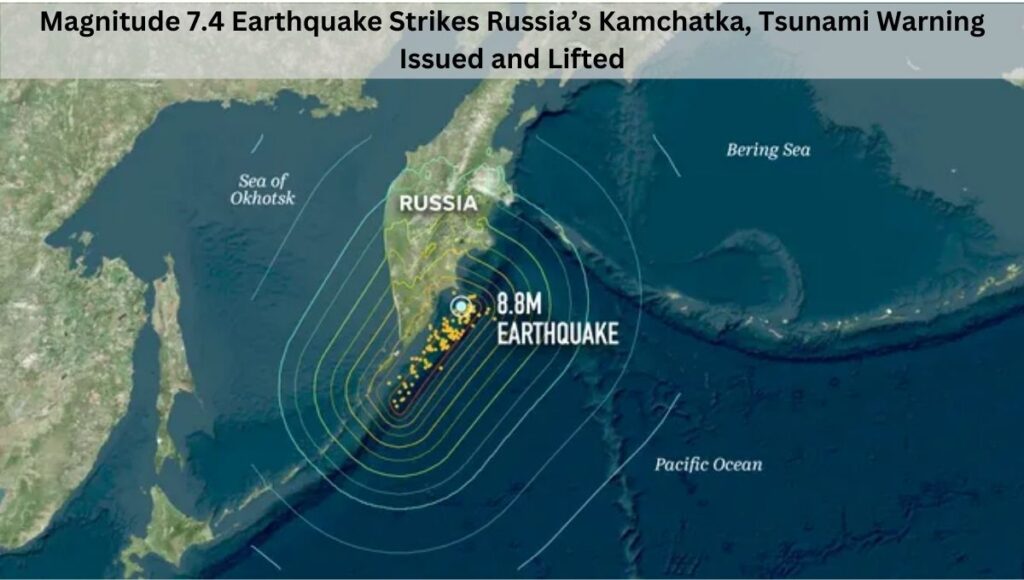
On September 13, 2025, a powerful Magnitude 7.4 Earthquake Strikes Russia’s Kamchatka, Tsunami Warning Issued and Lifted. A powerful 7.4-magnitude earthquake struck off the coast of Russia’s Kamchatka Peninsula on Saturday, September 13, according to the United States Geological Survey (USGS). The quake, initially reported at 7.5 before being downgraded, occurred at a depth of 39.5 kilometres (24.5 miles).
Its epicentre was located about 111 kilometres (69 miles) east of Petropavlovsk-Kamchatsky, the administrative centre of the Kamchatka region. The Pacific Tsunami Warning Centre (PTWC) initially cautioned that “hazardous” waves up to one metre (3.3 feet) could threaten Russian coasts within 300 kilometres of the epicentre. Hours later, the centre lifted the warning, confirming that the tsunami threat had passed.
Magnitude 7.4 Earthquake Strikes Russia’s Kamchatka, Tsunami Warning Issued and Lifted
Conflicting Magnitude Reports
While the USGS placed the magnitude at 7.4, Germany’s GFZ Research Centre for Geosciences estimated the tremor at 7.1 with a shallower depth of about 10 kilometres (6.2 miles). These discrepancies are common in the early hours of large quakes as global seismic agencies refine their data.
Japan’s Meteorological Agency and broadcaster NHK confirmed that no tsunami threat existed for Japanese coasts.
Kamchatka’s History of Seismic Upheaval
This latest earthquake adds to a long list of powerful tremors in Kamchatka, a region notorious for seismic activity due to its location along the Pacific Ring of Fire.
- In July 2025, a massive 8.8-magnitude earthquake struck off the Kamchatka Peninsula, sending tsunamis up to four metres (12 feet) high across the Pacific. It prompted evacuations from Hawaii to Japan and became the largest recorded quake since the 2011 Japan earthquake and tsunami that killed over 15,000 people.
- Historically, the region also suffered in 1952, when one of the world’s strongest earthquakes devastated Kamchatka and triggered widespread tsunami alerts across the Pacific.
The July 2025 quake forced nearly two million residents in Japan to move to higher ground before warnings were downgraded.
Why Kamchatka Is So Vulnerable
Kamchatka lies above one of Earth’s most active tectonic boundaries—the Kuril-Kamchatka Trench. Here, the massive Pacific Plate dives beneath the smaller Okhotsk microplate in a process called subduction.
- The plates converge at speeds of up to 86 millimetres per year, among the fastest anywhere on the planet.
- Strain builds over decades along the megathrust fault, releasing violently in the form of large earthquakes.
- This subduction process also fuels over 100 volcanoes scattered across the Kamchatka Peninsula.
This constant geological activity has earned Kamchatka its reputation as a “living laboratory” of Earth’s tectonic forces.
What Happens Below the Surface
Beneath Kamchatka, the Pacific Plate descends nearly 10 kilometres into Earth’s mantle. Friction along locked plate boundaries builds enormous pressure until it finally ruptures, unleashing powerful earthquakes.
At the same time, the subduction process drives magma upward, feeding the region’s volcanoes. These natural processes ensure that Kamchatka remains one of the most seismically restless regions in the world.
For residents, this is not just a scientific reality but a daily risk. While many earthquakes occur offshore with minimal impact, the threat of destructive quakes and tsunamis remains ever-present.
Volcanic Eruption in August
The September quake followed another significant geological event. In August 2025, the Krasheninnikov volcano in Kamchatka erupted for the first time in 600 years, just days after the July megaquake.
- Staff at the Kronotsky Nature Reserve reported ash plumes rising 6 kilometres into the sky.
- Kamchatka’s Emergencies Ministry confirmed the ash cloud drifted eastward over the Pacific Ocean but posed no danger to populated areas.
- The eruption was accompanied by a 7.0-magnitude earthquake, triggering temporary tsunami warnings in three parts of Kamchatka.
Olga Girina, head of the Kamchatka Volcanic Eruption Response Team, said it was the first historically confirmed eruption of Krasheninnikov in centuries.
Saturday’s Quake in Context
Saturday’s 7.4-magnitude earthquake is another reminder of the Pacific Ring of Fire’s volatility. This vast horseshoe-shaped belt encircling the Pacific Ocean is home to around 75% of the world’s active volcanoes and experiences about 90% of global earthquakes.
While no immediate casualties or large-scale damage have been reported from the latest quake, the event underscores the constant seismic risks faced by communities in Kamchatka and across the Pacific.
Authorities on High Alert
Russian emergency authorities confirmed that precautionary alerts were issued for coastal communities. Monitoring systems tracked for potential aftershocks and delayed tsunamis, though none of significance have been detected.
Experts warn that the quake, like many before it, may not be the last. Seismologists note that major tremors often occur in clusters in regions with high tectonic stress.
Looking Ahead
The Kamchatka Peninsula will likely continue to experience strong earthquakes and volcanic eruptions in the coming years. Scientists emphasize the importance of:
- Preparedness drills for coastal populations.
- Improved tsunami early-warning systems.
- International cooperation in seismic monitoring across the Pacific.
While Saturday’s quake did not result in major disaster, it serves as a stark reminder of nature’s raw power and the ongoing risks faced by those living along the Ring of Fire.
Also Read: Earthquake today: 6.2 magnitude quake jolts Afghanistan, tremors felt in Delhi-NCR
Also Read: Philippines Earthquake: 6.9 Magnitude Quake Devastates Cebu Province, 69 Dead, 150+ Injured
Related Posts:
- Magnitude 7.8 Earthquake Struck Russia’s Kamchatka,…
- Drake Passage Earthquake: 7.5-Magnitude Quake…
- Massive 8.8 Earthquake Hits Russia’s Kamchatka,…
- Why the Kamchatka 8.8 Earthquake Didn't Turn into a…
- 600-Year Dormant Russian Volcano Erupts After…

- 6.3-Magnitude Earthquake Devastates Northern Afghanistan