Amid escalating US tariffs, Xi Jinping, Lula, and Jaishankar Call for BRICS Unity Against Tariffs at Virtual Summit. Chinese President Xi Jinping, Brazilian President Luiz Inácio Lula da Silva, and India’s External Affairs Minister S. Jaishankar used the latest BRICS virtual summit to call for a united response against the escalating US tariffs imposed under President Donald Trump. The meeting, convened by Lula as the current BRICS chair, underscored the need for fair economic practices, resilient supply chains, and reform of multilateral institutions.
The summit comes at a time of mounting global trade tensions, with India and Brazil slapped with 50% tariffs on key exports to the United States. China, too, has been caught in prolonged trade wars with Washington. The BRICS grouping comprising Brazil, Russia, India, China, South Africa, and new members like Egypt, UAE, and Iran has positioned itself as the leading voice of the Global South.
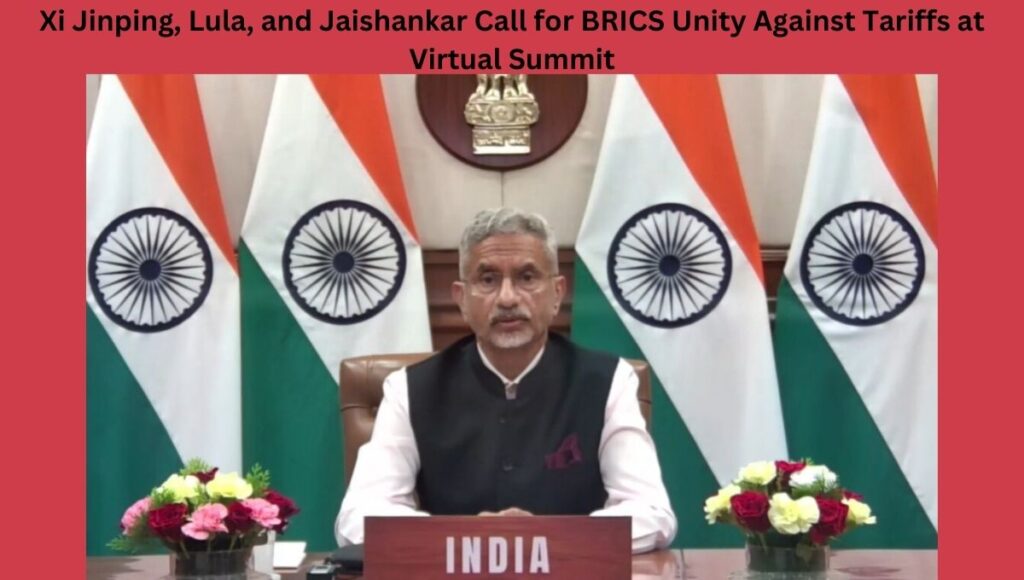
Xi Jinping, Lula, and Jaishankar Call for BRICS Unity Against Tariffs at Virtual Summit
Xi Jinping: BRICS Must Resist Hegemonism and Tariff Wars
Chinese President Xi Jinping delivered one of the strongest rebukes of Washington’s trade policies. Without directly naming the United States, Xi condemned “hegemonism, unilateralism, and protectionism,” saying they had become “more rampant” in recent years.
“Trade wars and tariff wars waged by some country severely disrupt the world economy and undermine international trade rules,” Xi declared.
He emphasized that BRICS must act as a collective bulwark against such disruptions, promoting openness, inclusiveness, and win-win cooperation.
Xi also spotlighted his Global Governance Initiative (GGI), proposed earlier at the Shanghai Cooperation Organisation (SCO) summit in Tianjin, as a counterweight to Western dominance.
“The Global Governance Initiative that I proposed is aimed at galvanising joint global action for a more just and equitable global governance system,” he said.
For Xi, BRICS must remain committed to multilateralism, the WTO system, and inclusive globalization, ensuring that the Global South participates in international cooperation on equal footing.
Lula Slams “Tariff Blackmail”
Brazilian President Luiz Inácio Lula da Silva minced no words in criticizing the United States’ tariff policies, calling them “tariff blackmail”.
“Tariff blackmail is being normalized as an instrument for market conquest and to interfere in domestic affairs,” Lula said, echoing growing frustration among developing nations.
Brazil has been hit especially hard by Trump’s 50% import duties, which Washington tied to Lula’s ally and former president Jair Bolsonaro, now facing trial over an alleged coup plot.
In his speech, Lula warned that BRICS countries have become “victims of unjustified and illegal trade practices.” He argued for stronger financial and trade integration among BRICS members to cushion against external shocks.
“Increasing barriers and complicating transactions will not help. Neither would the linking of trade measures to non-trade matters,” Lula emphasized.
The Brazilian leader also threw his support behind India’s upcoming chairmanship of BRICS, calling for a collective push toward fairer trade practices.
Jaishankar: Fair, Transparent, and Resilient Trade Practices
Representing India at the summit, External Affairs Minister S. Jaishankar placed heavy emphasis on fairness, transparency, and resilience in global economic practices.
“The world as a collective is seeking a predictable and stable environment for trade and investment. At the same time, it is imperative that economic practices are fair, transparent and to everyone’s benefit,” he said.
Jaishankar noted that multiple global disruptions from the Covid-19 pandemic to the Ukraine war, tensions in West Asia, and climate crises have exposed the fragility of international supply chains.
Building Resilient Supply Chains
He called for shorter, more resilient, and diversified supply chains to protect against external shocks:
- Reliable and redundant networks that can withstand crises
- Democratization of manufacturing and production to ensure regional self-sufficiency
- Avoiding overdependence on a single geography or nation
“Democratising manufacturing and encouraging production across geographies will enhance regional self-sufficiency and reduce anxieties during crises,” Jaishankar stressed.
India’s Trade Deficit with BRICS
In a veiled reference to China, Jaishankar highlighted India’s significant trade deficits with BRICS partners:
“Where India is concerned, some of our biggest deficits are with BRICS partners and we have been pressing for expeditious solutions. We hope that this realisation will be part of the takeaways from today’s meeting,” he added.
Jaishankar urged BRICS to set an example by reducing intra-bloc trade barriers and reviewing trade flows among member nations.
Trump’s Tariff Shockwaves
The virtual summit took place against the backdrop of escalating tariffs under Donald Trump’s administration. Both India and Brazil face 50% import duties on key exports:
- India: Tariffs were doubled last month in retaliation for its continued imports of Russian oil, reaching up to 50%.
- Brazil: The 50% levies are linked to Bolsonaro’s legal troubles, which Trump has framed as part of a “witch hunt.”
The punitive tariffs have strained India-US relations, already complicated by Washington’s criticism of New Delhi’s ties with Moscow, including oil purchases and arms deals.
For Brazil, the tariffs are a major blow to its agriculture and manufacturing exports, directly threatening Lula’s domestic growth agenda.
Also Read: Navarro calls Brics nations ‘vampires’: What is America’s problem with the bloc?
Modi: Trade Barriers Won’t Help
Indian Prime Minister Narendra Modi, though not directly attending, issued remarks shared by the Indian Foreign Ministry. He argued strongly against unilateral protectionism:
“Increasing barriers and complicating transactions will not help. Neither would the linking of trade measures to non-trade matters,” Modi said.
Modi underscored that protectionism undermines both global trade flows and sustainable development goals (SDGs), already lagging after years of pandemic and conflict disruptions.
Multilateralism Under Strain
A recurring theme across all speeches was the failure of the current multilateral system to address modern challenges:
- The United Nations, seen as gridlocked and unable to resolve conflicts in Ukraine or West Asia
- The WTO, struggling to counter unilateral tariff measures
- Global climate frameworks, failing to secure adequate action
Jaishankar urged urgent reform:
“Gridlocks have undermined the search for common ground. BRICS should become a strong voice for urgent reforms of multilateralism, the UN and its Security Council,” he said.
Xi echoed this sentiment, insisting that BRICS must “jointly defend multilateralism and the multilateral trading system.”
The Global South at the Center
The BRICS summit framed the Global South as the primary victim of trade wars and global instability. Leaders warned that:
- Conflicts in Ukraine and the Middle East are disrupting food, energy, and fertilizer supplies
- Shipping disruptions directly harm both trade and livelihoods
- Climate change and extreme weather events disproportionately hit developing economies
Xi, Lula, and Jaishankar all insisted that developing countries must not be sidelined in international cooperation.
The summit’s key collective priorities can be summarized as:
- Opposition to unilateral US tariffs and trade wars
- Strengthening intra-BRICS trade and financial integration
- Reforming multilateral institutions like the UN and WTO
- Building resilient, diversified global supply chains
- Safeguarding the Global South’s interests in food, energy, and development
Conclusion: BRICS Charts a Path Amid Uncertainty
The BRICS virtual summit made clear that the bloc views itself as a counterweight to US economic dominance and a champion of equitable globalization.
While Xi Jinping called for unity against hegemonism, Lula decried tariff blackmail, and Jaishankar demanded fair and transparent trade practices, all three leaders converged on one message: BRICS must act together to stabilize the global economy.
With India set to chair BRICS next year, the pressure will be on New Delhi to balance differences within the bloc, especially its trade deficit with China, while advancing a collective response to protectionist shocks.
At a time when the multilateral order is failing and trade wars threaten the stability of the world economy, the BRICS summit signals that the Global South is no longer content to remain a silent victim it is organizing to reshape the rules of global trade.
Related Posts:
- Modi and Lula Unite as Trump’s Tariffs Disrupt Global Trade

- “I Won’t Call Trump”: Lula Defiant After US Tariff…

- Lula Slams Trump’s 50% Tariff as “Unacceptable…

- BRICS Denounces Trump Tariffs, Condemns Iran Strikes…
- 5 Major Takeaways from the US Supreme Court's…

- Brazil’s Jair Bolsonaro is Sentenced to 27 Years for…