
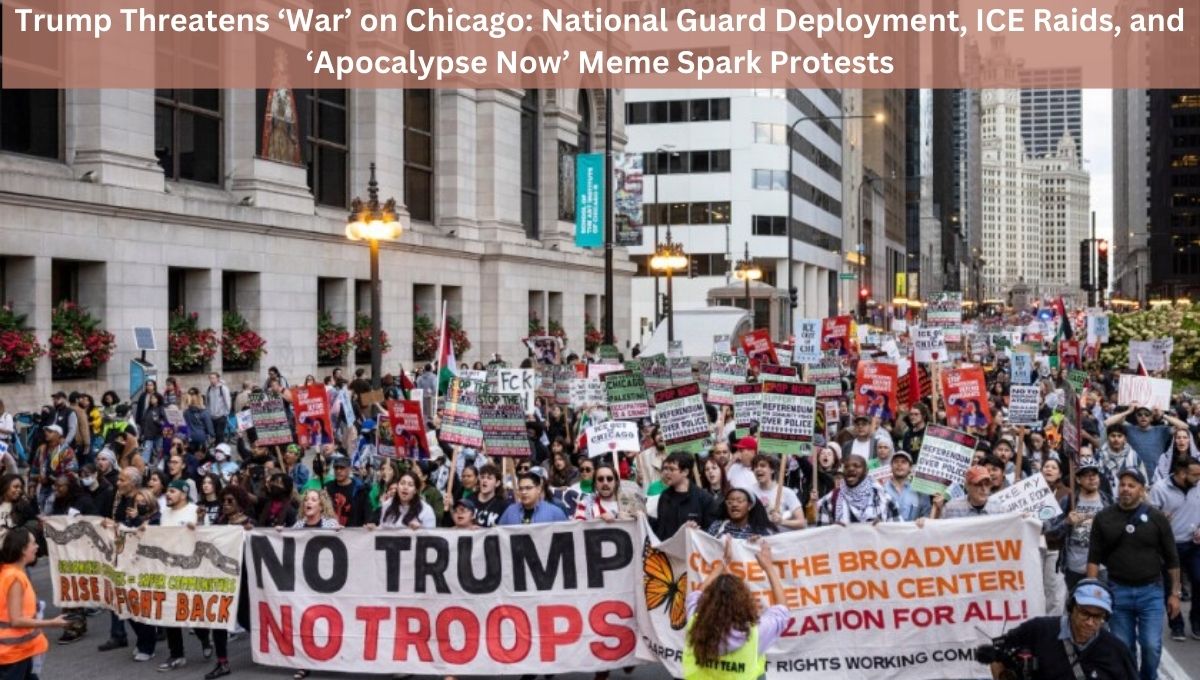
Escalating his feud, Trump Threatens ‘War’ on Chicago: National Guard Deployment, ICE Raids, and ‘Apocalypse Now’ Meme Spark Protests. Chicago, long a political target for President Donald Trump, is once again in the national spotlight. The president has threatened to deploy National Guard troops and expand immigration enforcement raids in the city, escalating his feud with Democratic leaders.
In a social media post that shocked many, Trump shared a doctored image referencing the Vietnam War film Apocalypse Now, declaring: “I love the smell of deportations in the morning… Chicago about to find out why it’s called the Department of WAR.”
The provocative message, coupled with the president’s executive order to rename the Pentagon as the Department of War, has ignited protests in Chicago and Washington, DC. While Trump insists his aim is to combat violent crime and illegal immigration, critics say his actions reflect an authoritarian approach to domestic governance.
Trump Threatens ‘War’ on Chicago: National Guard Deployment, ICE Raids, and ‘Apocalypse Now’ Meme Spark Protests
Chicago Communities Divided: “We Are the Troops”
On the South Side of Chicago, where gun violence has long plagued neighborhoods, some residents question whether Trump’s plan would make any difference.
In Bronzeville, a community near Chicago Police Headquarters, seven people were wounded in a drive-by shooting over Labor Day weekend. The attack was just one among at least 58 people shot and eight killed during the holiday.
Rob White, a youth coach working with the non-profit Chicago CRED, described the frustration of living in communities where violence occurs “right under the nose” of heavily armed police.
Yet his colleague, Kanoya Ali, argued that outside troops aren’t needed:
“The outcome [a drop in crime] is already happening. The troops are already here. We are the troops.”
Their message is clear: community-led programs, not federal militarization, are the answer to Chicago’s violence.
Trump’s Threat: National Guard on Standby
On Friday, Trump said he had chosen another U.S. city for National Guard deployment—without naming it directly. By Saturday, his Truth Social post made it clear that Chicago was the target.
Trump tied his threat to the Labor Day shooting statistics, claiming the city was “out of control.” He compared his crackdown to deployments already carried out in Los Angeles and Washington, DC.
But Illinois Governor JB Pritzker and Chicago Mayor Brandon Johnson have vowed to resist federal intervention.
Pritzker dismissed the president as an “unhinged” leader:
“The President of the United States is threatening to go to war with an American city. This is not a joke. This is not normal.”
Mayor Johnson accused Trump of trying to “occupy our city and break our Constitution.”
Also Read: Trump threatens to deploy troops to Baltimore to ‘clean up’ crime
Crime in Chicago: Numbers Tell a Different Story
While Trump portrays Chicago as lawless, data shows a more complex reality.
According to the Council on Criminal Justice, homicides in Chicago fell by one-third in the first half of the year compared with the same period last year.
Chicago Police Superintendent Larry Snelling reported:
- Homicides declined by 125 last year.
- Shooting victims dropped by more than 700.
Snelling cautioned that the National Guard lacks police powers and would require “serious coordination” with law enforcement to be effective.
“If I could have more officers, [I’d] love to help, 100 percent,” Snelling said.
The statistics highlight an irony: while crime remains higher than many U.S. cities, Chicago has made measurable progress in reducing violence.
Canaryville vs. Bronzeville: A Tale of Two Neighborhoods
The divide over Trump’s proposal is visible in different parts of the city.
In Bronzeville, many community leaders argue that investment in prevention programs not troops is the solution. They point to federal funding cuts under Trump that targeted crime-prevention efforts, including programs to disrupt weapons trafficking.
But in Canaryville, a predominantly white, working-class neighborhood, Trump’s message resonates. Stars and Stripes hang alongside Blue Lives Matter flags.
“I can’t wait till they get here,” said Tom Stack, a 68-year-old resident. “You got to get rid of the criminals. This city’s crazy, there’s too much crime. It’s common sense.”
This clash of perspectives underscores how Chicago’s response to Trump’s threats splits along community lines.
The Immigration Factor: ICE Raids Loom Over Latino Communities
Perhaps the most alarming part of Trump’s message was the possibility of expanded ICE raids.
Chicago is home to 2.7 million people, including more than 150,000 undocumented immigrants, nearly 8 percent of households. The city’s Little Village neighborhood one of the largest Latino communities has been buzzing with anxiety.
As Mexican Independence Day approaches, community organizers canceled the annual El Grito Chicago festival, citing fears of immigration raids.
Arturo Landa, a striking factory worker in Little Village, expressed the community’s concerns:
“We’ve seen a lot of things. They are stopping people [in other cities], and the new administration doesn’t care if someone has their documents. They are discriminating on people’s skin.”
Illinois Governor Pritzker confirmed that up to 300 ICE agents were expected to be deployed in the Chicago area, with operations potentially lasting 30 days.
The “Apocalypse Now” Meme: A Dangerous Symbolism
What shocked many was not just the threat of troops, but the way Trump delivered it.
His Truth Social post featured a doctored image from the 1979 film Apocalypse Now, replacing actor Robert Duvall’s Lt. Col. Kilgore with Trump’s own face. The caption twisted Kilgore’s famous line, changing “napalm” to “deportations.”
The Vietnam War film is infamous for its portrayal of U.S. military excesses and the destruction of civilian life. Trump’s appropriation of the imagery struck many as deeply provocative.
By invoking “war” and renaming the Pentagon the Department of War, Trump seemed to embrace a vision of governance defined by militarism and intimidation.
Protests in Chicago and Washington, DC
The response was swift. Thousands took to the streets in both Chicago and Washington, DC, denouncing Trump’s threats.
In Chicago, demonstrators carried signs reading:
- “ICE out of Illinois”
- “Resist Tyranny”
- “Trump must go now”
Many waved Palestinian flags, linking their struggle with global resistance movements. Nazek Sankari, co-chair of the U.S. Palestinian Community Network, told the crowd:
“We are inspired by the steadfastness of Palestinians in Gaza, and it is why we refuse to cower to Trump and his threats.”
In Washington, DC, protesters rallied under the banner “We Are All DC”, denouncing the presence of 2,000 federal troops deployed in the city. They compared Trump’s actions to occupation.
Former U.S. diplomat Mark Fitzpatrick said:
“Federal agents, National Guards patrolling our streets, that’s really an affront to the democracy of our city.”
Trump’s Expanding Crackdown
Chicago is not alone. Trump has already deployed federal forces in Los Angeles and Washington, DC, and hinted at possible action in Baltimore, New Orleans, and Portland.
Earlier this year, he signed an executive order renaming the Department of Defense as the Department of War, claiming it sends “a message of victory” to the world.
Trump has defended these actions by portraying Democratic-led cities as lawless, radical, and dangerous. He argues that local leaders embrace “woke” policies that prevent law enforcement from doing its job.
Critics Warn of Authoritarian Drift
Civil rights advocates and political opponents describe Trump’s actions as a dangerous step toward authoritarianism.
Mayor Brandon Johnson called the threats “beneath the honor of our nation.”
Governor Pritzker labeled Trump a “wannabe dictator.”
In DC, protesters chanted: “Resist tyranny.”
The use of military imagery, combined with federal deployments in U.S. cities, has fueled fears that Trump is testing the limits of presidential power.
Conclusion: A City on Edge, A Nation at a Crossroads
Trump’s threat to unleash the “Department of War” on Chicago has sparked widespread outrage, deepened community divisions, and heightened fears of mass deportations.
On one side, residents like Tom Stack welcome the idea of troops restoring order. On the other, community leaders like Rob White and Kanoya Ali argue that real safety comes from investment in youth and crime-prevention programs not federal militarization.
Chicago’s Latino neighborhoods brace for ICE raids. Protesters across the country denounce authoritarian overreach. And America is left asking: Is the federal government protecting cities, or waging war against them? The coming weeks will reveal whether Trump’s threats materialize into large-scale troop deployments and immigration raids or whether resistance from local leaders and mass protests forces a retreat.
Either way, the battle over Chicago’s future has become a national flashpoint, symbolizing the broader struggle over democracy, security, and presidential power in the United States.
Also Read: Trump Deploys 800 National Guard Troops to Washington Amid ‘Crime Emergency’
Related Posts:
- Donald Trump Imposes 100% Tariff on Foreign-Made…

- 5 Powerful Highlights as Trump Lands Second Nobel…

- Trump’s 2025 Gaza Peace Plan Signing and Historic…

- Trump Deploys 300 National Guard Troops to Chicago…
- 9 Explosive Revelations as Trump Declares His Health…

- Can the EU and NATO Impose Tariffs on India and…
