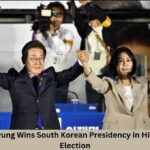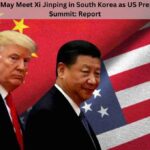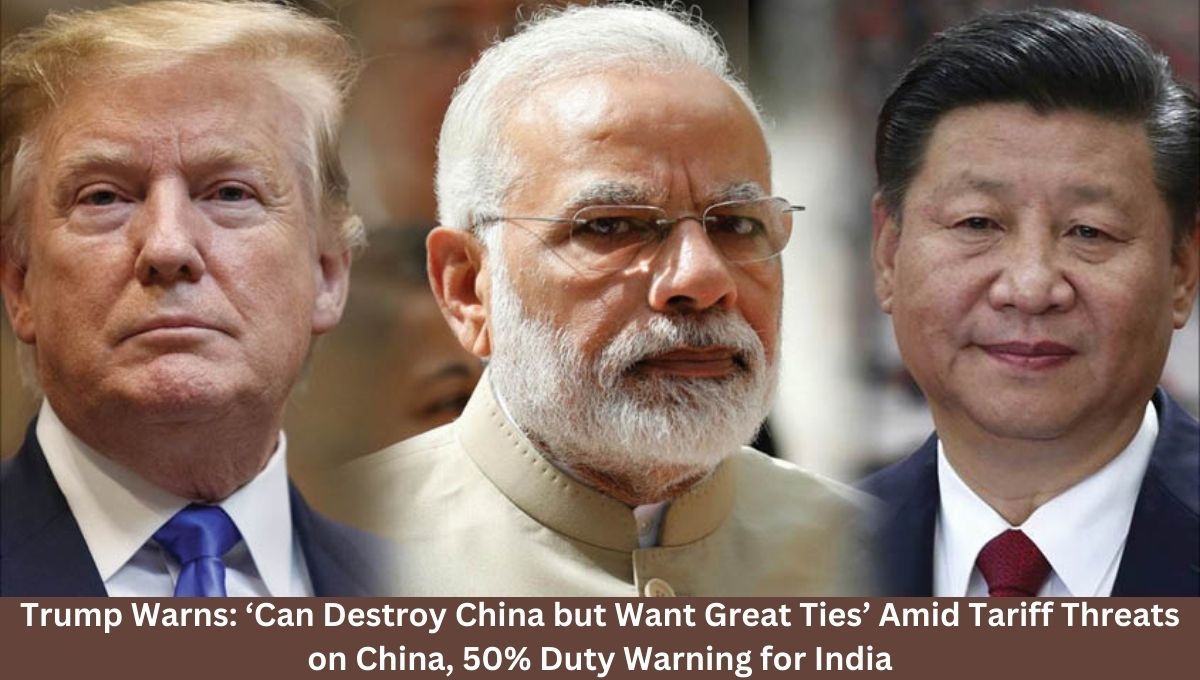
While signaling a possible Beijing visit, Trump Warns: ‘Can Destroy China but Want Great Ties’ Amid Tariff Threats on China, 50% Duty Warning for India. US President Donald Trump has once again raised the stakes in the global trade arena, this time with bold remarks on China and a looming tariff escalation against India. Speaking from the Oval Office during a meeting with South Korean President Lee Jae Myung, Trump warned that the United States holds “incredible cards” that could “destroy” China’s economy if played.
Yet, in a paradoxical tone, he emphasized his desire for a “great relationship” with Beijing, even hinting at a possible visit to China later this year following an invitation from Chinese President Xi Jinping. As Washington and Beijing attempt to navigate their turbulent trade relationship, Trump has also turned his focus to India, threatening 50% tariffs on its exports to the US, citing New Delhi’s purchases of discounted Russian oil.
Trump Warns: ‘Can Destroy China but Want Great Ties’ Amid Tariff Threats on China, 50% Duty Warning for India
Trump’s Stark Warning: “We Could Destroy China”
In his Oval Office remarks, Trump stressed that the US holds powerful leverage against Beijing.
“They have some cards. We have incredible cards, but I don’t want to play those cards. If I play those cards, that would destroy China. I am not going to play those cards,” he said, flanked by South Korea’s president.
While Trump did not specify whether these “cards” were economic, political, or strategic, the message was clear Washington believes it can decisively harm Beijing’s economy if it chooses to escalate the dispute.
The warning comes amid simmering tensions over tariffs, rare earth supplies, and China’s trade policies, despite recent attempts at de-escalation.
Also read: Trump Softens Stance on India, China Tariffs After Putin Meeting
Tariff Threat: 200% Duties on Chinese Magnets
At the heart of Trump’s comments lies a renewed focus on rare earth elements critical minerals essential for industries ranging from smartphones and semiconductors to electric vehicles and defense equipment.
China dominates this sector, controlling about 90% of the global magnet supply. Trump warned that Beijing must continue supplying rare earth magnets to the US or face crippling tariffs.
“They have to give us magnets,” Trump told reporters. “If they don’t give us magnets, then we have to charge them a 200% tariff or something. But we’re not going to have a problem, I don’t think, with that.”
This remark underlined how rare earths have become a strategic flashpoint in US-China trade relations. Washington sees China’s control over these resources as a vulnerability that could impact its technological and military edge.
Also Read: ‘We were not giving them Boeing parts,’ with 200% tariff threat, Trump wants magnets from China
US-China Trade Relations: Between Threats and Truce
The US-China trade war has entered yet another volatile chapter. At its peak earlier this year, both nations slapped triple-digit tariffs on each other’s goods, disrupting supply chains and rattling global markets.
- In April, Washington raised tariffs on Chinese imports as high as 145%.
- Beijing retaliated by tightening exports of rare earth elements, including key magnet materials.
- Importers worldwide faced uncertainty, suspending shipments and delaying contracts.
Yet, a trade truce in August brought temporary relief. Both sides agreed to reduce tariffs, with US duties scaled back to 30% and China’s to 10%.
They also extended a 90-day freeze on further tariff hikes, pushing back the deadline to November 10. Despite this calm, Trump’s latest remarks particularly the 200% tariff threat signal that tensions could reignite quickly if negotiations falter.
Xi Jinping Invitation: A Possible Trump Visit to Beijing
Amid this trade turbulence, Trump revealed that Chinese President Xi Jinping had invited him to Beijing, and that he was considering the trip.
“At some point, probably during this year or shortly thereafter, we’ll go to China,” Trump said, stressing his optimism about bilateral ties.
This apparent balancing act issuing threats while extending diplomatic gestures is emblematic of Trump’s negotiating style. By keeping Beijing uncertain, he seeks to maintain leverage in ongoing trade talks.
India in the Crosshairs: 50% Tariff Threat
While China remains Trump’s biggest economic rival, India has unexpectedly found itself under Washington’s trade hammer.
Trump has threatened 50% tariffs on Indian exports, with the second half of the duties set to take effect on August 27. The move is tied to New Delhi’s decision to increase imports of discounted Russian oil amid the war in Ukraine.
In an executive order, Trump declared:
“I determine that it is necessary and appropriate to impose an additional ad valorem duty on imports of articles of India, which is directly or indirectly importing Russian Federation oil.”
According to US officials, India’s imports of Russian oil jumped dramatically:
- Before the war: less than 1% of its oil came from Russia.
- After the invasion: that figure skyrocketed to 42%.
Treasury Secretary Scott Bessent defended the decision not to impose similar penalties on China, despite Beijing also increasing Russian oil imports.
“China’s importing (Russian oil) is suboptimal. Pre-invasion, 13% of China’s oil was already coming from Russia. Now it’s 16%, so China has diversified oil inputs,” Bessent argued, claiming India’s profits were “huge” compared to China’s.
India, however, has hit back, saying it is being unfairly singled out for actions “several other countries are also taking in their own national interest.”
Double Standards? Why India but Not China?
Critics note a striking contradiction in Trump’s policy: while India faces 50% tariffs for buying Russian oil, China the world’s largest buyer of Russian crude has escaped similar punishment.
Observers suggest Trump is reluctant to risk further antagonizing Beijing while critical trade talks are still ongoing. India, with a smaller economic footprint in US trade, may be seen as a softer target.
Rare Earths: The Strategic Battleground
The rare earth dispute underscores how trade policy is increasingly linked to national security. Rare earth elements are crucial in manufacturing:
- Magnets used in electric vehicles, wind turbines, and fighter jets.
- Semiconductor chips powering smartphones, computers, and defense systems.
- Medical equipment such as MRI machines.
China’s dominance in this sector gives it enormous leverage. By restricting exports, Beijing could pressure the US economy and defense industry.
Trump’s tariff threats, therefore, are not only economic bargaining chips but also a signal of Washington’s strategic concerns.
Global Supply Chains on Edge
The uncertainty surrounding US tariffs on both China and India has left global markets jittery. Businesses dependent on rare earth imports, technology parts, and energy supplies are struggling to adjust.
- Importers fear sudden tariff spikes could make goods unaffordable.
- Exporters worry about disrupted access to US markets.
- Supply chains across Asia are being restructured as companies seek alternatives.
Analysts warn that prolonged instability could accelerate decoupling trends, with manufacturers shifting production away from China and India to other regions.
Trump’s Balancing Act: Threats vs. Relationships
Despite his combative rhetoric, Trump insisted that the US will maintain strong ties with China.
“We are going to have a great relationship with China,” he said.
This dual approach threatening massive tariffs while praising the bilateral relationship reflects Trump’s strategy of pressure mixed with diplomacy.
By dangling both punishment and partnership, he seeks to maximize concessions from Beijing while keeping communication channels open.
What Lies Ahead
As the November tariff deadline approaches for China and the August 27 deadline looms for India, both countries are bracing for potential economic shocks.
- For China, rare earth exports remain the flashpoint, with the US threatening 200% tariffs if supplies are disrupted.
- For India, Washington’s punitive stance on Russian oil imports could severely impact its export competitiveness in US markets.
The next few months will determine whether Trump’s strategy leads to negotiated compromises or escalates into another round of trade wars with global repercussions.
Conclusion
Donald Trump’s latest remarks highlight the fragile state of global trade relations. His warning that the US could “destroy China” with economic leverage, coupled with threats of 200% tariffs on rare earth magnets, marks a sharp escalation in rhetoric.
Yet, his openness to visiting Beijing and his emphasis on a “great relationship” suggest that Washington is keeping the door open for diplomacy.
For India, however, the outlook is more severe. With 50% tariffs on its exports set to take effect, New Delhi faces tough choices as it balances energy security with trade relations. As the world’s largest and fastest-growing economies jostle for dominance, Trump’s unpredictable trade policy continues to keep global markets and world leaders on edge.