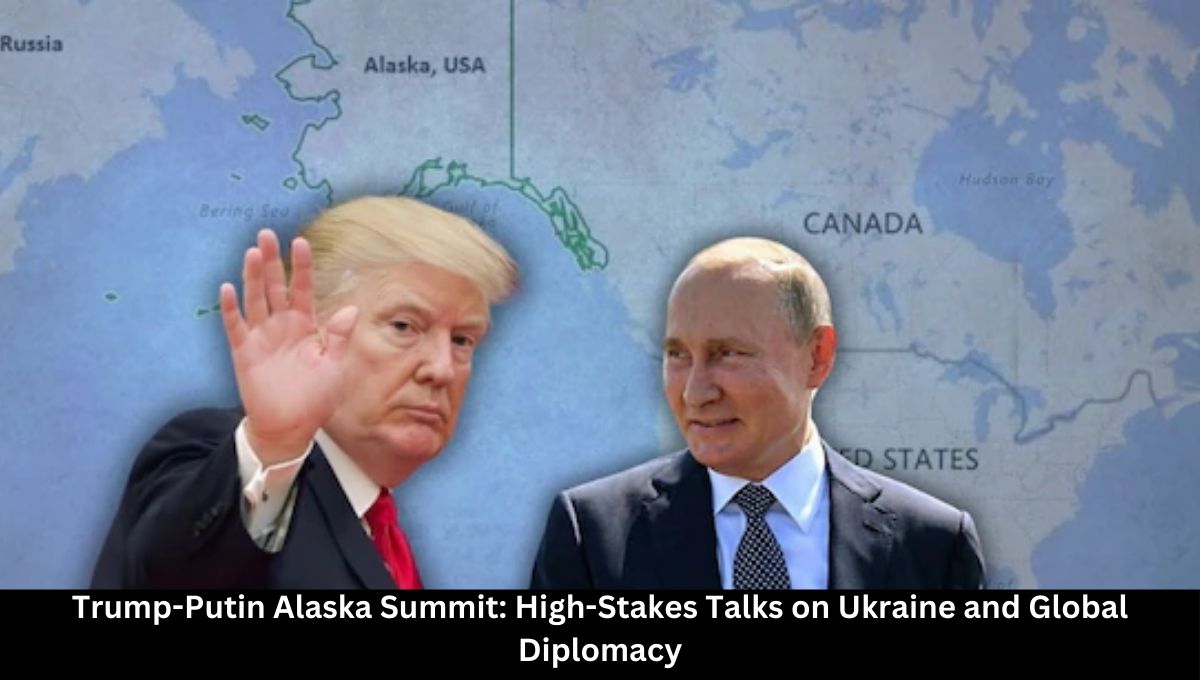
For the first time in over a decade, Putin visits the U.S. for the Trump-Putin Alaska Summit: High-Stakes Talks on Ukraine and Global Diplomacy. The world’s attention turns to Alaska this Friday, where former U.S. President Donald Trump and Russian President Vladimir Putin will meet for the most anticipated U.S.-Russia talks in years.
With the war in Ukraine entering its fourth year, the Alaska summit is being billed as a possible breakthrough or a diplomatic gamble with enormous consequences.
The meeting will not only focus on Ukraine ceasefire talks, but also marks Putin’s first visit to the United States in over a decade, ending a long period of diplomatic frost. The optics are powerful: the image of Trump welcoming Putin onto U.S. soil could signal a shift in global geopolitics.
Trump-Putin Alaska Summit: High-Stakes Talks on Ukraine and Global Diplomacy
For the first time in over a decade, Putin visits the U.S. for the Trump-Putin Alaska Summit: High-Stakes Talks on Ukraine and Global Diplomacy.
The world’s attention turns to Alaska this Friday, where former U.S. President Donald Trump and Russian President Vladimir Putin will meet for the most anticipated U.S.-Russia talks in years.
With the war in Ukraine entering its fourth year, the Alaska summit is being billed as a possible breakthrough or a diplomatic gamble with enormous consequences.
The meeting will not only focus on Ukraine ceasefire talks, but also marks Putin’s first visit to the United States in over a decade, ending a long period of diplomatic frost.
The optics are powerful: the image of Trump welcoming Putin onto U.S. soil could signal a shift in global geopolitics.
From Hamburg to Alaska: A History of Trump-Putin Meetings
The upcoming Trump-Putin Alaska Summit is the latest in a series of high-profile encounters between the two leaders.
Their history stretches back to July 2017, when they first met at the G20 Summit in Hamburg.
That initial meeting was cordial Trump, months into his presidency, exchanged warm words and a firm handshake with the seasoned Russian leader.
Ukraine was already a point of discussion, though no concrete outcomes emerged. Still, the rapport they built would shape future interactions.
Vietnam 2017: The Sidebar Meeting
Just months later, Trump and Putin crossed paths at an economic forum in Vietnam. Cameras captured a memorable image of Putin leaning in to speak directly into Trump’s ear.
Diplomats familiar with Putin’s style note that he often dominates conversations with long, rapid monologues a tactic that leaves little room for response.
According to former UK Ambassador to Russia Sir Laurie Bristow, Putin’s meeting style is all about control: timing, substance, and agenda. This approach would become a recurring theme in all their interactions.
Helsinki 2018: The Most Controversial Summit
The Helsinki Summit in July 2018 remains the most controversial chapter in Trump-Putin diplomacy.
After a closed-door session, Trump publicly sided with Putin over U.S. intelligence agencies regarding Russia’s alleged interference in the 2016 U.S. election.
“I have great confidence in my intelligence people, but I will tell you that President Putin was extremely strong and powerful in his denial today,” Trump said sparking bipartisan outrage back home.
The meeting also featured a symbolic moment when Putin gifted Trump a World Cup football a gesture analysts say was calculated to project goodwill while subtly reinforcing Russia’s influence.
G20 Encounters in Argentina and Japan
Subsequent meetings at the G20 Summits in Argentina (2018) and Japan (2019) revealed the stark contrast in their diplomatic styles.
- Putin: Prepared, methodical, calm traits rooted in his KGB background.
- Trump: Unstructured, relational, and often improvisational.
Former U.S. National Security Adviser John Bolton observed that Putin understood Trump’s style and knew how to exploit it for advantage.
Putin’s Style: Courteous but Calculated
Former Trump aide Fiona Hill has noted that Putin sometimes uses sarcasm and irony in Russian nuances that can be lost in translation.
This allowed him to make pointed remarks without Trump necessarily realizing it.
Former British Ambassador Sir Tony Brenton described Putin as courteous but reserved, using charm offensives when necessary to advance diplomatic goals.
Trump’s Second Term: Renewed Contact with Putin
Since his return to the White House in January 2025, Trump has spoken with Putin about six times by phone.
The Alaska summit, he says, could be “good, but it might be bad” an ambiguous statement that reflects both his unpredictability and the high stakes involved.
In the days leading up to the meeting, Trump warned of “very severe consequences” if Putin refuses to negotiate an end to the Ukraine war. At other times, he has suggested the talks will be more of a “feel-out” exercise.
Putin’s U.S. Comeback After a Decade of Absence
For Putin, this trip to Alaska is more than just a negotiation it’s a symbolic reentry into the Western diplomatic arena after years of isolation.
Following Russia’s full-scale invasion of Ukraine in 2022, Putin was widely treated as a pariah in Western capitals.
Sanctions, political boycotts, and the suspension of diplomatic channels painted the image of a leader cut off from the West.
Yet, just months into his second presidency, Trump extended a personal invitation to Putin for direct talks.
Russian opposition figure Dmitry Gudkov calls it a “breakthrough” for Putin, warning that it may legitimize him internationally without extracting meaningful concessions.
Breaking the Isolation Myth
Despite the West’s portrayal of Russia as isolated, Putin maintained strong ties with China, India, Iran, and sympathetic European leaders like Hungarian Prime Minister Viktor Orban and Slovak Prime Minister Robert Fico.
Russian analyst Fedor Krasheninnikov argues that this isolation was more narrative than reality, pointing out that Putin remained active in global diplomacy outside the Western sphere.
Trump’s Transactional Approach to Diplomacy
Since returning to the White House, Trump’s foreign policy has leaned heavily on transactional diplomacy viewing negotiations as business deals.
Trump’s special envoy Steve Witkoff has already met with key Russian officials, including Kirill Dmitriev, head of Russia’s sovereign wealth fund.
Analysts believe that business interests could be intertwined with political agreements in Alaska.
“Trump doesn’t need a strong Putin,” says Alexandra Filippenko, “but he sees no reason to corner him if there’s a potential deal on the table.”
European Concerns Over the Alaska Summit
European officials are cautious. Petar Tanev of the European Commission emphasizes that engagement with Russia must go through Ukraine, given Kyiv’s candidate status for EU membership.
Gudkov warns that Trump’s invitation may slow potential fractures within Putin’s inner circle, as it sends the message that his leadership is acceptable on the world stage.
The Stakes for Ukraine and Global Politics
The Alaska summit isn’t just about a Ukraine ceasefire it’s about testing Trump’s ability to handle authoritarian leaders while projecting U.S. strength.
Gudkov cautions that “aggressors around the world are watching”. If the West appears weak, it could encourage similar behavior elsewhere.
He argues that sanctions alone are not enough sustained military aid to Ukraine remains essential.
Putin’s Track Record with U.S. Presidents
Putin’s career has spanned relationships with five U.S. presidents:
- Bill Clinton – Early optimism, arms control talks.
- George W. Bush – Post-9/11 cooperation before tensions over NATO.
- Barack Obama – Sharp disagreements over Syria and Crimea.
- Donald Trump – Cordial but controversial encounters, notably Helsinki 2018.
- Joe Biden – Brief reset in 2021, collapsed after Ukraine invasion.
The Alaska Summit will be Putin’s 49th meeting with an American president, underscoring his longevity on the global stage.
Symbolism and Strategy at the Alaska Summit
Expect carefully choreographed public optics handshakes, gifts, and joint press conferences will be designed to send calculated messages.
Both leaders understand that images from this summit could have as much impact as the actual agreements.
Putin’s likely tactics: control the conversation with long, structured monologues.
Trump’s likely tactics: build personal rapport, use charm offensives, and frame talks as a “deal.”
Will the Alaska Summit Change the Game?
From Hamburg to Helsinki, from cordial gestures to political controversies, the Trump-Putin relationship has always mixed personal warmth with political friction.
Whether Alaska becomes a turning point or another symbolic moment will depend on whether the two leaders can find common ground on Ukraine and whether any agreement can hold in the volatile geopolitical climate of 2025.
Conclusion: A World Watching Closely
As Donald Trump and Vladimir Putin prepare to meet in Alaska, the stakes could not be higher.
A ceasefire agreement could mark a historic breakthrough, potentially reshaping not just U.S.-Russia relations, but the global balance of power. Failure, however, could deepen mistrust and embolden other authoritarian actors. One thing is certain when Trump and Putin meet in Alaska, the entire world will be watching.
Also Read: Zelensky Rejects Putin’s Donbas Demand Ahead of Trump-Putin Alaska Summit
Also Read: Alaska 2025: Can Trump and Putin Deliver a Camp David Moment?
Related Posts:
- 5 Major Takeaways from the US Supreme Court's…

- 7 Powerful Measures: Trump Sanctions Russian Oil…

- In 8 Moves, EU Targets China-Linked Refineries and…

- Trump’s 20-Point Gaza Peace Plan Gains Urgent Global…

- 9 Explosive Claims as Trump Says US Winning Iran War

- 7 Heartbreaking Facts About Venezuela's Earthquake Disaster