Despite India’s denial, Trump Again Claims Credit for India-Pak Ceasefire. US President Donald Trump has once again claimed that his intervention helped avert a potential nuclear confrontation between India and Pakistan following Operation Sindoor, despite repeated and firm denials from New Delhi that any foreign leader mediated the ceasefire.
Speaking to reporters at the White House on Thursday, Trump said,
“If you look at Pakistan and India, planes were being knocked out of the air. Six or seven planes came down. They were ready to go, maybe nuclear. We solved that.”
Trump’s remarks came on the eve of his high-stakes Alaska summit with Russian President Vladimir Putin, where he hopes to make progress on a possible Ukraine peace agreement.
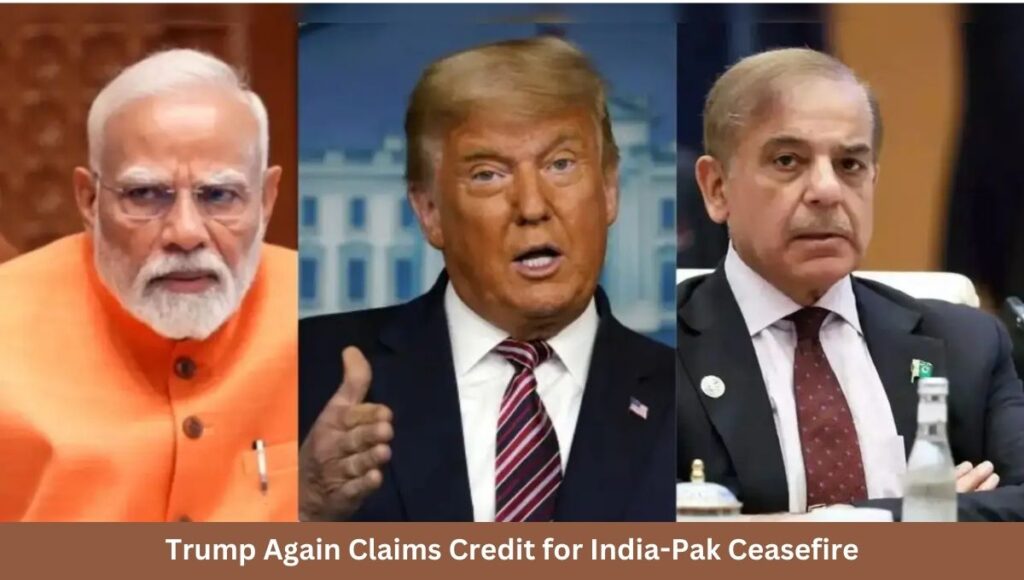
Trump Again Claims Credit for India-Pak Ceasefire
Operation Sindoor: The Trigger for Tensions
The conflict between India and Pakistan flared up after the April 22 Pahalgam terror attack in Jammu and Kashmir, which killed 26 people.
In response, Indian Armed Forces launched Operation Sindoor, conducting precise strikes on terror infrastructure in Pakistan and Pakistan-occupied Kashmir (PoK).
According to the Indian military, nine terror camps were destroyed within minutes, killing at least 40 Pakistani soldiers and over 100 terrorists, including several top militant leaders.
India Rejects Any Third-Party Mediation
From the outset, Prime Minister Narendra Modi and senior Indian officials have rejected the idea that outside mediation influenced their decision to halt operations.
Modi told parliament during a special discussion on Operation Sindoor:
“No leader in the world asked us to stop Operation Sindoor. We had said from day one that our action was non-escalatory. The Pakistan DGMO asked for a ceasefire, and we agreed only after achieving 100% of our objectives.”
External Affairs Minister S. Jaishankar also dismissed Trump’s claims, stressing that the ceasefire decision was unrelated to trade or diplomatic deals and came only after India had met its military goals.
Trump’s Version of Events
Trump, however, has stuck to his narrative since May 10, repeatedly telling US audiences that Washington’s behind-the-scenes diplomacy brought about a “full and immediate” ceasefire between the two nuclear-armed neighbors.
In the Oval Office on Thursday, Trump said,
“I have solved six wars in the last six months. I am very proud of that. If you look at Pakistan and India, planes were being knocked out of the air, six or seven planes came down. They were ready to go nuclear, we solved that.”
He did not specify which side suffered the aircraft losses, but Pakistani officials have publicly credited the US president for his role in ending hostilities and even nominated him for a Nobel Peace Prize.
Pakistan’s Reaction and US-Pakistan Alignment
While India has bristled at Trump’s remarks, Pakistan has welcomed his version of events. The latest comments come shortly after Pakistani Army chief General Asim Munir’s visit to the US, his second in two months, where he reportedly held closed-door meetings touching on nuclear issues.
The visit included high-level engagements with US political and military leaders and a private luncheon with Trump in June, underscoring the growing security alignment between Washington and Islamabad, particularly in counterterrorism cooperation.
Tensions in US-India Relations
Trump’s comments on Operation Sindoor have come against the backdrop of strained trade relations with India.
Recently, he announced a 50% tariff on all Indian imports as a penalty for purchasing and reselling Russian oil on the open market.
In a sharply worded social media post, Trump wrote:
“India is not only buying massive amounts of Russian Oil, they are then, for much of the oil purchased, selling it on the Open Market for big profits.
They don’t care how many people in Ukraine are being killed by the Russian War Machine. Because of this, I will be substantially raising the tariff paid by India to the USA.”
The move has drawn criticism from Indian officials, who insist their energy purchases are legal and necessary for national needs.
Linking India-Pakistan and Ukraine Peace Efforts
Trump’s latest India-Pakistan remarks came as he prepared for his Alaska meeting with Putin.
He expressed cautious optimism that both Putin and Ukrainian President Volodymyr Zelensky are open to a peace deal, though he played down expectations of an immediate breakthrough.
“I think President Putin will make peace, I think President Zelenskiy will make peace,” Trump told reporters. “We’ll see if they get along. If they can, it will be great.”
Trump added that a more significant second meeting possibly including Zelensky and European leaders could follow.
The Alaska Summit and Nuclear Arms Control
The Trump-Putin Alaska Summit is set to address not only Ukraine but also strategic nuclear arms control, with both leaders hinting at interest in updating or replacing the New START treaty, which expires in 2026.
The summit will begin with a one-on-one session before expanding to delegation-level talks. On the Russian side, officials including Foreign Minister Sergey Lavrov and Defense Minister Andrey Belousov will join.
Press Conference Uncertainty
While the Kremlin has said there will be a joint press conference after the Alaska talks, Trump has suggested he might hold a separate briefing if discussions do not go well.
“If it’s a bad meeting, it’ll end very quickly. If it’s a good meeting, we’ll go on to end up getting peace in the pretty near future,” he said.
US Says Relationships with India and Pakistan Are ‘Unchanged’
US State Department spokesperson Tammy Bruce said Wednesday that Washington’s relationships with both India and Pakistan remain the same despite recent events.
“Our relationship with both nations remains unchanged, and our diplomats are committed to both countries,” Bruce said.
She acknowledged the past India-Pakistan conflict after the Pahalgam attack as a moment that “could have developed into something quite horrible” and said it was positive that the US engages with both sides.
High-Stakes Diplomacy
Trump’s claim of preventing a nuclear showdown between India and Pakistan adds another controversial chapter to his record on international mediation. While Pakistan appears willing to endorse his version of events, India’s firm denials suggest that the diplomatic reality is more complicated than the US president portrays.
The Alaska summit with Putin offers Trump another chance to present himself as a global peacemaker, but just as with Operation Sindoor, perceptions of success may depend more on political narratives than on the facts on the ground.
Also Read: Trump Repeats Claim He Mediated India-Pakistan Ceasefire Amid Denials from New Delhi
Also Read: “6-7 Planes Came Down”: Trump Doubles Down On India-Pak Ceasefire Claim