

On aid entering Gaza, Israel Eases Gaza Aid Restrictions Amid Rising Global Outcry Over Starvation Crisis. Israel has begun rolling back restrictions on aid entering Gaza in what appears to be a direct response to mounting global condemnation over the Gaza hunger crisis, now widely regarded as one of the world’s worst humanitarian emergencies.
On Sunday, the Israel Defense Forces (IDF) announced a limited “tactical pause” in military operations and resumed humanitarian aid deliveries, including previously suspended food drops. The move marks the most significant shift in Israeli policy on Gaza aid deliveries since March and comes as images of starving children and chaotic soup lines fuel public anger worldwide.
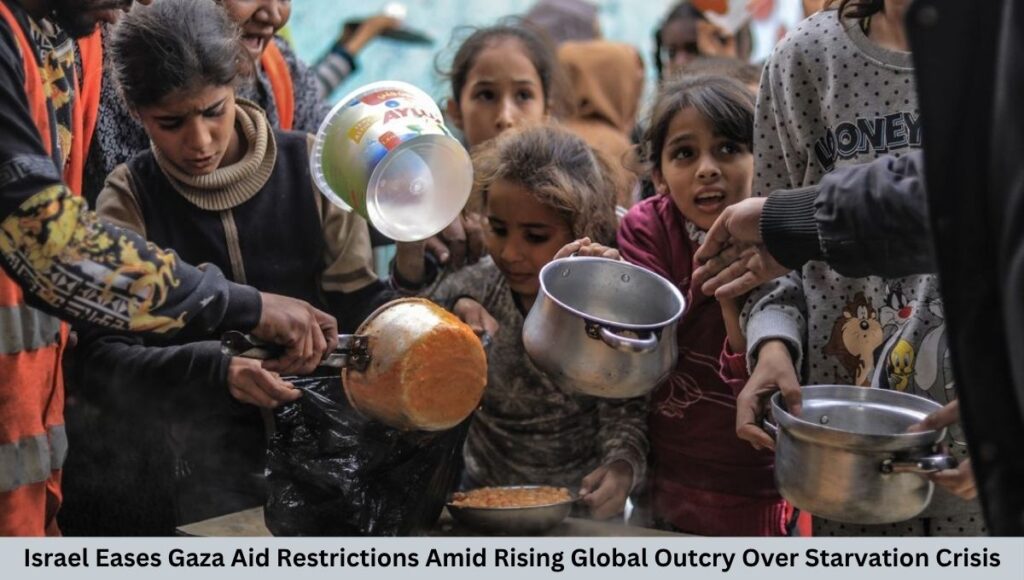
Israel Eases Gaza Aid Restrictions Amid Rising Global Outcry Over Starvation Crisis
A Humanitarian Shift Under Pressure
The military decision, made without formal comment from Israeli Prime Minister Benjamin Netanyahu or Defense Minister Israel Katz, reflects growing discomfort among Israel’s allies over the deteriorating situation in Gaza.
For the first time since spring, Israel restored electricity to a Gaza desalination plant, and the IDF began allowing limited movement of UN relief convoys.
Still, it was Danny Danon, Israel’s ambassador to the UN, who perhaps best explained the motivation:
“There’s a campaign full of lies underway… but the cabinet decided to bring in aid to show the world we are listening even if we disagree with the facts.”
The reversal follows widespread condemnation by aid groups and disturbing images of emaciated children, families scrambling for flour, and collapsing hospitals.
How Severe Is the Gaza Hunger Crisis?
The Gaza hunger crisis has reached catastrophic levels. The World Food Programme (WFP) and UNRWA estimate that the entire 2.1 million population faces crisis levels of food insecurity.
One in five children in Gaza City is now malnourished, with thousands at risk of death due to starvation.
Since July 23, at least 43 Gazans have died of hunger, according to Gaza’s Health Ministry. More than 127 starvation-related deaths have been recorded since the war began, including 85 children.
Aid organizations believe the true number is far higher.
Dr. Ahmad al-Farra, a pediatrician at Nasser Medical Complex, warned,
“Our malnutrition ward is overcrowded. Children sleep on the floor. We are out of medicine and food.”
British surgeon Dr. Nick Maynard added,
“This is man-made starvation. ‘Skin and bones’ doesn’t even begin to describe what we’re seeing.”
Infrastructure in Ruins: A Warzone Starved of Supplies
The roots of the crisis lie not only in the war but in the collapse of Gaza’s infrastructure. Since Israel launched its offensive in response to the October 7, 2023 Hamas attack, more than 75% of Gaza has been overrun by troops and tanks.
Before the war, around 3,000 trucks brought in goods weekly. That number has fallen sharply due to closed crossings, security checks, and damaged roads. Hospitals have been bombed, water lines cut, and supply chains shattered.
Food is scarce, and when it’s available, it’s often unaffordable. A kilo of flour can cost more than $30. Fuel shortages have halted refrigeration, limiting even the meager food that makes it into homes.
A Tactical Pause and Parachute Aid: Symbolic or Substantive?
Under pressure from allies and aid groups, Israel announced a daily tactical pause between 10 AM and 8 PM in Gaza City, Deir al-Balah, and Muwasi.
The IDF said it would coordinate with UN agencies to ensure safe corridors for humanitarian deliveries.
Following this, the UAE and Jordan carried out large-scale airdrop operations, delivering 25 tons of food by parachute the first such effort in months.
Israel itself also resumed limited airdrops, a method it had previously abandoned due to safety and logistical concerns.
Meanwhile, aid trucks from Egypt and Jordan began flowing again through the Kerem Shalom crossing, diverted from the damaged Rafah gate.
But despite these efforts, humanitarian leaders were cautious.
“Airdrops are not a substitute for ground delivery,” said Philippe Lazzarini, head of UNRWA Gaza.
“They are dangerous, expensive, and offer only symbolic relief.”
Critics Say It’s Not Enough
Humanitarian organizations largely greeted the moves as too little, too late.
Oxfam’s Bushra Khalidi said:
“Starvation won’t be solved with a few airdrops or trucks. What’s needed is a ceasefire, open crossings, and unrestricted aid access.”
Joe English, a UNICEF spokesman, warned that urban airdrops could be deadly:
“In cities like Gaza, it’s simply not safe. Civilians could die scrambling for falling aid packages.”
Ciarán Donnelly of the International Rescue Committee dismissed the pause as a public relations tactic:
“It’s a grotesque distraction. The hunger crisis requires scale, not stunts.”
Refeeding Syndrome and Medical Crisis: The Next Wave
Medical professionals warn that even when food becomes available, refeeding syndrome a potentially fatal condition could threaten many.
Dr. Thaer Ahmad, who has led missions to Gaza, explained:
“You can’t just give starving people full meals. Their organs are too weak. It must be gradual and carefully monitored.”
Meanwhile, hospitals are seeing pregnant women miscarrying due to malnutrition, and babies born underweight, immuno-compromised, and dying within days.
“We are expected to save lives while our own are slowly being consumed,” said one Gaza doctor.
Fallout Within Israel’s Government
The decision to ease restrictions has also sparked internal political backlash. National Security Minister Itamar Ben Gvir and Finance Minister Bezalel Smotrich, both far-right members of Netanyahu’s coalition, opposed the aid resumption.
Smotrich advocates for a full takeover of Gaza, regardless of the 20 remaining hostages believed to be alive. Ben Gvir said he was not even consulted.
Still, pressure from the U.S. and European Union, as well as growing media scrutiny, left Netanyahu little room.
“We are considering alternative options to bring our hostages home and secure lasting peace,” he said Friday.
Hostage Negotiations and War Goals Collide
Negotiations over a new ceasefire have stalled. The last proposal would have seen 25 hostages freed in exchange for hundreds of jailed Palestinians, plus aid increases over 60 days.
However, Hamas demanded Israel commit to ending the war a nonstarter for Netanyahu’s government, which insists Hamas must be destroyed before any final ceasefire.
“The objectives remain the same: recover hostages, end Hamas rule, and destroy its military capabilities,” said Danny Danon.
U.S. President Donald Trump weighed in harshly on Friday, saying,
“I think they [Hamas] want to die… you’re going to have to finish the job.”
Aid Numbers Fall Short of Needs
Israel’s U.S.-backed Gaza Humanitarian Foundation (GHF) claims to have delivered 90 million meals worth of supplies, yet hunger is still rampant.
Multiple reports have alleged that Palestinian civilians have been shot while attempting to reach aid distribution points claims denied by both the IDF and GHF, though investigations are ongoing.
Meanwhile, local flour prices dropped 20% overnight as new aid trickled in a modest improvement but hardly enough for a region where one in three Gazans goes a full day without food.
Conclusion: Real Relief Requires Real Change
The resumption of airdrops, flour trucks, and electricity to a single desalination plant may mark a turning point but aid groups warn it’s a fragile one.
Without a sustained ceasefire, open border crossings, and uninterrupted large-scale aid access, the Gaza hunger crisis will persist. Every day of delay means more lives lost to starvation in Gaza, especially among children and the elderly.
As one exhausted aid worker put it:
“Parachutes won’t fix this. Peace will.”
Also Read: Gaza Faces “Mass Starvation” as Death Toll from Hunger Climbs Amid Ongoing Israeli Strikes
Also Read: Gaza suffering man-made mass starvation, says WHO chief
Related Posts:
- Gaza Faces “Mass Starvation” as Death Toll from…

- Gaza Starvation Crisis Worsens Despite Israeli Aid Claims

- Trump’s 20-Point Gaza Peace Plan Gains Urgent Global…

- 171 Gaza Flotilla Activists Deported Amid Alleged Torture

- Israel’s Gaza Takeover Plan: What’s Been Achieved…

- Israel–Hamas Ceasefire Under Strain: 4 More Hostage…
