With historic gains in the upper house Far-Right Sanseito Surges in Japan’s Elections as PM Ishiba Faces Pressure to Resign. Japan’s political landscape is shifting dramatically after the far-right Sanseito party made stunning gains in the upper house elections, fueled by nationalist rhetoric and voter frustration over the economy. The rise of Sanseito comes at a time when Prime Minister Shigeru Ishiba is under immense pressure to resign following his coalition’s historic loss and the announcement of a controversial $550 billion trade deal with former U.S. President Donald Trump.
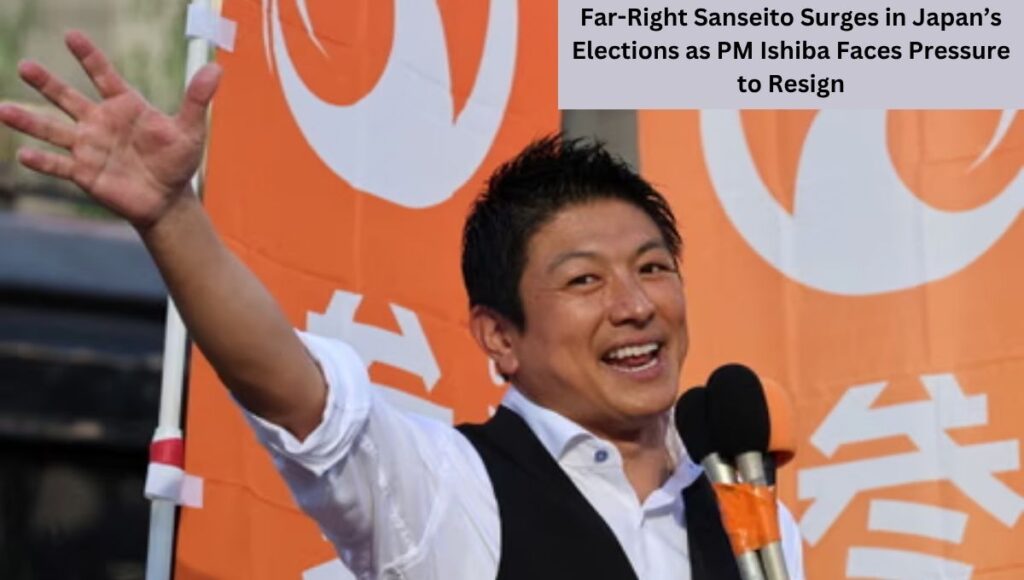
Far-Right Sanseito Surges in Japan’s Elections as PM Ishiba Faces Pressure to Resign
Sanseito Party: From Fringe to Frontline
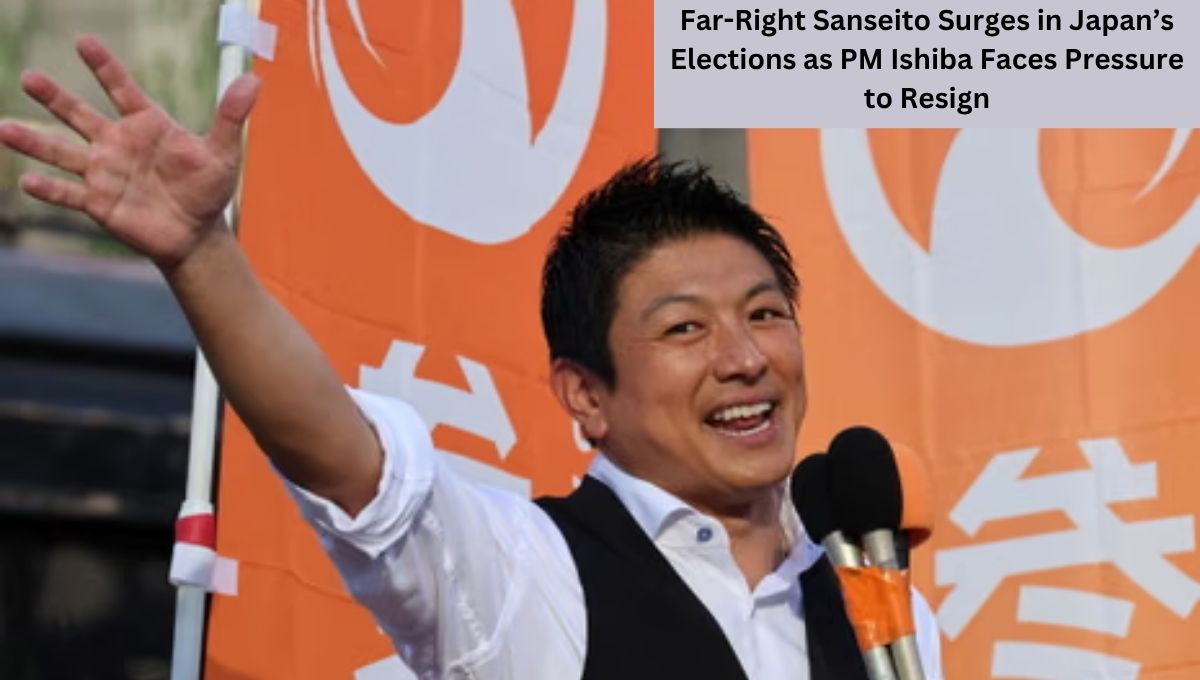
The Sanseito party, meaning “Participate in Politics,” was once a fringe movement started in 2020 by political activist and former Self-Defense Force reservist Sohei Kamiya.
Using YouTube and social media, Kamiya attracted disillusioned voters fed up with Japan’s traditional parties.
Now, the party holds 15 seats in the 248-member upper house, up from just one seat before Sunday’s election.
This massive jump marks Sanseito as one of the biggest winners of the election and a growing force in Japanese far-right populism.
Japanese First: Nationalism in a Globalized World
Sanseito ran on a “Japanese First” platform, inspired in part by Donald Trump’s “America First” policies.
The party called for tougher restrictions on immigration, the exclusion of foreigners from welfare benefits, and stricter screening for Japanese citizenship.
Critics say this has led to a rise in xenophobia both in political discourse and on social media.
During the campaign, Kamiya proposed the creation of a new regulatory agency to oversee foreigners, stoking fears about rising crime and economic threats supposedly posed by foreign workers.
These claims have been widely disputed foreigners make up just 3% of Japan’s population and welfare recipients but the messaging resonated deeply with economically frustrated voters, especially the youth.
Fueled by the Internet and the Pandemic
Sanseito’s growth was digitally driven. The party’s online-first strategy helped it gain traction during the coronavirus pandemic, especially when it took an anti-vaccine stance that appealed to conspiracy theorists and globalism skeptics.
Kamiya’s YouTube channel has gained over 100,000 subscribers in recent weeks, soaring past nearly 500,000 subscribers far more than the Liberal Democratic Party’s 140,000.
The party’s base has been galvanized by calls to reject Western-style diversity, gender equality, and decarbonization, echoing similar sentiments in far-right movements across Europe and the U.S.
Trump Trade Deal Sparks Political Crisis
Just as Sanseito celebrated its surge, Donald Trump announced a $550 billion trade deal with Japan, claiming it was the “largest ever made.” According to Trump, the agreement includes:
- $550 billion in Japanese investments into the U.S.
- A 15% “reciprocal” tariff on Japanese goods exported to America.
- The opening of Japan’s markets to U.S. agricultural products, vehicles, and more.
- “90% of profits” flowing to the U.S., though without details on how this is calculated.
The announcement was made via Truth Social and stunned Tokyo, where Prime Minister Shigeru Ishiba responded with caution, saying he needed time to “scrutinize the outcome.”
Shigeru Ishiba on the Brink
For Prime Minister Ishiba, the timing could not have been worse. His Liberal Democratic Party (LDP) suffered a bruising election defeat, losing its majority in the upper house.
His approval rating has plunged to just 21%, a danger zone for Japanese leaders.
Ishiba has reportedly told aides he may resign by the end of August, once the full details of the Trump trade agreement are clear.
Japanese media outlet Yomiuri reports that Ishiba plans to travel to the U.S. before the end of July for direct talks with Trump and negotiator Ryosei Akazawa.
“I can’t say until I scrutinize the agreement,” Ishiba told reporters. “But I will stay in office and do everything in my power to resolve these challenges.”
No Political Vacuum? Or a Convenient Exit?
While Ishiba argues that Japan must avoid a political vacuum during critical U.S. trade negotiations, many analysts see his stance as buying time before stepping down.
His leadership is now openly questioned within the LDP, and new conservative challengers are eyeing a succession battle.
Despite promoting the trade deal as a potential economic breakthrough, critics argue that it heavily favors the United States, lacks transparency, and was announced without Tokyo’s coordination.
U.S. Treasury Secretary Scott Bessent noted that Ishiba’s political weakness has “given them a bit of impetus to get things done” in the trade talks. Washington believes Tokyo is more pliable due to Ishiba’s weakened domestic position.
Kamiya and Sanseito: No Interest in Alliances
As Ishiba fights for survival, Sanseito leader Sohei Kamiya has ruled out forming alliances with traditional parties like the LDP.
“We have no interest in working with conventional parties,” he said Tuesday. Instead, he’s eyeing a longer-term strategy: gaining more influence in the more powerful lower house and potentially leading a European-style multiparty coalition in the future.
Kamiya’s approach is grassroots and strategic. He has focused on local elections and winning over disillusioned younger voters, particularly those concerned about Japan’s rising cost of living, lack of wage growth, and stagnant politics.
Xenophobia and National Purity
Sanseito’s rhetoric is not just nationalist it’s racially and culturally exclusionary. Human rights groups have flagged Kamiya’s anti-Semitic remarks, promotion of ethnic purity, and rejection of gender equality and LGBTQ+ rights.
Kamiya blames Japan’s declining birth rate on progressive gender policies and opposes allowing a female-line emperor.
He even controversially suggested that the imperial family may need concubines if the government does not act fast enough on succession issues.
These views have alarmed activists and academics, but Kamiya’s passionate base sees him as a truth-teller against the political elite.
A Populist Parallel: Trump and Kamiya
Throughout his campaign, Kamiya praised Donald Trump’s leadership, describing it as a model for Japan to follow. He supports Trump’s opposition to globalism, climate agreements, and diversity mandates.
“We share the same concern,” Kamiya said during a televised party leaders’ debate. Like Trump, Kamiya is a fiery public speaker, unafraid of controversy and skilled at using social media to dominate political discourse.
His ability to connect with frustrated voters, particularly younger demographics via digital platforms, mirrors the playbook used in the U.S. and parts of Europe.
What Lies Ahead: A Divided and Changing Japan
Japan’s political arena is rapidly transforming. The Sanseito party’s rise, combined with Ishiba’s looming resignation and an unprecedented U.S.-Japan trade deal, has upended the country’s status quo.
While Sanseito currently holds only 15 seats, its real power lies in shaping the national conversation.
Its growth reflects a broader trend of right-wing populism fueled by dissatisfaction with globalization, immigration, and stagnant wages.
Political scientist Izuru Makihara of the University of Tokyo told NHK, “Sanseito is still inexperienced, but its future depends on whether it can turn slogans into policies.”
Conclusion: A Nation at the Crossroads
Prime Minister Shigeru Ishiba’s tenure appears to be nearing its end, with reports pointing to a resignation by late August. Whether his final act the Trump-brokered trade deal will be remembered as a diplomatic success or a capitulation remains to be seen. Meanwhile, Sanseito and Sohei Kamiya represent a rising tide in Japanese politics: nationalist, online-savvy, and eager to challenge the postwar liberal consensus. As Japan grapples with demographic decline, economic pressures, and changing global dynamics, 2025 may be remembered as the year the far-right truly arrived on the national stage.
Also Read: Japan’s ‘house of cards’: Ishiba clings to power as hawks demand LDP election