

A day after the announcement Global Trade War Intensifies as Trump Slaps Massive Tariffs on China and Allies. President Donald Trump on Wednesday announced a massive tariff on all Chinese imports. He raised duties to 54%, and this escalated trade war between the United States and China to new heights. Multiple trading partners have also been slapped with higher tariffs and this move has been met with concerns from economic analysts worldwide and fierce opposition from Beijing.
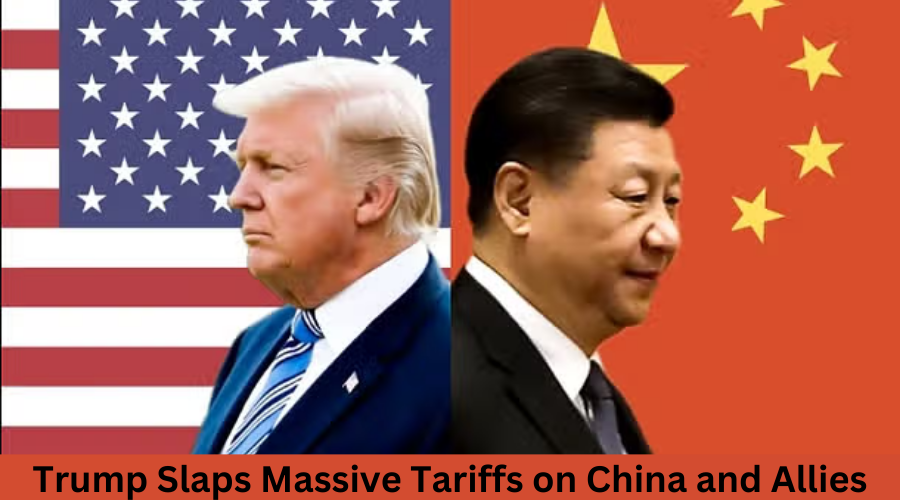
Global Trade War Intensifies as Trump Slaps Massive Tariffs on China and Allies
China Denounces U.S. Tariffs, Pledges Countermeasures
China calls this “unilateral bullying practices” by the U.S. government and has vowed a strong retaliation against high tariffs. The Chinese Ministry of Commerce warned that Beijing would take resolute countermeasures to protect its economic interests and urged Washington to withdraw the latest tariffs immediately.
The statement read that, the United States reciprocal tariffs were based on subjective and unilateral assessments, which is conflicting with international trade rules, seriously damaging the legitimate rights and interests of relevant parties.
Earlier Trump had imposed an additional 20% tariff on Chinese goods. Yesterday a new 34% tariff was imposed and now Chinese exports to the U.S. will face an overall tariff of 54%, nearing the 60%-mark Trump had floated during his campaign. On April 5 an additional 10% baseline tariff on all global imports is set to take effect and by April 9, increased rates for some nations, including the European Union and Japan, will coming into play.
U.S Tariffs Reshape Global Trade
Since the post-World War II era the latest decision by the Trump’s administration marks the most significant turbulence in international trade policy. Trump declared that America since for over five decades had been pillaged, looted, raped, and plundered by nations near and far. He also said that they are standing up for the American worker and finally putting America first.
The countries Vietnam (46%), Cambodia (49%), Japan (24%), and India (26%) are hit hardest by the new tariffs. On their exports to the U.S, even smaller economies such as Lesotho will face duties as high as 50%. Two of America’s closest trade partners, Canada and Mexico have been spared from the new tariff measures—for now.
Economic Fallout and Investor Concerns
Possible economic downturns in multiple nations sparked fears and also some analysts warned of a potential global recession with sudden escalation of tariffs. Former chief economist at the International Monetary Fund, Ken Rogoff, described the move as a nuclear bomb on the global trading system.
The stock markets negatively reacted to the announcement. ASX 200 from Australia dipped by 2% while Japan’s Nikkei 225 in early trading plummeted by 4%. Dan Ives, Wedbush Securities analyst called the tariffs as worse than the worst case anticipated by investors.
The tariffs could also make U.S. economy face consequences. Consumer prices on essential goods, from food and vehicles to clothing and electronics are expected to surge due to higher tariffs. Scott Bessent, Treasury Secretary warned countries not to retaliate. He said that if the countries retaliate there will be escalation and if they do not retaliate this will be the high watermark.
China’s Next Move: Precision Strikes Over Broad Retaliation?
China has appropriately responded with targeted countermeasures to U.S. tariffs and analysts are expecting a similar approach this time. Beijing, on Industrial machinery, energy exports, and American agricultural products may impose new tariffs. Moreover, China could restrict exports of critical minerals, squeeze U.S. companies operating in its market, or blacklist American firms under its ‘Unreliable Entity List’ policy using its regulatory power.
A senior fellow at the Foundation for Defense of Democracies, Craig Singleton, predicted that instead of a broad retaliation, expect a playbook of calibrated pressure: new tariffs on politically sensitive U.S. exports, selective export controls, and expanded use of regulatory tools.
A Strategic Shift in Global Trade Relations
Trump’s aggressive trade policy has its implications beyond U.S. and China as well. Other nations such as Vietnam and Cambodia that had been benefiting from the U.S.-China trade dispute by attracting investment away from China are now facing their own steep tariffs.
Some traditional U.S. allies are being pushed by Trump’s decision to reconsider their economic relationships. Unable to directly retaliate against the U.S., countries such as Japan and South Korea, may seek to strengthen ties with China in response.
A senior fellow at the Hudson Institute, Jason Hsu, said that, Japan and Korea are still in no position to retaliate against the U.S., so they could quietly develop a relationship with China to re-engage and reassess opportunities in Chinese markets.
Conclusion: A Turning Point in Trade Policy
Latest tariffs by Trump represent a fundamental shift in global trade dynamics. The world is bracing for an intensified economic confrontation, with the European Union hinting at countermeasures and China vowing to retaliate. The White House stands by the fact that the new tariffs will protect American jobs and industries, while the global economic fallout may tell a different story in the coming months.
One thing stands out clear: the era of open, multilateral trade agreements is under threat, and the economic powers of the world are preparing for an unpredictable and a prolonged battle in world trade relations.
Also Read: Trump’s Tariff Tsunami: What It Means for India and the Global Trade Landscape
Also Read: China, EU hit back with their own tariffs as Trump’s trade war intensifies
Related Posts:
- Can the EU and NATO Impose Tariffs on India and…

- In 8 Moves, EU Targets China-Linked Refineries and…

- U.S.–China Trade War 2025: 500% Tariff Threat Sparks…
- 7 Crucial Insights Into Trump and Xi’s High-Stakes…
- 7 Powerful Measures: Trump Sanctions Russian Oil…

- 7 Big Takeaways: Macron’s High-Stakes China Visit…
