
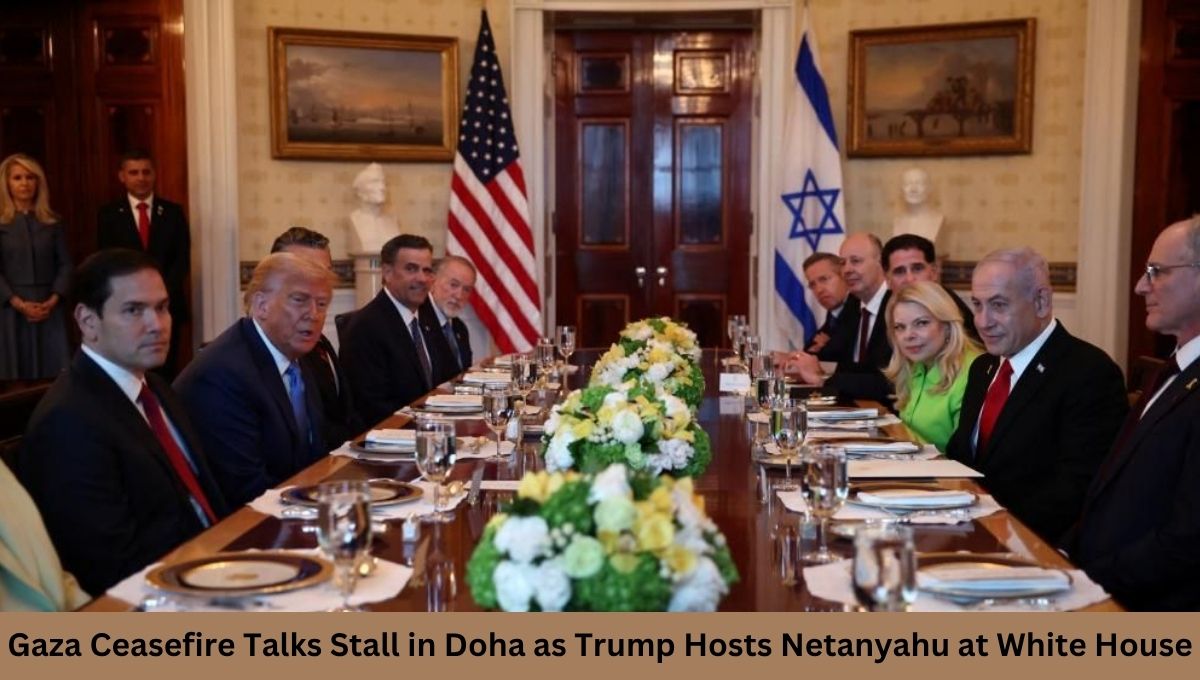
Without progress the Gaza Ceasefire Talks Stall in Doha as Trump Hosts Netanyahu at White House. Efforts to secure a Gaza ceasefire between Hamas and Israel resumed over the weekend in Doha, Qatar, but the first indirect negotiations since the Israel-Iran war concluded without significant progress. According to Palestinian sources, the Israeli delegation lacked the authority to finalize any deal, stalling the possibility of a breakthrough.
“The Israeli delegation is not sufficiently authorised to reach an agreement with Hamas,” a Palestinian negotiator told Reuters. Despite increased international pressure and active involvement from the Trump administration, the 22-month Gaza war remains unresolved, with heavy casualties, widespread displacement, and a deepening humanitarian crisis.
Gaza Ceasefire Talks Stall in Doha as Trump Hosts Netanyahu at White House
Netanyahu Meets Trump in Washington, Nominates Him for Nobel Peace Prize
While ceasefire talks stalled in Doha, Israeli Prime Minister Benjamin Netanyahu traveled to Washington for the third time since Donald Trump resumed the U.S. presidency.
In a symbolic move, Netanyahu nominated Trump for the Nobel Peace Prize, citing his role in ending the recent Israel-Iran war and advancing Middle East peace efforts.
“It’s the nomination of you for the peace prize, which is well-deserved,” Netanyahu told Trump during their White House meeting.
Trump accepted the letter with visible surprise and gratitude, calling it “very meaningful,” especially amid escalating global pressure for a ceasefire.
Trump’s Optimism vs. Ground Reality
Despite the lack of concrete progress in Doha, Trump expressed confidence during a media briefing:
“I don’t think there is a hold-up. I think things are going along very well. They [Hamas] want to meet and they want to have that ceasefire.”
He emphasized that the U.S. would remain engaged and hinted that a deal could be finalized this week.
Ceasefire Framework Faces Deep Divisions
The U.S.-backed 60-day ceasefire proposal involves a phased release of hostages, increased humanitarian aid, and a partial withdrawal of Israeli troops from Gaza.
However, negotiations have stumbled over multiple issues:
- Hostage Release: Hamas has demanded clear guarantees for long-term peace before releasing the remaining hostages.
- Humanitarian Aid: Disagreements persist over the role of the Gaza Humanitarian Foundation (GHF). Hamas accuses it of being a political weapon, while Israel maintains operational control.
- Governance of Gaza: Israel insists Hamas must be dismantled and barred from ruling post-war Gaza something Hamas rejects outright.
These obstacles underscore deep political and ideological rifts that remain unresolved despite American mediation.
Hostage Crisis: A Painful Stalemate
The war began on October 7, 2023, when Hamas launched a surprise attack, killing approximately 1,200 Israelis and taking 251 hostages.
Around 50 captives remain, with 20 believed to be alive. Under the ceasefire plan, Hamas would release 10 living hostages and 18 bodies in exchange for Palestinian prisoners.
However, Israel’s negotiators say they lack the mandate to approve this mechanism, prolonging the impasse.
In Tel Aviv, thousands of Israelis took to the streets demanding a ceasefire and the return of hostages. Families waved placards and chanted for urgent action.
Netanyahu Proposes Voluntary Relocation of Palestinians from Gaza
During his White House visit, Netanyahu suggested working with the U.S. to offer Palestinians the option to relocate from Gaza, stating:
“If people want to stay, they can stay. But if they want to leave, they should be able to leave. It shouldn’t be a prison.”
This controversial statement builds on Trump’s earlier proposal to turn Gaza into the “Riviera of the Middle East.”
Human rights organizations condemned the idea, calling it a form of ethnic cleansing and a violation of international law.
Trump: “Great Cooperation from Neighboring Countries”
Though he initially avoided specifics, Trump later claimed that neighboring Arab countries were cooperating with the relocation plan.
“We’ve had great cooperation from every single one of them. So something good will happen,” he said.
Analysts view this as part of a broader strategy to reshape post-war Gaza, though critics warn it risks igniting regional backlash and intensifying Palestinian resistance.
ICC Arrest Warrants Shadow Netanyahu’s Visit
Adding further tension to the ceasefire effort are the International Criminal Court (ICC) arrest warrants issued against Netanyahu, former Israeli Defense Minister Yoav Gallant, and Hamas commander Mohammed Deif for alleged war crimes.
During Netanyahu’s White House visit, hundreds of protesters rallied outside, demanding his arrest.
Many waved Palestinian flags, wore keffiyeh scarves, and held signs reading “Stop Arming Israel” and “Say No to Genocide.”
Trump, who has previously dismissed the ICC’s legitimacy, sanctioned four ICC judges last month in retaliation.
Trump Eyes New U.S.-Iran Deal After Military Showdown
The Gaza ceasefire talks are unfolding in the shadow of Trump’s recent military confrontation with Iran, which ended after the U.S. bombed three Iranian nuclear sites in retaliation for Tehran’s attacks on Israel.
“They took a big drubbing,” Trump said, comparing the strikes to World War II atomic bombings that ended the conflict swiftly.
Despite the tough rhetoric, Trump confirmed plans for direct U.S.-Iran dialogue, with envoy Steve Witkoff stating that talks could begin within the week. Trump said lifting sanctions was possible “at the right time.”
Humanitarian Crisis in Gaza Reaches Catastrophic Levels
The situation in Gaza continues to deteriorate. According to Gaza’s Health Ministry, over 57,000 Palestinians have been killed, with tens of thousands more injured. Nearly 500,000 are facing famine, according to the United Nations.
Food distribution is limited due to Israeli restrictions, and most of Gaza’s population has been displaced by airstrikes and ground offensives.
One displaced resident, Abu Suleiman Qadoum, told Reuters: “It has totally become unbearable. I ask God that the negotiators solve this issue.”
Political Stakes for Netanyahu Remain High
Netanyahu’s domestic position is increasingly precarious. He faces an ongoing corruption trial involving charges of bribery, fraud, and breach of trust, which he denies.
Critics claim he is prolonging the war to divert attention and retain support from hardline coalition partners.
Nevertheless, public pressure in Israel is mounting, with protests growing louder and more frequent.
A ceasefire deal, if successfully brokered, could boost his standing though any compromise on Gaza governance may also cost him political capital.
Envoy Steve Witkoff Heads to Doha for Second Round
Middle East envoy Steve Witkoff, credited with drafting the 60-day ceasefire plan, is set to travel to Doha to continue negotiations.
The Trump administration remains hopeful that direct U.S. involvement will help bridge the gap. Still, experts remain cautious.
Professor Adnan Hayajneh of Qatar University told Al Jazeera: “The chance of a ceasefire is slim. Israel’s leadership isn’t interested in ending the war they want the land unliveable.”
Without guarantees of aid access and truce extensions, Hamas may refuse to proceed.
What’s Next: Will a Deal Happen This Week?
Trump’s declaration that “we’ll have a deal this week” remains unconfirmed. While the administration continues to push for a breakthrough, no official agreement has been reached.
U.S. Ambassador to Israel Mike Huckabee was noncommittal: “I simply don’t know.”
Without a signed document, the path forward remains uncertain. Yet the increased tempo of diplomacy and backchannel communication suggests that the groundwork for a deal is being laid.
Final Thoughts: Progress Made, But Peace Remains Elusive
The first Hamas-Israel ceasefire talks since the Iran war have ended without a breakthrough, but with new momentum and international engagement. Trump’s personal involvement, Netanyahu’s repeated visits, and the urgency of the humanitarian crisis have turned global eyes toward Gaza.
Whether a ceasefire agreement can be reached depends on the willingness of both parties to compromise and whether the U.S. can leverage its influence to get it done. As Trump put it: “They want it. They want to meet and they want to have that ceasefire.” Only time will tell whether this desire will finally lead to peace.
Also Read: Trump and Netanyahu Push Gaza Ceasefire, Propose Palestinian Relocation Amid Growing Backlash
Also Read: Israel expected to present new Gaza withdrawal map in Doha talks
Related Posts:
- Trump’s 20-Point Gaza Peace Plan Gains Urgent Global…

- Trump’s Historic Gaza Ceasefire Deal 2025 - Powerful…

- Trump’s 2025 Gaza Peace Plan Signing and Historic…

- 5 Powerful Highlights as Trump Lands Second Nobel…

- Trump’s Breakthrough Gaza Ceasefire Deal 2025: Key Insights

- Dramatic Moments Behind Trump’s Gaza Peace Push and…
