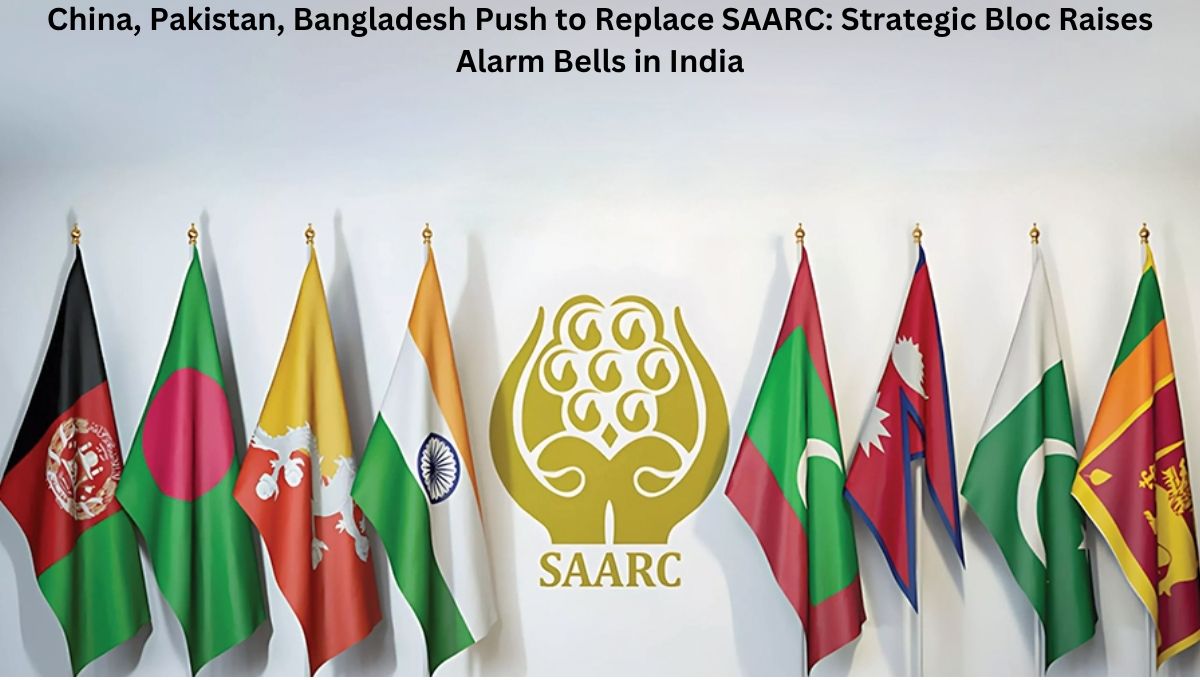
In a move that could fundamentally alter South Asia’s strategic landscape, China, Pakistan, Bangladesh Push to Replace SAARC: Strategic Bloc Raises Alarm Bells in India. China, Pakistan, and Bangladesh are reportedly laying the groundwork for a new regional bloc aimed at replacing the long-dormant South Asian Association for Regional Cooperation (SAARC).
The trilateral meeting held in Kunming, China, on June 19, 2025, marks the first formal step in what analysts are calling a “geopolitical realignment” targeting India’s central role in the region.
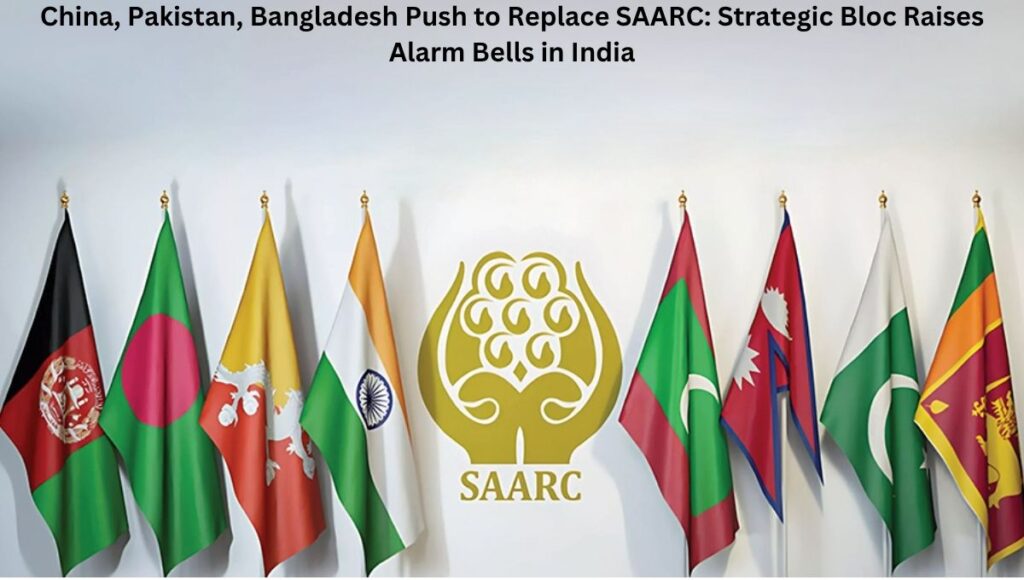
China, Pakistan, Bangladesh Push to Replace SAARC: Strategic Bloc Raises Alarm Bells in India
SAARC: Once a Beacon, Now Dormant
Founded in 1985, SAARC was envisioned as a regional platform to foster peace, economic growth, and integration across South Asia.
India, the region’s largest economy, played a pivotal role in shaping and funding key SAARC institutions such as the SAARC Development Fund and the South Asian University.
However, SAARC has been effectively non-functional since 2016, following the cancellation of its Islamabad summit after the Pakistan-sponsored Uri terror attack.
India, joined by Afghanistan, Bhutan, and Bangladesh, withdrew in protest, accusing Pakistan of harboring terrorism and blocking key trade and security frameworks.
Despite attempts to revive SAARC most notably Prime Minister Narendra Modi’s COVID-19 Emergency Fund initiative in 2020 the organization has remained in a state of paralysis.
Now, China and Pakistan appear eager to fill that vacuum, with Bangladesh’s involvement adding credibility and complexity.
The Kunming Meeting: Laying the Foundation
The trilateral meeting in Kunming included Chinese Vice Foreign Minister Sun Weidong, Bangladesh’s Acting Foreign Secretary Ruhul Alam Siddique, and Pakistan’s Additional Foreign Secretary Imran Ahmed Siddiqui. Pakistan’s Foreign Secretary Amna Baloch participated virtually.
Though the joint statement issued after the meeting claimed the dialogue was “not aimed at any third party,” the composition and timing have raised eyebrows in India, which sees the initiative as a clear attempt to challenge its regional leadership.
According to Pakistani media reports, the meeting’s real goal was to create a new regional grouping that would include SAARC nations like Sri Lanka, Nepal, Bhutan, the Maldives, and Afghanistan but under new leadership, with China at the center.
Bangladesh’s Involvement: Alliance or Anomaly?
Bangladesh’s participation has stirred controversy, both domestically and internationally. Dhaka’s foreign affairs adviser, M Touhid Hossain, dismissed concerns by saying the meeting was “not political.”
Yet, multiple sources claim that Bangladesh had initially asked China to keep the meeting low-profile.
Pakistan, however, released its own version of the meeting’s outcomes, prompting dissatisfaction in Dhaka, with one official reportedly calling it a “betrayal.”
Critics, including economist Dr. Selim Raihan, have also questioned the authority of Bangladesh’s interim government, led by Chief Adviser Muhammad Yunus, to engage in significant diplomatic activities without an electoral mandate.
The lack of transparency and perceived alignment with anti-India forces has fueled suspicions that Dhaka may be drifting from its traditionally balanced foreign policy.
Strategic Agenda: Extending CPEC Toward Bangladesh
One of the most significant concerns for India is that this new China-Pakistan-Bangladesh bloc may serve as a vehicle to expand the China-Pakistan Economic Corridor (CPEC) into Bangladesh.
CPEC, a key component of China’s Belt and Road Initiative (BRI), passes through Pakistan-occupied Jammu & Kashmir (PoJK), a region India claims as its sovereign territory.
If extended eastward, CPEC could link up with Bangladeshi infrastructure, giving China maritime access to the Bay of Bengal.
This development would not only deepen Beijing’s economic presence but also enable military logistics an unacceptable scenario for Indian security planners.
Siliguri Corridor: A Choke Point Under Threat?
The potential expansion of China’s influence into Bangladesh also brings India’s “Chicken’s Neck” into focus.
The Siliguri Corridor is a narrow strip of land that connects mainland India to its northeastern states and is considered a critical vulnerability.
Recent reports indicate that Bangladesh, with Chinese support, may look to revive the Lalmonirhat airfield located just 12 to 20 km from the Indian border.
Strategic thinkers like Brahma Chellaney have warned that any Chinese activity in this area could threaten Indian territorial integrity.
Assam Chief Minister Himanta Biswa Sarma has already signaled New Delhi’s unease, warning of “firm responses” should the corridor be compromised.
Strategic Encirclement or Cooperative Development?
Many military analysts are calling this new trilateral initiative a “devil’s triangle,” designed to strategically encircle India.
With access to both the Bay of Bengal and the Arabian Sea, China would be positioned to surround India from both flanks using infrastructure labeled as “development aid” to build long-term influence and potential military outposts.
Subhashish Banerjee of the P3 Think Tank has termed the alliance a covert attempt to dominate South Asia’s economic and strategic pathways.
Journalist Gautam Lahiri echoed these concerns, stating that informal references to CPEC during the Kunming meeting signal that “economic cooperation is being used as a Trojan horse for military influence.”
Undermining India’s Regional Strategies
In response to SAARC’s dysfunction, India has invested heavily in alternative regional groupings like BIMSTEC (Bay of Bengal Initiative for Multi-Sectoral Technical and Economic Cooperation) and the Indian Ocean Rim Association (IORA).
These platforms exclude Pakistan and focus on practical cooperation.
However, a new China-led bloc could dilute these efforts by offering smaller South Asian nations a lucrative alternative backed by Chinese infrastructure investments and economic incentives.
This fragmentation risks eroding the unity and effectiveness of India’s regional vision.
Indo-Pacific Repercussions: Challenging U.S. Strategy
This development also has major implications for the Indo-Pacific region. The United States and its allies have been working to promote a “free, open, and rules-based” Indo-Pacific, with India as a key partner.
A China-dominated regional bloc in South Asia would act as a spoiler to these plans.
If institutionalized, the new bloc could emerge as a parallel power center one that offers development on Beijing’s terms, with little regard for transparency or democratic values.
This would not only sideline India but also weaken U.S. efforts to balance China’s growing assertiveness.
India’s Diplomatic Crossroads
India now faces a serious diplomatic challenge. It must respond to the emerging alliance without alienating key neighbours like Bangladesh. This will require a multi-pronged approach:
- Reinforce Ties with Bangladesh: Re-establish high-level diplomatic engagement with Dhaka and remind it of the historic and economic ties shared with India.
- Strengthen BIMSTEC: Accelerate infrastructure projects and trade agreements within BIMSTEC to offer a viable, non-China alternative.
- Fortify the Northeast: Enhance military and infrastructure readiness in the Northeast, especially around the Siliguri Corridor.
- Coordinate with Allies: Deepen engagement with the U.S., Japan, Australia, and ASEAN partners to counterbalance China’s regional moves.
Conclusion: Strategic Clarity Is the Need of the Hour
The China-Pakistan-Bangladesh push to replace SAARC isn’t just about trade or connectivity it’s a recalibration of power in South Asia. Framed in the language of multilateralism and development, the deeper intent seems to be the marginalization of India and the rise of a China-centric regional order.
India must act with clarity and purpose. Silence or passive engagement will only embolden the emerging axis. Instead, New Delhi must lead the charge for an inclusive, democratic, and secure South Asia—backed by economic strength, diplomatic outreach, and strategic preparedness.
In an increasingly multipolar world, the stakes have never been higher. South Asia stands at a crossroads and India must ensure it remains the anchor of stability and leadership in the region.
Also Read: Chinese Nationals Arrested in U.S. for Smuggling Deadly Fungus Linked to Agroterrorism