

A risky gamble turns into a diplomatic win as Trump Brokers Iran-Israel Ceasefire After Alarming Missile Escalation. In a high-stakes move that many initially feared would plunge the Middle East into a full-blown regional war, President Donald Trump’s decision to strike Iran’s nuclear sites has now led to what he’s calling a “complete and total ceasefire” between Iran and Israel.
After 12 days of continuous warfare, which included unprecedented U.S. airstrikes on Iran and retaliatory missile attacks on American bases in Qatar and Iraq, Trump announced on Tuesday that both Iran and Israel have agreed to halt hostilities.
The surprising turn of events has left analysts debating whether the conflict has truly ended or simply entered a temporary lull.
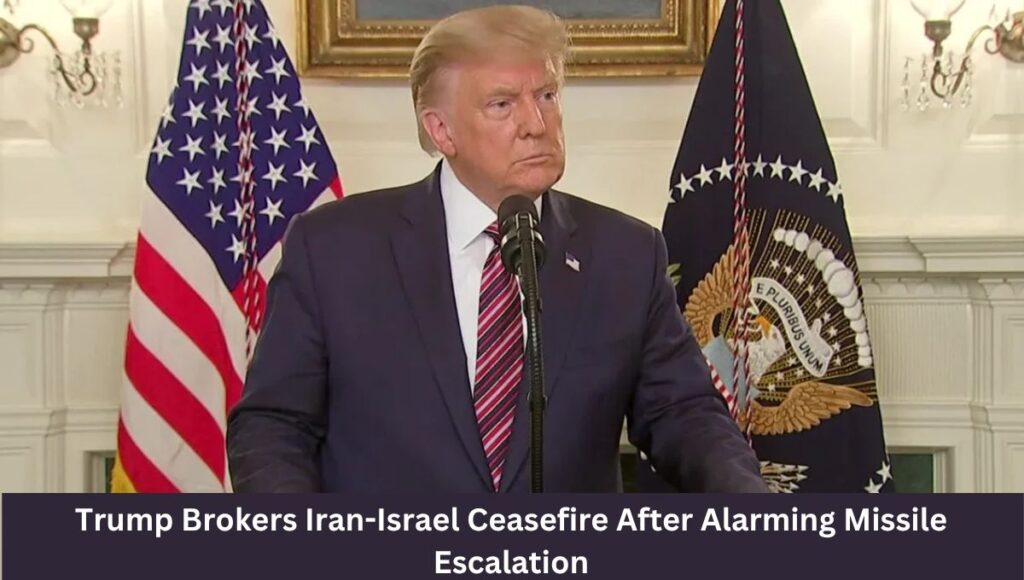
Trump Brokers Iran-Israel Ceasefire After Alarming Missile Escalation
From Bombs to a Ceasefire: The Explosive Timeline
The escalation began with a devastating American airstrike campaign on Saturday, targeting three key Iranian nuclear facilities in Fordow, Natanz, and Isfahan.
These bunker-buster bombings came after Israel’s earlier attacks, which were aimed at halting Iran’s alleged rush toward nuclear weapons capability.
In response, Iran launched a dramatic ballistic missile strike on the Al Udeid Air Base in Qatar the largest U.S. military installation in the Middle East.
Dubbed Operation Besharat Fatah (“Annunciation of Victory”), Iran claimed it matched the number of U.S. bombs with its own missile barrage.
Despite the scale, no casualties were reported, and 13 of 14 missiles were intercepted, according to President Trump. Qatar’s government, however, condemned the attack, calling it a violation of its sovereignty.
Inside the Ceasefire: How Trump’s Team Sealed the Deal
According to sources inside the White House, the moment Iran launched its missiles, President Trump immediately shifted to diplomatic mode. His first words, aides say, were: “Get me Bibi,” referring to Israeli Prime Minister Benjamin Netanyahu.
Key figures behind the scenes included Vice President JD Vance, Secretary of State Marco Rubio, and Special Envoy Steven Witkoff.
They worked tirelessly alongside Qatar’s Prime Minister Sheikh Mohammed bin Abdulrahman Al Thani, who acted as a mediator with Tehran.
By early Tuesday morning just before a Tehran deadline for further Iranian strikes Iran’s Foreign Minister Abbas Araghchi hinted at a de facto ceasefire, saying Iran would pause attacks if Israel ceased its military operations.
Soon after, both Iranian and Israeli airstrikes halted a rare and tentative silence across a war-weary region.
Trump Declares the “12-Day War” Over
Taking to Truth Social, President Trump posted a celebratory message:
“It has been fully agreed by and between Israel and Iran that there will be a Complete and Total CEASEFIRE… At which point the War will be considered ENDED!”
He added that his administration had averted a “prolonged regional war”, calling the resolution a “peace through strength” moment.
In a follow-up post, Trump stated: “Perhaps Iran can now proceed to Peace and Harmony in the Region, and I will enthusiastically encourage Israel to do the same.”
Iran’s Strike on Al Udeid Air Base: Symbolic or Strategic?
Iran’s missile barrage on the Al Udeid Air Base located southwest of Doha, Qatar was the most significant military strike by Tehran since 2020.
Iran’s Islamic Revolutionary Guard Corps (IRGC) stated that the attack was “proportional,” stressing that it gave advance notice to Qatari officials to minimize casualties.
The operation’s symbolic nature was evident, as Iran carefully avoided deaths while making a point: no U.S. attack would go unanswered.
The base, which houses nearly 10,000 U.S. troops and serves as the CENTCOM headquarters, saw panic grip civilians in Doha, as explosions lit up the night sky. Viral footage from Villaggio Mall showed civilians fleeing in fear.
Qatar Condemns Iran, Closes Airspace
While no physical damage was reported, Qatar condemned the attack as a violation of international law, even as it acknowledged Iran’s warning ahead of time.
The Gulf nation temporarily shut its airspace, grounding over 100 flights and disrupting operations at Hamad International Airport, one of the busiest in the world.
Bahrain and Kuwait also briefly closed their airspace as regional tensions spiked.
Ayatollah Khamenei’s Defiance
Iran’s Supreme Leader Ayatollah Ali Khamenei remained defiant even after announcing the ceasefire. In a widely circulated image on X (formerly Twitter), Khamenei posted a burning American flag with the caption:
“We didn’t harm anyone. And we will not accept any harassment from anyone under any circumstances. This is the logic of the Iranian nation.”
Khamenei emphasized that the strike was meant to uphold Iran’s dignity, not escalate war.
Simultaneous Strike on Iraq’s Ain al-Assad Base
Iran also targeted the Ain al-Assad airbase in Iraq, another hub of U.S. military operations. While Iran’s state television broadcast the strike with celebratory music, U.S. officials confirmed that all personnel were safe.
Saudi Arabia Sides with Qatar, Slams Iran
In a strong statement, Saudi Arabia condemned Iran’s missile strikes, labeling them “unjustifiable and unacceptable.”
The Kingdom pledged full support to Qatar and warned Iran against violating regional peace agreements and international law.
“Iran’s aggression is a flagrant violation of the principles of good neighborliness,” said the Saudi foreign ministry.
Civilian Cost: Iran and Israel Count the Dead
The human toll of the 12-day conflict is now becoming clear.
- In Iran, Human Rights Activists in Iran (HRAI) reported 974 deaths and over 3,400 injuries due to Israeli airstrikes.
- In Israel, at least 24 civilians and military personnel were killed, and over 1,000 injured in retaliatory missile attacks and drone strikes.
Cities like Tehran and Isfahan saw mass evacuations, with thousands fleeing to the countryside.
Has the War Truly Ended?
While Trump’s ceasefire announcement has sparked global relief, skepticism remains.
Iran has not formally acknowledged a ceasefire agreement, and Israeli officials have offered only muted confirmation.
A Reuters report cited an unnamed Israeli official saying the truce was conditional on Iran halting all missile launches.
The U.S., meanwhile, has kept its military forces on high alert, and intelligence reports suggest the situation could quickly reignite.
What Happens Next?
While diplomatic channels are now more active than they’ve been in weeks, the root causes of the Iran-Israel conflict remain unresolved particularly Iran’s nuclear program and Israel’s pre-emptive doctrine.
President Trump has hinted at organizing direct talks between Tehran and Jerusalem, but analysts say that would require unprecedented diplomacy and mutual trust both in short supply. For now, the ceasefire offers a fragile but vital pause a chance for diplomacy to replace destruction.
Conclusion: A Pause, Not Peace
Trump’s high-risk strategy of military escalation followed by rapid diplomacy may have paid off at least temporarily. But the situation in the Middle East remains volatile, and one misstep could lead to renewed conflict.
Whether Operation Besharat Fatah was Iran’s final word or merely the opening salvo in a longer confrontation depends on what happens next.
For now, the guns are silent. But the silence is uneasy.
Also Read: Tehran Burns, Tel Aviv Trembles: Iran-Israel War Sparks Humanitarian Crisis
Also Read: Iran-Israel conflict raises alarm in Pakistan amid fears over own security
Related Posts:
- 11 Explosive Warnings as Trump Vows to ‘Knock the…

- 10 Explosive Warnings as Donald Trump Calls Iran…
- Trump's 3 Blunt Warnings to China and Russia Over…

- 9 Explosive Claims as Trump Says US Winning Iran War

- Trump Brokers Fragile Iran-Israel Ceasefire After…
- 5 Powerful Highlights as Trump Lands Second Nobel…
