
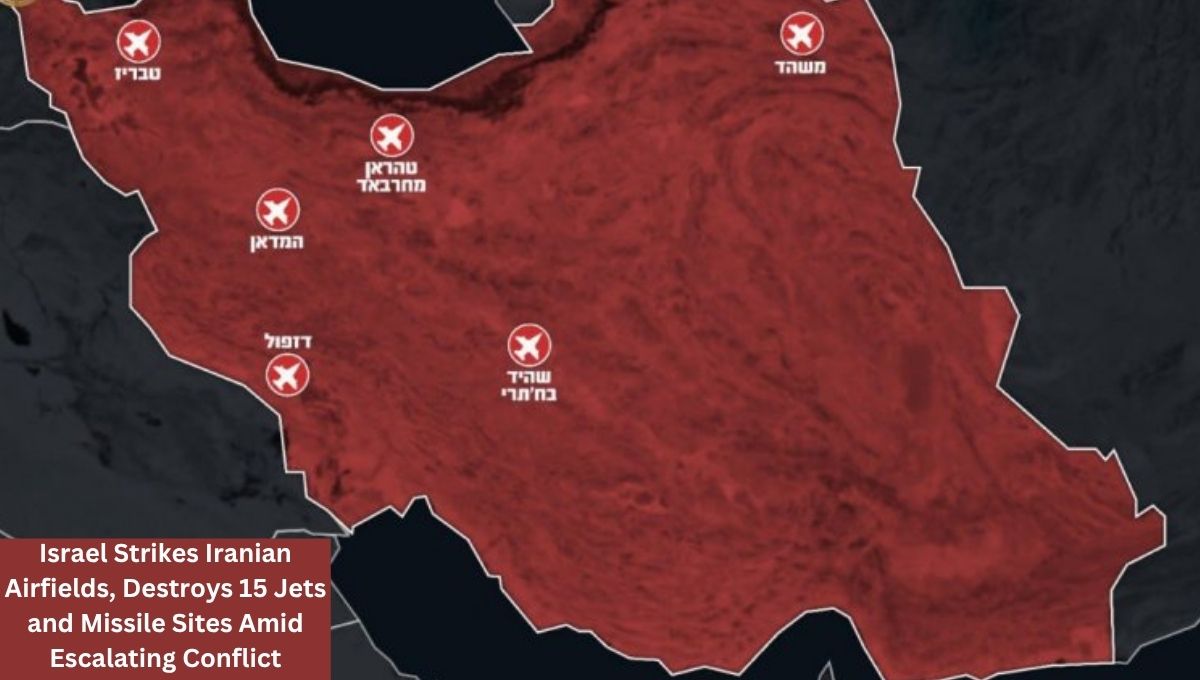
The war reaches new heights as Israel Strikes Iranian Airfields, Destroys 15 Jets and Missile Sites Amid Escalating Conflict. In a major escalation in the ongoing Iran-Israel conflict, the Israel Defense Forces (IDF) confirmed on Monday (June 23) that it had carried out precision airstrikes on at least six Iranian military airports, destroying 15 fighter jets and helicopters and crippling missile storage facilities.
The strikes, seen as a retaliatory move against Iran’s recent missile barrage on Tel Aviv and Haifa, mark the most intense round of aerial confrontation since the beginning of the regional crisis nearly two weeks ago.
Israel Strikes Iranian Airfields, Destroys 15 Jets and Missile Sites Amid Escalating Conflict
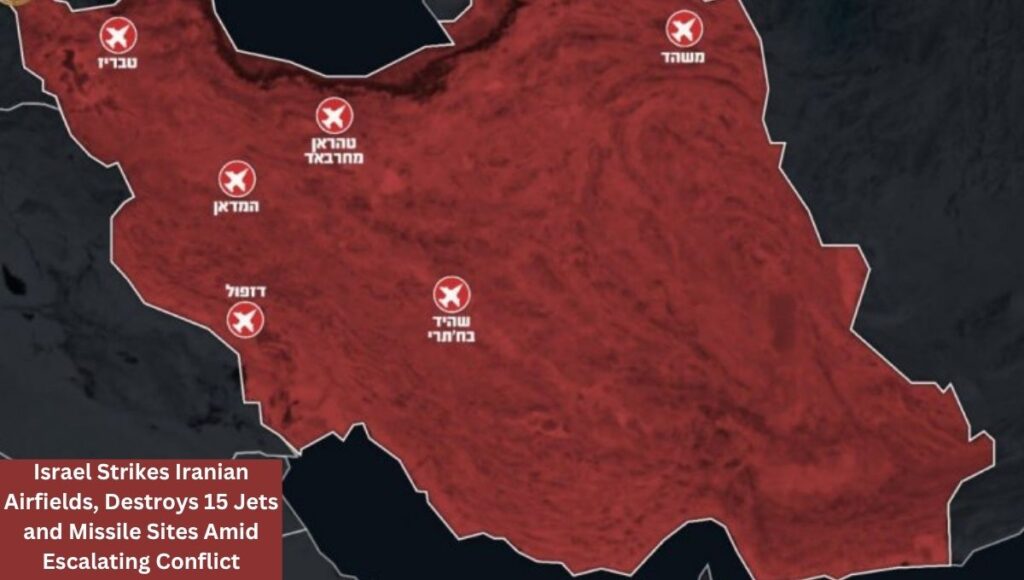
Precision Strikes Across Iran: Mehrabad, Mashhad, and Dezful Among Targets
The Israeli military announced that its jets struck airfields in Tehran (Mehrabad Airport), Mashhad, Dezful, and areas in western, eastern, and central Iran, including the Kermanshah and Hamedan provinces.
“The Air Force disrupted the ability to take off from these airports and the operation of the Iranian army’s air power,” the IDF stated on its official X account.
According to the IDF, runways, underground bunkers, refueling infrastructure, and key aircraft such as F-14s, F-5s, and AH-1 helicopters were targeted and destroyed. Israel claims these aircraft were positioned for use against Israeli targets in the event of further escalation.
Focus on Missile Storage and Launch Sites
Beyond the airfields, the Israeli military also struck surface-to-surface missile storage and launch facilities, especially in Kermanshah, from where recent missile launches had reportedly been directed at Israeli territory.
“Intelligence guidance from the Military Intelligence Service led to the destruction of several missile launch and storage sites,” read an IDF statement.
These strikes aim to cripple Iran’s short-term missile capabilities and establish Israeli air superiority over hostile Iranian skies.
Operation Escalates Following Iran’s Missile Attack on Israeli Cities
The dramatic escalation followed Iran’s missile attacks on Israeli cities, including Tel Aviv and Haifa, which were launched in retaliation for the US airstrikes on Iran’s nuclear sites the day before.
On Sunday, U.S. President Donald Trump declared that American bombers had delivered “monumental damage” to Iran’s nuclear facilities, including Fordow, Natanz, and Isfahan, using bunker-buster bombs.
Trump described the precision of the strikes as hitting the “bullseye,” but other U.S. officials were more cautious, saying it was too early to gauge the full impact on Tehran’s nuclear program.
IDF: Air Superiority Is the Goal
Israel’s latest wave of airstrikes is part of what it calls an effort to “deepen air superiority over Iranian airspace” and prevent Iran from launching further direct or proxy attacks.
“The IDF continues to intensify its attacks on the Iranian regime’s military capabilities and will continue to work to achieve air superiority in order to maintain the security of the State of Israel,” the military said in a follow-up statement.
The IDF revealed that over 20 fighter jets were involved in the air raids, deploying more than 30 munitions. Targets included radar installations, satellite surveillance systems, and missile command centers.
Iran Vows Retaliation: ‘Enemies Will Be Punished’
In response, Iran’s Supreme Leader Ayatollah Ali Khamenei issued a stern warning: “The enemies will face severe punishment for their reckless provocation.”
Iranian President Masoud Pezeshkian echoed the sentiment, calling the strikes on Iran’s nuclear facilities an “act of aggression” that must be answered.
“The United States must receive a response,” he said in a televised address, condemning both Washington and Tel Aviv for their “joint military assault” on Iranian sovereignty.
Deaths Reported in Israeli Drone Strike on Civilian Vehicle
Iranian state media also reported that an Israeli drone strike in Isfahan province targeted a civilian ambulance, killing three people on board, including a patient, a driver, and a companion.
Iran’s ISNA news agency quoted a local official as saying the vehicle was not a military target and labeled the incident as a violation of international law.
Defense Minister Katz: ‘Striking With Unprecedented Force’
Israeli Defense Minister Israel Katz issued a statement confirming the strikes, describing them as “unprecedented in force” and directly targeting “regime elements and repression bodies” in Tehran and elsewhere.
“For every missile fired at the Israeli home front, the Iranian dictator will be severely punished,” Katz said. “We will continue to act to defend the home front and defeat the enemy until all war objectives are achieved.”
Katz indicated that images of the destruction will be released soon, showcasing the depth of the damage caused by the airstrikes.
International Response: Calls for De-escalation
The global community is increasingly alarmed by the rapid escalation and the direct involvement of the United States in military operations against Iran.
UK Foreign Secretary David Lammy expressed serious concern during an interview on BBC Breakfast: “Let’s calm this thing down. I still believe diplomacy must and can prevail.”
Lammy revealed he had spoken to Iran’s foreign minister, urging Tehran to comply with international nuclear agreements and avoid further confrontation.
What’s Next: A Region on Edge
With both sides trading airstrikes and issuing threats of retaliation, the Middle East faces its most dangerous moment in years. The regional and global stakes are enormous:
- Oil prices have already started climbing, fearing a broader regional war.
- US forces in Iraq and the Gulf may become further entangled.
- Iranian proxies like Hezbollah and the Houthis could intensify attacks on Israel and its allies.
India, China, and European nations have called for restraint amid fears of global economic instability.
Conclusion: The Path to Escalation or Resolution
As Israel continues to pound Iranian targets with military precision and Iran vows decisive revenge, the road ahead looks perilous. What began as a cycle of provocation and response now teeters on the brink of a broader war involving multiple nations.
While Israel aims to eliminate immediate threats to its territory, and Iran seeks to defend its sovereignty and nuclear program, the fallout could be global. The coming days will determine whether this spiraling conflict finds a diplomatic off-ramp or crosses the threshold into full-scale war.
Also Read: Trump’s Iran Airstrikes Spark War Powers Fight as Lawmakers Push to Limit Military Action
Also Read: ‘The stars aligned’: Why Israel set out for a war against Iran, and what it achieved
Related Posts:
- 10 Explosive Strikes: Israel Bombs Tehran Oil Depots…

- 5 Major Takeaways from the US Supreme Court's…

- 7 Heartbreaking Facts About Venezuela's Earthquake Disaster
- 3 Explosive Conditions Iran Sets to End War with US…

- Israel–Hamas Ceasefire Under Strain: 4 More Hostage…

- Afghanistan–Pakistan War 2025: Inside the 48-Hour Ceasefire
