Iran’s supreme leader Khamenei Rejects U.S. Nuclear Proposal, Vows Iran Will Continue Uranium Enrichment. In a forceful speech on Wednesday, Iran’s Supreme Leader Ayatollah Ali Khamenei sharply criticized a new U.S. nuclear proposal, calling it “100 percent against” the principles of Iran’s 1979 Islamic revolution.
Although Khamenei did not entirely close the door on a potential agreement with the United States, he was unequivocal in rejecting any deal that would force Iran to give up uranium enrichment a key component of the country’s nuclear program. The comments come amid the sixth round of indirect nuclear talks between Iran and the U.S., aimed at reviving a broader agreement and easing decades-long tensions.
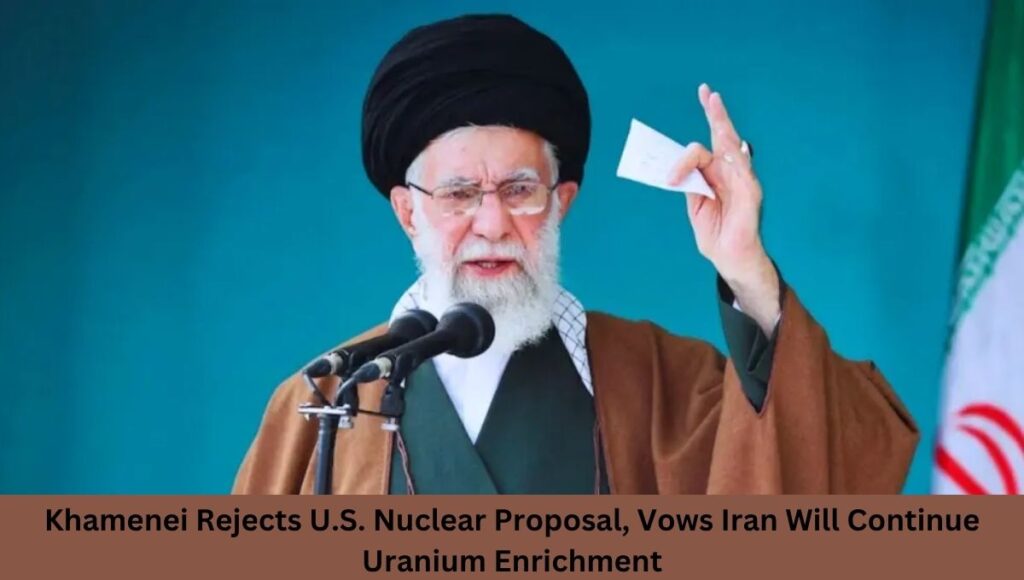
Khamenei Rejects U.S. Nuclear Proposal, Vows Iran Will Continue Uranium Enrichment
“We Will Not Beg America for Fuel”: Khamenei’s Defiant Stand
Ayatollah Khamenei framed the issue as one of national independence and pride. “If we had 100 nuclear power plants while not having enrichment, they are not usable for us,” he said. “If we do not have enrichment, then we should extend our hand (begging) to the US.”
Khamenei invoked the slogan “We Can” popularized by the Iranian government to emphasize self-reliance and insisted that uranium enrichment is essential to Iran’s sovereignty and scientific advancement.
He accused the U.S. of trying to dictate Iran’s future: “Independence means not waiting for the green light from America and the likes of America,” he said. “The rude and arrogant leaders of America repeatedly demand that we should not have a nuclear programme. Who are you to decide whether Iran should have enrichment?”
The U.S. Proposal: A Temporary Deal With Conditions
The proposal spearheaded by U.S. President Donald Trump’s envoy Steve Witkoff is being described as a temporary solution that would allow Iran to continue enriching uranium at low levels while a regional consortium is formed to supply nuclear fuel.
This consortium would be monitored by the International Atomic Energy Agency (IAEA) and would reportedly include the U.S., Saudi Arabia, and the UAE.
According to Axios and other U.S. media reports, Iran would eventually be required to cease all enrichment, dismantle enrichment facilities, and halt nuclear R&D in exchange for sanctions relief and access to peaceful nuclear energy.
President Trump emphasized the deal’s red lines: “Under our potential Agreement WE WILL NOT ALLOW ANY ENRICHMENT OF URANIUM!” he posted on Truth Social.
Iranian Officials Reject Terms as “Non-Starter”
Iranian officials have made it clear that the proposal, as it stands, is unacceptable. Foreign Minister Abbas Araghchi said, “Without respecting our right to enrich uranium, there will be no agreement.”
He added that Iran “will respond to the US proposal in line with the principles, national interests and rights of the people of Iran.”
A Reuters report quoting Iranian diplomats suggested that Tehran sees the proposal as a “non-starter,” particularly because it does not offer meaningful concessions on sanctions or acknowledge Iran’s enrichment rights.
Iran’s History of Distrust and the JCPOA Legacy
Many in Iran remain deeply skeptical of U.S. intentions, especially after President Trump withdrew from the Joint Comprehensive Plan of Action (JCPOA) in 2018, calling it a “horrible one-sided deal.” That move led to the re-imposition of crippling economic sanctions, which Iran says have devastated its economy.
Iran’s trust deficit with Washington is reflected in statements from President Masoud Pezeshkian, who reaffirmed Iran’s “scientific and nuclear rights,” while asserting that Tehran has no interest in developing nuclear weapons.
Tehran has long insisted that its nuclear program is peaceful. However, the IAEA recently reported that Iran has increased its stockpile of uranium enriched to 60% a level dangerously close to weapons-grade enough, it said, to produce several nuclear bombs if further refined.
Military Tensions Loom Over Diplomacy
Failure to reach an agreement could have severe consequences for regional and global stability. Trump has warned of “grave consequences” if Iran does not accept the U.S. offer. He has also reportedly given Iran a two-month deadline to respond.
In his recent speech, Trump stated, “Time is running out on Iran’s decision pertaining to nuclear weapons.” The warning echoes repeated threats from both the U.S. and Israel to carry out military strikes on Iranian nuclear facilities if diplomacy fails.
The situation is further complicated by ongoing tensions in the Middle East, particularly the Israel-Hamas conflict in Gaza. Analysts warn that failure to resolve the nuclear impasse could push the region toward a broader confrontation.
The Road Ahead: Will Iran and the U.S. Find Common Ground?
As Iran prepares to formally respond to the latest U.S. offer, many observers are questioning whether a viable middle ground exists. A “political deal” that allows for limited enrichment in return for frozen asset release and international monitoring has been floated but there is little sign of convergence between Tehran and Washington.
Iran’s chief negotiator, Abbas Araghchi, hinted at a possible compromise, but only if Iran’s fundamental rights are respected: “No enrichment, no deal. No nuclear weapons, we have a deal.”
The world watches closely as the sixth round of talks continues. With trust in short supply and stakes at an all-time high, the coming days may determine whether diplomacy or confrontation defines the next chapter in the Iran nuclear saga.
Conclusion
The conflict over uranium enrichment is more than just a technical dispute it is a reflection of deep ideological divides, historical grievances, and geopolitical calculations. As Iran’s Supreme Leader Ayatollah Ali Khamenei doubles down on the right to enrich uranium, and the Trump administration insists on zero enrichment, the path to a new nuclear deal remains uncertain.
The nuclear standoff is not just about centrifuges and uranium it’s about sovereignty, trust, and regional power dynamics. And unless both sides shift their red lines, the risk of escalation could soon overshadow the promise of diplomacy.
Also Read: Trump Declares ‘No Uranium Enrichment’ as Iran Nuclear Talks Falter
Also Read: Iran to present counterproposal for nuclear deal to US via Oman
Related Posts:
- 11 Explosive Warnings as Trump Vows to ‘Knock the…

- Iran Defiant on Nuclear Enrichment Despite US-Israel…
- 10 Explosive Warnings as Donald Trump Calls Iran…
- 7 Explosive Impacts of Trump’s 25% Iran Tariff on…
- 3 Explosive Conditions Iran Sets to End War with US…
- 7 Powerful Facts About Ayatollah Ali Khamenei’s…