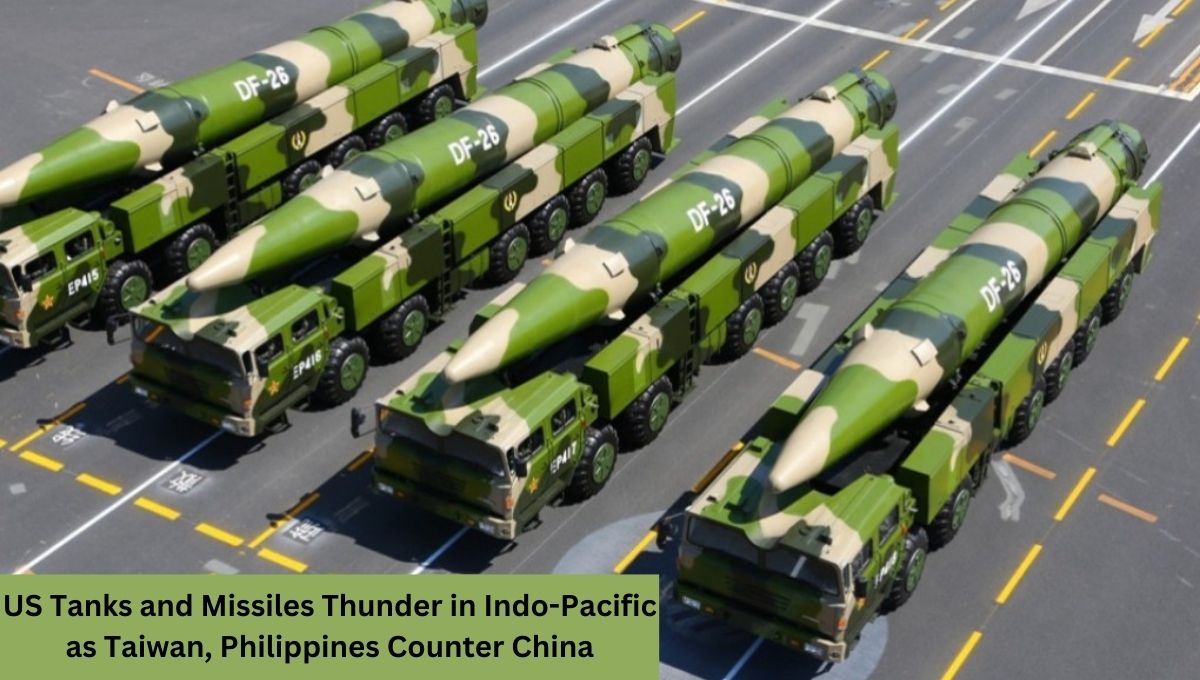
In a bold deterrent move, US Tanks and Missiles Thunder in Indo-Pacific as Taiwan, Philippines Counter China. Taiwan launched its annual Han Kuang military exercise on July 9, extending it to 10 days this year in response to growing Chinese military threats. These drills are focused on countering Beijing’s “grey zone” tactics, activities that fall just short of war but amount to serious aggression.
A highlight of the exercise was the deployment of US-origin M1A2T Abrams tanks, displayed in a live-fire exercise at a training ground in Hsinchu County. These powerful tanks navigated a rugged, muddy terrain and targeted both stationary and mobile threats.
President Lai Ching-te observed the drills and praised the tanks’ performance: “Every increase in the military’s combat power means our nation gains another layer of security.” He added that the M1A2T is “undoubtedly the strongest tank on the battlefield.”

US Tanks and Missiles Thunder in Indo-Pacific as Taiwan, Philippines Counter China
A Strategic Upgrade to Counter China
The arrival of the Abrams tanks signals a major boost to Taiwan’s ground capabilities. The first batch of 38 tanks arrived in December 2024, with additional shipments expected through 2026 to complete the 108-unit order.
While Taiwan traditionally focuses on asymmetric warfare, military analysts stress the importance of conventional ground power.
In the event of a Chinese amphibious assault, these tanks could play a decisive role in defending key terrain and countering PLA armored units.
Taiwan’s current tank fleet, consisting of M60A3s and CM-11s, is outdated. The M1A2T represents a transformative upgrade that improves not just firepower but integration with drone and electronic warfare systems.
Combining Modern Armor with Tech-Forward Tactics
Though the Abrams live-fire exercise was not officially part of the core Han Kuang drills, it aligns with Taiwan’s evolving military doctrine.
President Lai emphasized that modern warfare must blend traditional armor with drone operations and innovative tactics.
This integration could prove critical in countering China’s growing use of low-cost, expendable drones, which pose a major threat to large armor systems.
The Philippines Positions NMESIS Near Taiwan Strait
While Taiwan showcased its US-supplied hardware, the Philippines took its turn as a key regional ally by hosting the American Navy-Marine Expeditionary Ship Interdiction System (NMESIS) during Balikatan 2025.
The annual Balikatan military drills, which ended in May, saw unprecedented deployment of high-end US systems to Northern Luzon and the Batanes Islands territories that lie within striking distance of Taiwan and the strategic Bashi Channel.
The NMESIS system, capable of destroying surface ships at ranges up to 100 nautical miles, adds a formidable deterrent against Chinese naval aggression.
Though the US Pacific Fleet initially reported a missile launch, it later clarified that no actual firing occurred.
Balikatan 2025: A Show of Force in China’s Backyard
Balikatan 2025 was the largest-ever joint drill between the US and the Philippines. It sent a strong message to China, especially as tensions rise in the South China Sea.
The NMESIS system, alongside the Typhon missile system, marks a new era of defense cooperation between Manila and Washington.
Although the NMESIS did not launch a missile, its deployment to Bashi Channel’s periphery is telling.
This narrow strait between Taiwan and the Philippines is a key chokepoint for Chinese naval forces. Any conflict scenario would likely see the PLA attempting to control this vital corridor.
Will the US Missile Systems Remain?
While official statements haven’t confirmed permanent deployment, Philippine Navy spokesperson Capt. John Alcos confirmed that the NMESIS system remains in the country for now and will be used for training by the Philippine Marine Corps.
It remains unclear whether the NMESIS will be withdrawn or if it will stay on a rotational or semi-permanent basis similar to the US Typhon system previously stationed in the Philippines.
Escalating PLA Incursions: Taiwan Responds
As Taiwan ramps up its drills and weapon acquisitions, China has continued aggressive incursions. Taiwan’s Ministry of National Defence (MND) reported that on July 13, 14 PLA aircraft, nine naval vessels, and one official ship were detected around the island.
Of particular concern, nine aircraft crossed the median line an unofficial but respected boundary in the Taiwan Strait and entered Taiwan’s northern and eastern Air Defence Identification Zone (ADIZ).
In response, Taiwan scrambled jets, mobilized naval assets, and deployed coastal missile systems to monitor and counter the threat.
Taiwan’s Lai Warns of Prolonged China Pressure
President Lai has been vocal about the long-term threat posed by Beijing. In a speech on June 28, he warned that China’s campaign of influence warfare and military intimidation is part of a broader goal to annex Taiwan and expand Chinese hegemony in the Indo-Pacific.
Speaking at the Democratic Progressive Party (DPP) national congress, Lai underscored the need for national unity in defending Taiwan’s sovereignty, accusing the opposition-controlled legislature of undermining democratic governance through procedural overreach and budget cuts.
Civil Society: Taiwan’s Democratic Shield
Lai also credited Taiwan’s active civil society with maintaining the island’s democratic resilience. He invoked the Wild Lily protests of 1990 and the 2014 Sunflower movement as evidence of Taiwanese resolve to resist Chinese influence.
“Better democracy, better Taiwan” was the theme of the DPP congress, emphasizing the centrality of civic participation and national identity in Taiwan’s strategic vision.
Conclusion: Regional Flashpoint Reignites
Taiwan and the Philippines are on the frontlines of growing regional tensions, and both nations are stepping up their defense postures with strong US backing. From Abrams tanks in Taiwan to NMESIS systems in the Philippines, the Indo-Pacific is becoming a proving ground for 21st-century deterrence strategies.
As Beijing continues its pressure campaigns, these joint military displays may serve as both a warning and a strategic recalibration of regional balance. The message is clear: aggression will be met with resistance, backed by advanced firepower and international alliances.
Also Read: Trump faces global backlash over the Pentagon’s halt of weapons to Ukraine
Also Read: US Sends F-35 Stealth Jets to the Philippines for the First Time