US Government Shutdown 2025: Trump’s Shutdown Gamble Risks $400M Daily Losses and could be the most dangerous shut down in History. The United States government entered a shutdown on Wednesday, unleashing political and economic turmoil across the nation. President Donald Trump, however, has framed the crisis not as a failure, but as a rare opportunity to slash “dead wood, waste, and fraud” from the federal workforce.
But with $400 million in wages lost daily, 750,000 federal workers furloughed, and critical infrastructure projects halted, this government shutdown could be the most damaging in American history.
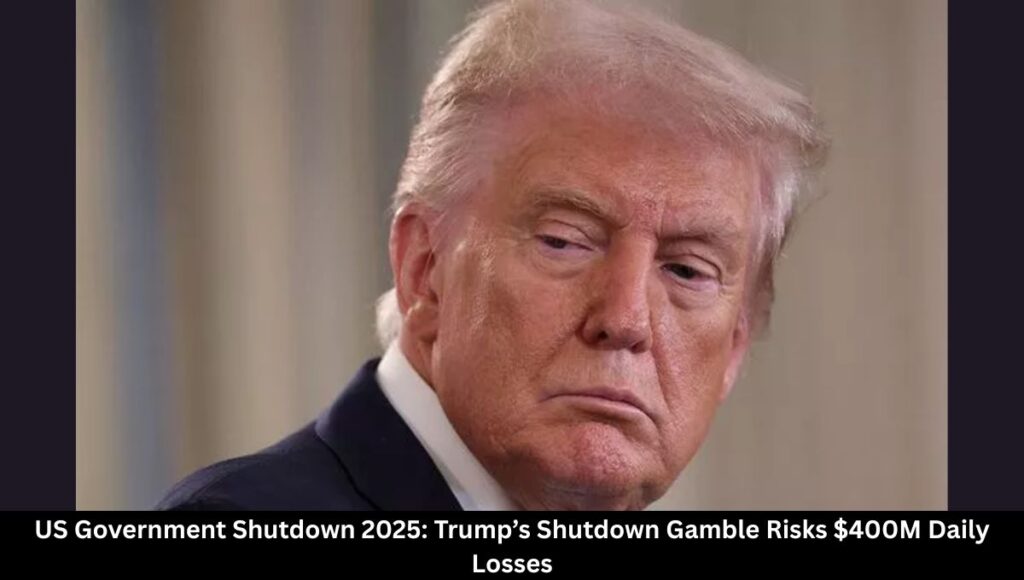
US Government Shutdown 2025: Trump’s Shutdown Gamble Risks $400M Daily Losses
Trump Calls Shutdown a “Democrat-Forced Closure”
Speaking on Truth Social, President Trump blamed Democrats for the standoff, posting:
“Republicans must use this opportunity of Democrat forced closure to clear out dead wood, waste, and fraud. Billions of Dollars can be saved. MAKE AMERICA GREAT AGAIN!”
By branding the shutdown as a political tool, Trump has signaled he intends to use the crisis to push for long-term structural changes in government operations. Unlike past shutdowns, where workers were furloughed temporarily, his administration has openly floated the possibility of mass layoffs.
White House Press Secretary Karoline Leavitt warned that layoffs were “imminent,” underscoring the administration’s combative approach.
Also Read: US Government Shutdown 2025: Why It Happened, Costs, and Political Fallout
The Human Cost: $400 Million Lost Daily
According to the Congressional Budget Office (CBO), the shutdown is costing federal employees approximately $400 million per day in lost wages.
- 750,000 federal workers could be furloughed daily.
- Essential workers, including TSA agents, border patrol, and military personnel, may continue working without pay until the shutdown ends.
- Paychecks missed in October could push thousands of families into financial crisis.
With the shutdown deepening, delays at airports, suspended federal services, and frozen aid programs are beginning to bite.
Infrastructure Funds Frozen: $18 Billion Targeted
In one of the most controversial moves so far, the Office of Management and Budget (OMB) announced a freeze on $18 billion earmarked for New York infrastructure projects, including the Hudson Tunnel and NYC subway upgrades.
These projects are considered critical to the state’s economy and have been top priorities for Senate Majority Leader Chuck Schumer and House Democratic Leader Hakeem Jeffries.
By targeting projects in Democratic strongholds, Trump is weaponizing the shutdown to exert political pressure.
Why This Shutdown Is More Dangerous Than Ever
The 2025 shutdown is not just about budget numbers—it’s about the future shape of the federal government. Trump and allies have described it as an opportunity to make “irreversible cuts” to programs favored by Democrats.
Vice President JD Vance hinted at the GOP’s leverage during a White House briefing:
“We’re willing to have a conversation about ensuring that Americans continue to have access to health care.”
But Democrats remain firm: no funding bill will pass without guarantees to preserve healthcare subsidies under the Affordable Care Act (Obamacare).
Congress Gridlocked Amid Yom Kippur Break
Despite the crisis, Congress remains at a standstill. Lawmakers left Washington for the Jewish holy day of Yom Kippur:
- The Senate will reconvene Friday.
- The House won’t resume until next week.
- No immediate negotiations are planned.
This delay underscores the political gridlock that has made shutdowns increasingly common.
A Look Back: Past US Government Shutdowns
Shutdowns are not new, but each has carried its own political battles:
- 2013 Shutdown (16 days): Led by Senator Ted Cruz and House Republicans to dismantle Obamacare. The effort failed.
- 2018 Shutdown (3 days): Democrats demanded protections for “Dreamers.” It ended with no permanent immigration deal.
- 2018-2019 Shutdown (35 days): Trump demanded border wall funding. It became the longest shutdown in US history and ended without wall money.
The current 2025 shutdown, however, stands apart: its scale, threats of permanent layoffs, and partisan intensity make it far more dangerous.
Trump’s Past Words Haunt Him: “A Shutdown Falls on the President”
As the shutdown unfolds, old quotes from Donald Trump have resurfaced—and they contradict his current stance.
In 2013, during the Obama-era shutdown, Trump told Fox News:
“A shutdown falls on the president’s lack of leadership. I mean the top, and they have to get solved from the top. A shutdown means the President is weak.”
He repeated similar sentiments in interviews that year, insisting the President must lead negotiations and bear the responsibility for government closures.
Back in 2011, he had said:
“If there is a shutdown, I think it would be a tremendously negative mark on the president of the United States.”
Now, more than a decade later, Trump faces his own words being used against him.
Trump Unleashes Social Media Barrage
Instead of behind-the-scenes negotiations, Trump is fighting the shutdown online.
On Truth Social, he has:
- Accused Democrats of “giving your healthcare money to illegal aliens.”
- Posted memes mocking Chuck Schumer and Hakeem Jeffries.
- Shared doctored videos with partisan imagery, including Jeffries in a sombrero set to mariachi music.
- Teased “Trump 2028” campaign hats, hinting at his interest in a third presidential term.
Even the White House press office has joined in, sending auto-replies blaming Democrats for “staff shortages from the Democrat Shutdown.”
Critics call the approach callous and unserious, but Trump’s team views it as sharp-edged political branding.
Public Opinion: Who Gets the Blame?
Polls suggest Trump may face political backlash:
- A New York Times/Siena poll found slightly more voters were ready to blame Republicans than Democrats.
- A Washington Post survey showed 47% blamed Trump and Republicans, while only 30% blamed Democrats.
This echoes the 2018-2019 shutdown, when Trump’s approval dropped as unpaid federal workers protested.
The Stakes Ahead
As the shutdown drags on:
- Federal workers face mounting hardship.
- Healthcare funding remains the central sticking point.
- Infrastructure projects in Democratic states risk collapse.
- Public patience may wear thin, pressuring Congress to strike a deal.
But Trump sees a longer-term opportunity. By framing the crisis as a fight to cut “waste, fraud, and dead wood”, he is signaling that this shutdown is not a temporary standoff—it’s a battle for the very structure of the federal government.
Whether this gamble pays off, or backfires like the 2019 shutdown, remains to be seen.
Conclusion
The US Government Shutdown of 2025 is already one of the most consequential in American history. President Trump’s strategy of leveraging the closure to force permanent structural changes—from layoffs to infrastructure freezes—marks a break from past shutdowns.
But the human cost, estimated at $400 million lost daily, is staggering. As federal workers brace for missed paychecks and vital services stall, the political blame game intensifies. History has shown that shutdowns often end with political damage to those perceived as responsible.
Whether Trump escapes that fate—or confirms his own 2013 warning that shutdowns reflect “a president’s lack of leadership”—will depend on how long this standoff drags on.