
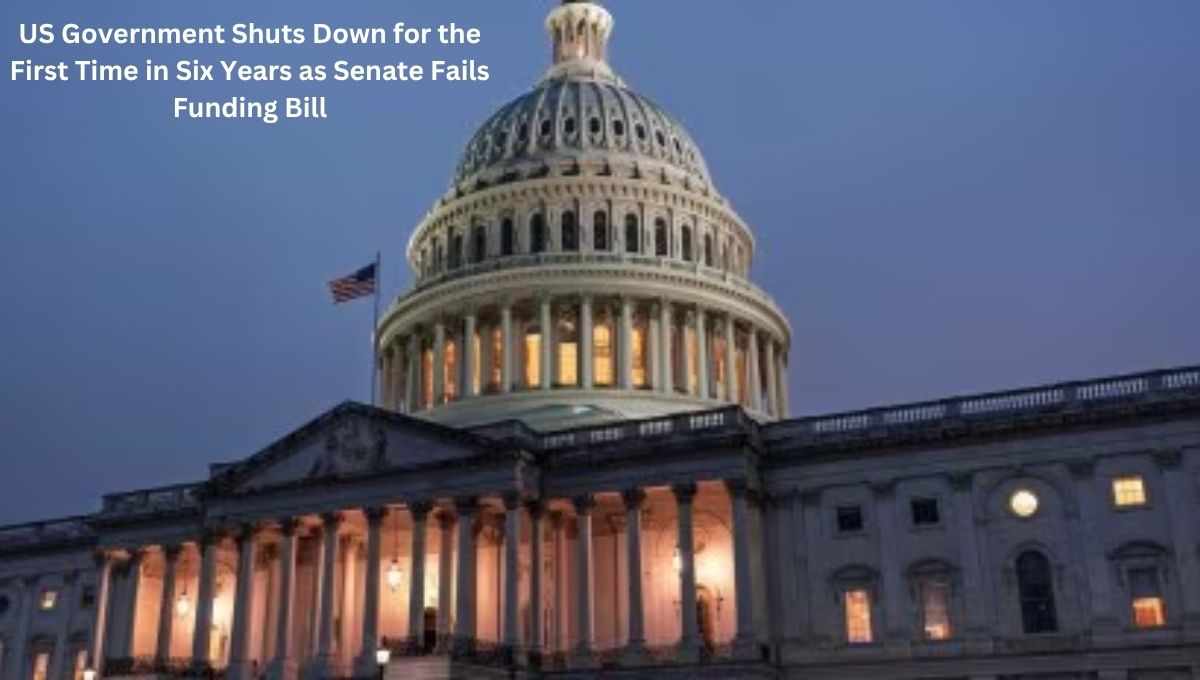
Amid threats of federal employee layoffs, US Government Shuts Down for the First Time in Six Years as Senate Fails Funding Bill. The United States government shut down much of its operations at 12:01 a.m. on Wednesday after lawmakers failed to reach a deal to keep federal agencies running. It is the first shutdown in six years and marks the 15th shutdown since 1981.
The Senate rejected rival stopgap funding bills late Tuesday in back-to-back votes, leaving the government without money to function. The impasse, centered on healthcare subsidies and Trump’s Medicaid cuts, has plunged Washington into political chaos and threatens to disrupt daily life across the nation.
President Donald Trump, far from easing tensions, raised the stakes by threatening mass layoffs of federal workers if Democrats refused to cave.
US Government Shuts Down for the First Time in Six Years as Senate Fails Funding Bill
How the Shutdown Happened: A Senate Deadlock
The Senate vote was the breaking point. A Republican bill to extend funding until November 21 failed 55–45, falling short of the 60 votes needed. Hours later, Democrats’ proposal to fund the government through October — with $1 trillion in healthcare provisions — failed 47–53.
Key swing senators crossed party lines:
- Two Democrats (John Fetterman of Pennsylvania and Catherine Cortez Masto of Nevada) and Independent Angus King voted with Republicans.
- No Republicans backed the Democratic bill.
Without agreement, the government’s legal authority to spend money expired at midnight, triggering the shutdown.
This deadlock highlights the razor-thin margins in Congress and the deep partisan divide over healthcare and spending priorities.
Also Read: Why government shutdowns seem to only happen in the US
Trump’s Hardline Stance: “We’ll Be Laying Off a Lot of People”
Instead of calming fears, President Trump escalated them.
Speaking at the White House, he warned:
“We’ll be laying off a lot of people. They’re going to be Democrats. We can do things during the shutdown that are irreversible, that are bad for them and irreversible by them, like cutting vast numbers of people out, cutting things that they like, cutting programs that they like.”
Trump’s comments stunned many, as past shutdowns traditionally led to temporary furloughs with back pay, not permanent layoffs. Federal worker unions denounced the remarks as intimidation.
Everett Kelley, president of the American Federation of Government Employees (AFGE), said:
“Federal employees are not bargaining chips. The president’s threats are unprecedented and cruel.”
Legal experts note that while the administration has leeway in defining “essential” and “non-essential” services, mass permanent layoffs would face serious legal hurdles.
The Stakes: Who Keeps Working, Who Doesn’t
As in past shutdowns, federal agencies activated contingency plans.
Essential Workers (Unpaid but Still on Duty):
- Military personnel
- Border Patrol agents
- Federal law enforcement officers
- Air traffic controllers
- Power grid operators
Furloughed Workers (Not Allowed to Work):
- Education Department: 90% of staff
- EPA: Pollution cleanups halted
- Small Business Administration: Loan approvals frozen
- Labor Department: Monthly jobs report suspended
Public Impact:
- Smithsonian museums and National Zoo: Closed
- National Parks: Likely locked gates or minimal staff
- Scientific research: Frozen mid-project
- Economic data releases: Delayed — including Friday’s crucial jobs report
Altogether, 750,000 federal workers are furloughed, costing the government about $400 million per day.
Also Read: Trump, Democrats Face High-Stakes Government Shutdown Showdown Over Healthcare and Power Struggle
Healthcare at the Heart of the Fight
At the center of the stalemate is healthcare funding.
Democrats insist the funding bill must include:
- Extension of subsidies under the Affordable Care Act (ACA), set to expire this year.
- Reversal of Medicaid cuts included in Trump’s “One Big Beautiful Bill Act” passed earlier this summer.
Republicans accuse Democrats of holding the budget hostage, arguing that healthcare should be addressed separately.
Senate GOP Leader John Thune said:
“The far left’s determination to oppose everything President Trump has said or done is not a good reason to subject the American people to the pain of a government shutdown.”
But Democrats counter that without subsidies, 24 million Americans could see their premiums rise, especially in red states like Florida and Texas.
A Familiar Crisis: Shutdowns in US History
The US has experienced 15 shutdowns since 1980.
- The most recent was in 2018–2019, lasting 35 days — the longest in history.
- That shutdown cost the US economy $3 billion in lost GDP, according to the Congressional Budget Office.
- Past shutdowns were often short-lived, lasting days or weeks, but political polarization has made them longer and more damaging.
This latest lapse is the first full shutdown since 2018, as Congress has failed to pass any of the 12 appropriations bills required to fund the government.
Trump’s Strategy: A Shutdown as Political Weapon
Unlike past presidents, Trump is openly framing the shutdown as a tool to shrink government.
The OMB Memo
A leaked memo from the Office of Management and Budget (OMB) instructed agencies to “consider” sending layoff notices to staff whose jobs do not align with “the president’s priorities.”
This suggests Trump may use the shutdown to permanently cut federal agencies, a move critics say would violate civil service protections.
Richard Painter, former ethics lawyer under President George W. Bush, said:
“Some of what he is threatening, he may be able to do, but much of it is not authorized by Congress, including firing federal workers with civil service job protection.”
Economic Fallout: Markets, GDP, and Services
Economists warn the shutdown could quickly damage the US economy.
- GDP Growth: A one-week shutdown could shave 0.2 percentage points off quarterly GDP growth.
- Markets: Investors dislike uncertainty, especially without access to economic data like jobs reports.
- Households: Unpaid workers may miss mortgage payments and bills, rippling through the economy.
Carl Weinberg of High Frequency Economics cautioned:
“If there are layoffs this time, the path back to a functioning government will be longer and rockier.”
The Politics: Blame and Brinkmanship
Both parties are blaming each other:
- Democrats: Accuse Republicans of bullying and holding healthcare hostage. Chuck Schumer said:
“It’s only the president who can do this. We know he runs the show here.”
- Republicans: Say Democrats are playing politics ahead of the 2026 midterms. Thune told Fox News:
“This was all unnecessary. This was all done to satisfy their left political base.”
Inside the White House, aides privately argue that a shutdown could strengthen Trump politically if he can frame Democrats as responsible for the chaos.
How Does a Government Shutdown End?
The process is straightforward, but politically messy:
- Congress must pass appropriations bills.
- The President must sign them into law.
- Only then does funding resume, and workers return.
The president cannot unilaterally end a shutdown. Both the House and Senate must agree on the terms — something that looks increasingly unlikely in the short term.
Comparisons to 2018: Lessons Learned
The last shutdown, from December 22, 2018, to January 25, 2019, lasted 35 days.
- Triggered by Trump’s demand for border wall funding.
- Ended only after mounting public anger and unpaid TSA workers causing airport chaos.
- Demonstrated that shutdowns often backfire politically.
But Trump appears more willing than ever to push the limits, suggesting he views this as an opportunity to reshape government permanently.
The Human Cost: Federal Workers on the Line
For workers, the shutdown means paychecks vanish overnight.
- Furloughed workers are barred from working, even voluntarily.
- Essential staff work without pay until Congress acts.
- Families face immediate financial strain, with no guarantee of back pay if Trump pushes layoffs instead of temporary furloughs.
“It interrupts the longer-term investments that are necessary to make our government run over time,” said Max Stier, head of the Partnership for Public Service.
The Road Ahead: Chaos or Compromise?
With no clear path forward, uncertainty looms:
- Republicans plan to retry their stopgap bill later this week, hoping a few Democrats will switch.
- Democrats insist healthcare subsidies must be included.
- Trump appears determined to use the crisis to weaken federal agencies and intimidate opponents.
Analysts expect mounting public anger — especially if paychecks are missed in two weeks — could force a deal.
Until then, America faces a partial paralysis of government with ripple effects across society.
Conclusion: Shutdown Politics in an Era of Polarization
The 2025 US government shutdown underscores the deep partisan gridlock in Washington. Unlike past shutdowns, President Trump has openly threatened to use the crisis not just as leverage, but as a weapon to dismantle parts of the federal government.
While Social Security checks will still go out and Medicare continues, hundreds of thousands of workers are in limbo, services are frozen, and the economy is at risk.
The big question now:
Will Congress reach a compromise, or will Trump turn the shutdown into a prolonged test of political will — with American workers and families caught in the crossfire?


