
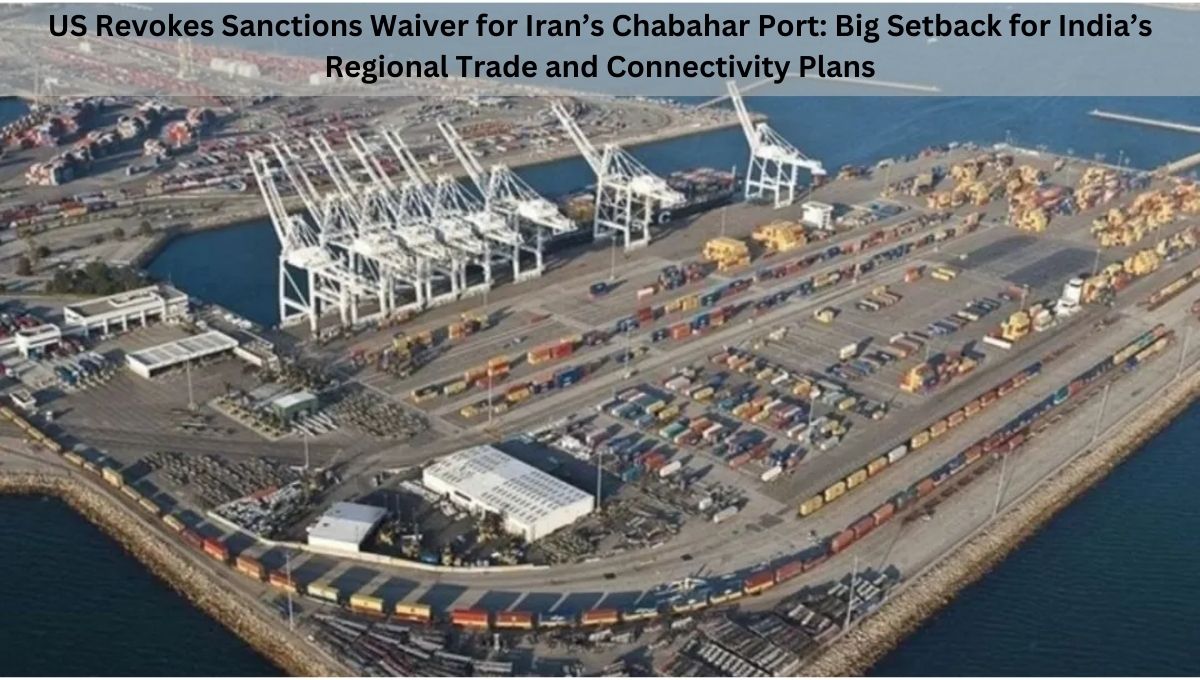
US Revokes Sanctions Waiver for Iran’s Chabahar Port: Big Setback for India’s Regional Trade and Connectivity Plans also exposing Indian operators to penalties under IFCA. The United States has revoked the sanctions waiver it granted in 2018 for Iran’s Chabahar Port, a move that threatens India’s multi-billion-dollar regional connectivity ambitions. Effective September 29, 2025, the decision means that Indian operators, investors, and contractors working at the strategic port may now be exposed to penalties under the Iran Freedom and Counter-Proliferation Act (IFCA).
For New Delhi, this development represents a significant diplomatic and economic blow. India views Chabahar as its gateway to Afghanistan, Central Asia, and Europe, bypassing Pakistan, and as a counterweight to China’s presence at Pakistan’s Gwadar Port.

US Revokes Sanctions Waiver for Iran’s Chabahar Port: Big Setback for India’s Regional Trade and Connectivity Plans
What is the Chabahar Port Project?
Located in Sistan-Balochistan province on Iran’s southern coast, the Chabahar Port is just 140 km from Gwadar, the Pakistani port run by China under the Belt and Road Initiative (BRI).
For India, Chabahar is more than just a port—it is a strategic lifeline. Since as early as 2003, New Delhi has pushed for the port’s development as part of its long-term strategy to access landlocked Central Asia and Afghanistan without relying on Pakistan.
Key highlights of the project include:
- India operates the Shahid Beheshti terminal through Indian Ports Global Limited (IPGL).
- In May 2024, India signed a 10-year operating agreement with Iran’s Port and Maritime Organisation.
- India committed $120 million in direct investments and offered an additional $250 million credit line for infrastructure.
- The port is a critical node of the International North-South Transport Corridor (INSTC), linking India with Iran, Russia, and Europe.
The port has also been used for humanitarian and trade purposes, including:
- Shipping 20,000 tonnes of wheat aid to Afghanistan in 2023.
- Exporting eco-friendly pesticides to Iran in 2021.
- Facilitating essential supplies to Afghanistan during US sanctions on Tehran.
Why Did the US Revoke the Waiver?
The waiver was first issued in 2018, when the Trump administration reimposed sanctions on Iran but allowed limited exceptions for Chabahar. The rationale was that the port would help Afghanistan’s reconstruction and provide New Delhi with an alternative trade corridor.
However, the US State Department has now said the waiver no longer applies, citing three major reasons:
- Trump’s “Maximum Pressure” Policy
- The revocation is “consistent with President Donald Trump’s maximum pressure campaign to isolate the Iranian regime.”
- Concerns About Iran’s Financial Networks
- The US Treasury recently sanctioned Iranian networks in Hong Kong and the UAE tied to the Islamic Revolutionary Guard Corps (IRGC), accusing them of financing Tehran’s military activities.
- Shift in Afghanistan Context
- With the Taliban back in power since 2021, US officials argue that Chabahar no longer plays the same role in supporting Afghanistan’s reconstruction under an elected government.
In a strongly worded statement, the US warned:
“Once the revocation is effective, persons who operate the Chabahar Port or engage in other activities described in IFCA may expose themselves to sanctions.”
India’s $370 Million Investment at Risk
India’s investment at Chabahar now faces serious challenges:
- $120 million direct funding by IPGL is immediately exposed to sanctions risks.
- The $250 million credit facility for railway and infrastructure development may not materialize.
- Expansion plans to increase capacity to 500,000 TEUs and build 700 km of rail links to Zahedan are jeopardized.
For Indian companies involved, the uncertainty raises concerns of:
- Possible secondary sanctions from Washington.
- Disruptions in financing and insurance.
- Suspension of ongoing contracts and projects.
Strategic Importance of Chabahar for India
Chabahar is not just about trade; it carries deep geopolitical weight for India:
1. Bypassing Pakistan
India sees Chabahar as its only viable route to Afghanistan and Central Asia without going through Pakistan, which has blocked Indian access.
2. Counter to China’s Gwadar
With Gwadar only 140 km away, Chabahar offers New Delhi a strategic counterbalance to Beijing’s growing presence in the Arabian Sea.
3. Part of INSTC
The port integrates India into the International North-South Transport Corridor, a 7,200 km multi-modal trade route connecting Mumbai to Moscow via Iran and the Caspian Sea.
4. Energy Security & Rare Earth Access
Chabahar provides India an alternative channel for energy imports from Iran and Central Asia, while offering potential access to rare earth elements.
5. Humanitarian Corridor
The port has played a key role in delivering aid to Afghanistan during humanitarian crises.
Why the Timing Matters
The revocation of the waiver comes at a diplomatically sensitive moment for India:
- India and the US had just resumed stalled trade talks on September 16.
- The same day, Washington announced the end of the waiver.
- India is also balancing ties with Iran, Israel, the Gulf states, and the US—all of whom have competing interests in the region.
Adding to the pressure:
- The US has imposed a 50% duty on Indian labor-intensive goods since August 27, risking $86.5 billion worth of exports.
- New Delhi is also under pressure from Washington to reduce oil imports from Iran and Russia.
Expert Views on the Impact
Dr. Amit Singh, JNU (National Security Studies):
“When sanctions were reimposed in 2018, the US made a rare exception for Chabahar because of Afghanistan. That rationale no longer applies, and India must now either seek another waiver or rethink its strategy.”
Former Ambassador Ranjit Suri:
“This is a diplomatic setback for New Delhi. India must negotiate with both Washington and Tehran to keep its investment safe. Otherwise, Chabahar could slip out of India’s hands, weakening its regional leverage.”
Strategic Analysts:
- Some argue that India could increase engagement with Russia and Iran to bypass US pressure.
- Others caution that ignoring US sanctions risks jeopardizing Indo-US defense and technology ties.
Also Read: Opportunities and Challenges: The Importance of Chabahar Port
How Has Iran Reacted?
Iran has welcomed India’s investment in Chabahar and sees it as part of its broader connectivity strategy.
- Tehran has assured New Delhi that it will protect Indian interests in the project.
- However, without US waivers, international financing and insurance for Chabahar will be difficult.
- Iran’s leadership has framed the move as proof of Washington’s unreliable policy shifts.
Will India Abandon Chabahar?
Despite the sanctions risk, experts believe India is unlikely to walk away:
- Long-Term Investment
- India has already spent over $120 million and signed a 10-year contract.
- Strategic Calculations
- Walking away would cede ground to China, which could expand its presence in Chabahar.
- Diplomatic Leverage
- India may push for a fresh waiver, arguing that the port benefits regional trade and stability.
- Geopolitical Balancing
- New Delhi could attempt to navigate a middle path, maintaining work at Chabahar while avoiding open confrontation with Washington.
Chabahar vs Gwadar: The Regional Contest
| Feature | Chabahar (India-Iran) | Gwadar (China-Pakistan) |
| Location | Iran’s southern coast | Pakistan’s Balochistan coast |
| Operator | Indian Ports Global Ltd. | China Overseas Port Holding Co. |
| Strategic Aim | Access to Central Asia bypassing Pakistan | Part of China’s Belt & Road Initiative |
| Distance | 140 km apart | 140 km apart |
| Backers | India & Iran | China & Pakistan |
The two ports symbolize the India-China rivalry in the Indian Ocean and Central Asia. Losing space at Chabahar would undermine India’s ability to counterbalance China in the region.
What Happens Next?
The revocation of the waiver raises several key questions:
- Will India negotiate a new waiver with Washington?
- Can New Delhi protect its companies from secondary sanctions?
- Will Iran offer additional guarantees or concessions to India?
- Could China exploit the situation to expand into Chabahar?
For now, India has not issued an official response. The Ministry of External Affairs has repeatedly described Chabahar as a “vital connectivity project” and may continue lobbying Washington for a special exemption.
Conclusion: A Diplomatic Balancing Act
The US decision to revoke the 2018 sanctions waiver for Chabahar Port places India in a difficult spot. On one hand, New Delhi cannot afford to abandon its $370 million investment and 10-year agreement. On the other, it risks alienating its most powerful partner, the United States.
Chabahar has always been more than a port—it is India’s attempt to rewrite regional trade geography by bypassing Pakistan and countering China’s Gwadar. Losing operational space here could weaken India’s long-term strategy in South Asia, Central Asia, and the Indian Ocean. The coming months will reveal whether India can successfully balance ties with Washington and Tehran or whether Chabahar becomes another casualty of great power rivalry in the region.
Also Read: Iran, European Powers Set to Resume Nuclear Talks Amid Sanctions Threat
Related Posts:
- 7 Powerful Measures: Trump Sanctions Russian Oil…

- In 8 Moves, EU Targets China-Linked Refineries and…

- Trump Honors Late Activist Charlie Kirk With…

- Afghanistan–Pakistan War 2025: Inside the 48-Hour Ceasefire

- 11 Explosive Revelations From Ted Cruz’s Leaked…

- 5 Key Shifts in Bangladesh–Pakistan Relations as…
