

A geopolitical shift in the approach to the region, Trump’s $2 Trillion Gulf Tour: Real Diplomatic Wins or Political Theater? In his first foreign trip since re-entering the White House, President Donald Trump embarked on a whirlwind tour of three Gulf states – Saudi Arabia, Qatar, and the UAE.
His three-day visit was packed with announcements of massive investment deals, new defense and tech agreements, and diplomatic overtures to former adversaries like Syria and Iran. Dubbed a “historic” moment by Gulf leaders and Trump allies, the tour is already reshaping how US foreign policy is viewed in the Middle East.
But the $2 trillion question remains:
Was this truly a game-changing diplomatic breakthrough, or just a spectacle of high-level political theater?
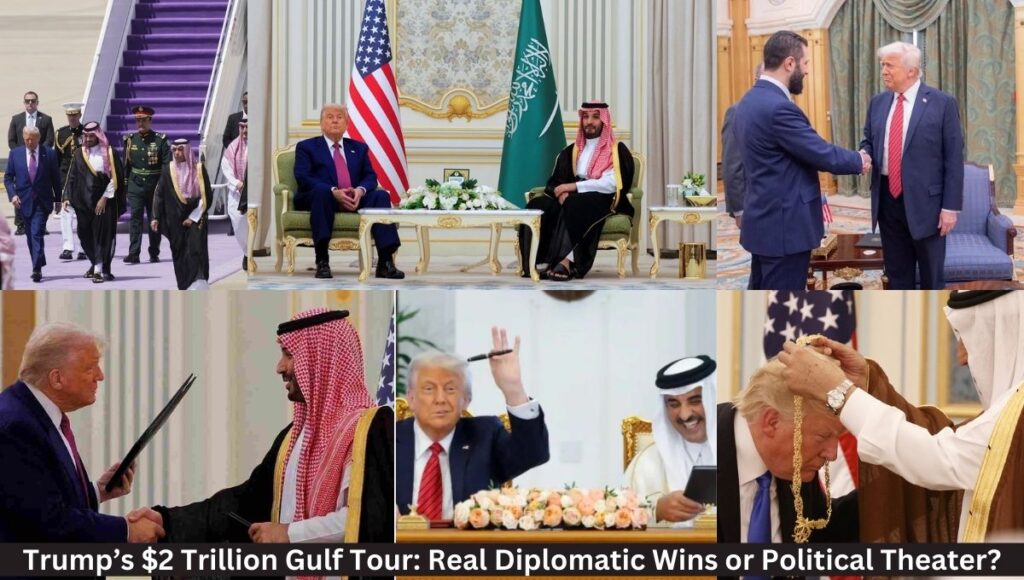
Trump’s $2 Trillion Gulf Tour: Real Diplomatic Wins or Political Theater?
Saudi Arabia: Big Deals, Bigger Ambitions
Trump’s first stop was Riyadh, where he and Crown Prince Mohammed bin Salman unveiled $600 billion in economic and defense agreements.
These included $142 billion earmarked for new military partnerships and large-scale infrastructure investment.
While a formal US-Saudi defense treaty remains elusive, both parties declared “strong progress” toward deeper bilateral security ties.
Another headline-grabbing development was Trump’s announcement of plans to lift US sanctions on Syria following a meeting with interim Syrian President Ahmad al-Sharaa.
Riyadh’s hosting of this diplomatic thaw could position the kingdom to play a major role in Syria’s reconstruction.
However, not all Saudi ambitions were fulfilled. The US remained cautious on approving a Saudi civilian nuclear program, citing concerns over uranium enrichment and proliferation risks.
Key takeaway: Saudi Arabia gained major defense and economic wins but fell short on nuclear technology access.
Qatar: Controversial Gifts and Strategic Gains
In Doha, Qatar rolled out the red carpet for Trump’s first official US presidential state visit. Among the biggest announcements was a $96 billion Boeing deal for 210 aircraft signaling the deepening of US-Qatar economic ties.
Yet it was Trump’s acceptance of a Qatar-gifted Boeing 747-8, intended for use as Air Force One, that stirred the most controversy. Critics labeled it a blatant case of influence peddling, while Qatari officials dismissed the accusations as political noise.
Trump praised Qatar’s strategic location near Iran and its role as host to the largest US military base in the region, pledging American protection and support.
Key takeaway: Qatar secured both economic and symbolic wins, but not without raising ethical eyebrows over Trump’s acceptance of lavish gifts.
UAE: Betting Big on AI and Future Tech
The UAE focused its agenda on future-forward investments, particularly in artificial intelligence. Trump and UAE leaders announced a groundbreaking plan to build a 5-gigawatt AI data megacomplex in Abu Dhabi one of the largest of its kind worldwide.
This marks a significant shift in regional collaboration from traditional arms sales to tech-centric partnerships.
Trump revealed that the UAE may soon gain access to advanced Nvidia H100 chips, even though Biden-era restrictions on semiconductor exports remain in place.
Key takeaway: The UAE positioned itself as a future AI hub, though full access to US chip technology remains just out of reach.
Sidestepping Israel: A New US Strategy?
Perhaps the most telling aspect of Trump’s Gulf tour was where he didn’t go Israel. In a dramatic departure from traditional US diplomatic protocol, Trump bypassed Tel Aviv entirely.
The move comes amid ongoing tensions with Prime Minister Netanyahu and suggests a shift in US priorities toward engaging with Arab powers and even former adversaries like Syria and Iran.
Trump’s muted response to the humanitarian crisis in Gaza and failure to push for a ceasefire have sparked criticism from pro-Israel groups.
Meanwhile, he described Syria’s interim leader Ahmad al-Sharaa in positive terms and expressed interest in renewing nuclear talks with Iran.
Key takeaway: Trump is pivoting away from Israel-centric policy and exploring risky new alignments in the region.
The Reality Behind the $2 Trillion Headline
Despite the bombastic headline figure of $2 trillion in investments, closer analysis reveals that many of the agreements are non-binding Memoranda of Understanding (MoUs) rather than firm contracts.
Experts estimate the value of enforceable deals to be closer to $700 billion.
This pattern aligns with Trump’s known preference for flashy announcements over structured policy a strategy that plays well in the Gulf, where ceremonial displays and personal diplomacy are valued.
Key takeaway: Many of the touted deals are symbolic rather than actionable, raising questions about long-term impact.
The F-35 Question: Balancing Gulf Ambitions and Israeli Security
One key omission from the defense agreements was the sale of F-35 stealth fighters. Both Saudi Arabia and the UAE have long sought to acquire them, but the US remains committed to maintaining Israel’s Qualitative Military Edge (QME).
Analysts predict a tiered system may emerge:
- Israel to receive next-gen F-47 jets
- Gulf allies to get downgraded F-35 or future variants
- Broader regional partners to access lower-tier models
Key takeaway: Arms deals remain constrained by US-Israel dynamics, despite Gulf interest in top-tier weapons.
Conclusion: Flash or Foundation for a New Middle East?
Trump’s Gulf tour delivered massive announcements and headline-grabbing moments. From AI data centers to symbolic defense pacts, it reflects a dramatic realignment of US-Gulf relations built on transactional diplomacy, strategic tech transfers, and strongman-style pageantry.
Yet questions linger: Will these promises translate into real-world policy? Or is this another example of Trump’s stagecraft eclipsing substance?
Final thought:
Whether or not the full $2 trillion materializes, Trump’s tour signals a new playbook for US engagement in the Middle East one where optics, influence, and innovation matter as much as treaties and tradition.
Also Read: Donald Trump Gets Hair-Flipping Royal Welcome in UAE with Traditional Al-Ayyala Dance
Also Read: How Trump’s Gulf trip turned oil kingdoms into tech superpowers
Related Posts:
- 5 Powerful Highlights as Trump Lands Second Nobel…

- Trump’s 2025 Gaza Peace Plan Signing and Historic…

- Dramatic Moments Behind Trump’s Gaza Peace Push and…

- Trump’s Historic Gaza Ceasefire Deal 2025 - Powerful…

- 11 Explosive Revelations From Ted Cruz’s Leaked…

- Can the EU and NATO Impose Tariffs on India and…
