

Tensions flair up as Trump Warns Iran: ‘Radicalised People Can’t Have Nuclear Weapons’ Amid Renewed Nuclear Talks. He vowed harsh consequences if the Islamic Republic does not abandon what he calls “the concept of a nuclear weapon.” Trump’s warning comes after the first round of indirect nuclear talks in Oman on April 12 between US and Iranian officials, the first dialogue since Trump’s return to the presidency. Both sides call the talks “positive” and “constructive,” while Trump made it clear that he expects swift progress—or else.
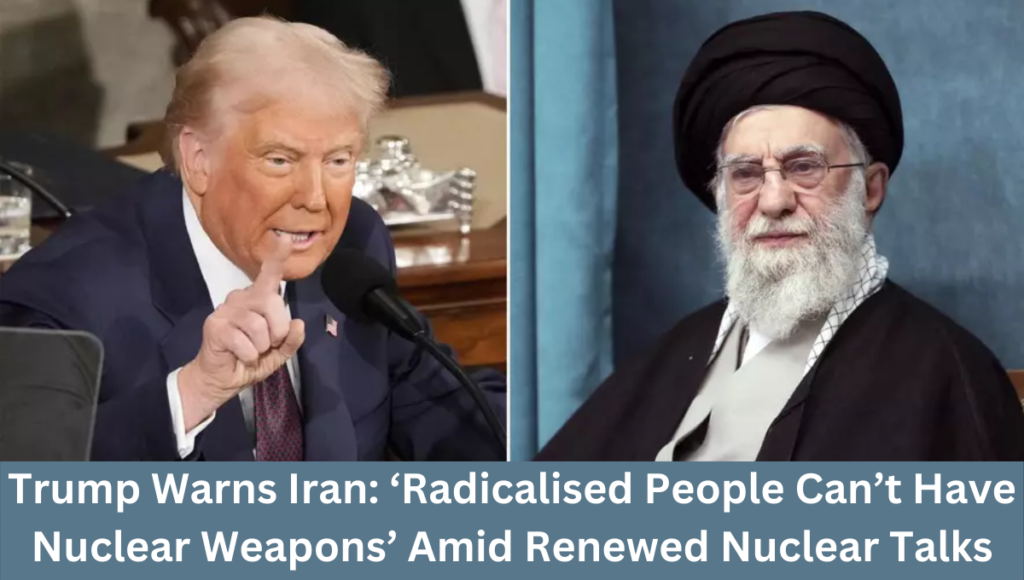
Trump Warns Iran: ‘Radicalised People Can’t Have Nuclear Weapons’ Amid Renewed Nuclear Talks
Trump Doubles Down on Iran: “They Can’t Have a Nuclear Weapon”
On Sunday, April 13, speaking to reporters aboard Air Force One, Trump said that military action remains on the table if Iran does not promptly act in accordance with US demands.
Trump said, “Iran has to get rid of the concept of a nuclear weapon. These are radicalized people, and they cannot have a nuclear weapon.” When asked if military strikes would be considered if talks fall through, “Of course,” military strikes are an option, he added.
Trump charged Tehran of intentionally stalling the negotiation process, stating, “I think they’re tapping us along.” He warned that the time for action is now, as Iran is “fairly close” to developing a nuclear weapon.
Nuclear Talks: Oman Meeting Sets Stage for Rome
The meeting in Muscat, Oman, April 12, brought together Iranian Foreign Minister Abbas Araghchi and Trump’s Middle East envoy Steve Witkoff. Both nations described them as a step in the right direction despite indirect discussions. The next round of talks will be on April 19 in Rome.
A senior Italian official said that the Italian government is preparing to host the high-stakes discussions in Rome. The upcoming talks were also confirmed by Italian Foreign Minister Antonio Tajani.
However, President Trump remains skeptical while he admitted that “the Iran situation is going pretty good, and nothing matters until you get it done.”
US Military Posturing: A Signal to Tehran?
At least six B-2 stealth bombers were deployed by the US recently to Diego Garcia, a strategic island in the Indian Ocean, in a move as a warning to Iran. Analysts depict that the deployment is a show of strength aimed at deterring Tehran from pursuing its nuclear program.
Moreover, US Defense Secretary Pete Hegseth pointed out Washington’s readiness to act if diplomacy fails. He said on Sunday, “We are prepared to go deep and to go big.If Iran crosses the line, our response will be swift and decisive.”
IAEA Steps In: Monitoring Iran’s Nuclear Progress
Adding to the growing international scrutiny, the International Atomic Energy Agency (IAEA) has announced that Rafael Mariano Grossi, the director, will visit Iran later this week. The visit is aimed to improve access for inspectors monitoring Iran’s nuclear activities.
In the 2015 nuclear deal, IAEA played a key role in verifying Iran’s compliance with the deal, which during his first term Trump famously pulled out of in 2018. Tehran has gradually restricted international oversight, since then, raising fresh concerns about its intentions.
Rafael Mariano Grossi, during his trip, is expected to meet President Masoud Pezeshkian and Foreign Minister Araghchi. Iranian state media say that discussions will focus on ways to restore transparency and build trust between the international community and Iran.
A Deal or a Dead End?
Trump remains critical of Iran’s willingness to negotiate in good faith, despite the cautious optimism following Oman talks. In the Oval Office Trump told reporters during a meeting with El Salvador’s President Nayib Bukele, “Iran wants to deal with us, but they don’t know how,”
Pressure is mounting to reach a resolution on both sides, with the next round of talks just a few days away. Trump stated he will make a decision “very quickly” following the Rome summit. He said of the week-long wait between meetings “That’s a long time. So, I think they might be tapping us along.”
Iran continues to insist that its nuclear program is for peaceful purposes, while Western intelligence agencies maintain that uranium enrichment levels are now nearing weapons-grade—raising the stakes for any potential agreement.
Conclusion: High Stakes, Tight Timeline
In Rome, the upcoming talks may prove pivotal, as the world watches closely. Trump’s rhetoric suggests that his patience is wearing thin. With diplomatic channels still open and military assets on standby, the next few days could determine whether there would be a new nuclear deal or a potential military confrontation. For now, Trump’s message is loud and clear: Forget nuclear weapons—or face the consequences.
Also Read: Khamenei Rejects U.S. Nuclear Proposal, Vows Iran Will Continue Uranium Enrichment
Also Read: Trump says he wants “real end” to Iran’s nuclear program, not just an Iran-Israel ceasefire


