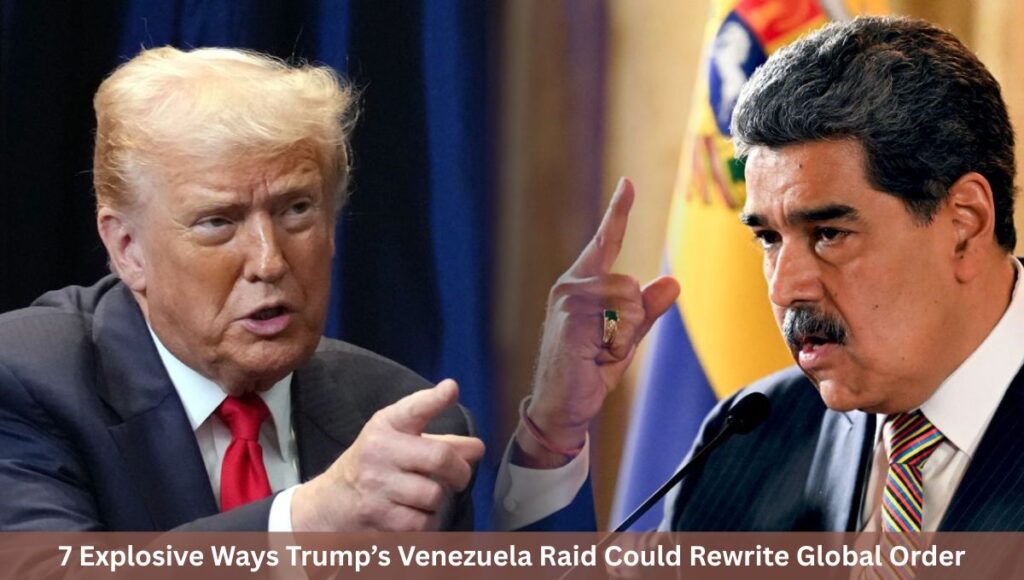
7 Explosive Ways Trump’s Venezuela Raid Could Rewrite Global Order — and why it matters. The United States has crossed a line few believed it would — at least so openly.
In a move that stunned allies, enraged rivals, and reignited global debates over sovereignty and power, President Donald Trump announced that the United States would “run Venezuela” following a daring military raid that captured Venezuelan President Nicolás Maduro and his wife, Cilia Flores.
The operation, carried out in the early hours of Saturday under the codename Operation Absolute Resolve, involved U.S. airstrikes, cyber operations, and a Special Forces extraction from Caracas. By Sunday night, Maduro was no longer in the presidential palace. He was in a New York detention center, awaiting trial on U.S. federal charges including narco-terrorism conspiracy.
What followed was not merely the fall of a leader — but the opening of one of the most consequential geopolitical chapters of the 21st century.
7 Explosive Ways Trump’s Venezuela Raid Could Rewrite Global Order
Operation Absolute Resolve: How Maduro Was Taken
According to U.S. officials, the operation was the culmination of months of covert planning involving the CIA, Pentagon, and U.S. Special Operations Command.
A Precision Strike on Caracas
In the pre-dawn hours, U.S. aircraft struck Venezuelan air defense systems and select military installations, briefly plunging parts of Caracas into darkness.
Cyber operations disrupted communications as American helicopters crossed Venezuelan airspace under heavy cover.
Delta Force operators stormed Maduro’s residence, where the Venezuelan leader attempted to flee to a fortified safe room. Within minutes, he and his wife were in U.S. custody.
From Caracas to New York
Maduro was flown offshore to a U.S. Navy vessel, then transferred to an aircraft that landed at Stewart Air National Guard Base near New York City.
Images released by U.S. authorities showed the Venezuelan president handcuffed and blindfolded — visuals that instantly reverberated across the globe.
Trump later said he watched the raid unfold “like a television show” from Mar-a-Lago.
“We Will Run the Country”: Trump’s Stunning Declaration
At a press conference in Florida, President Trump made his most controversial claim yet.
“We will run the country until such time as we can do a safe, proper and judicious transition.”
The statement went far beyond a law enforcement action. It suggested de facto U.S. control over a sovereign nation of 31 million people — without a UN mandate, congressional authorization, or international consensus.
Trump made clear that Venezuela’s vast oil reserves were central to his thinking.
“It won’t cost us a penny. The money comes out of the ground.”
Why Venezuela Matters: Oil, Gold, and Power
The World’s Largest Oil Reserves
Venezuela holds the largest proven oil reserves on Earth, primarily concentrated in the Orinoco Belt. Estimates suggest up to 1.4 trillion barrels of extra-heavy crude lie beneath its soil — surpassing Saudi Arabia.
Yet production has collapsed due to mismanagement, sanctions, and infrastructure decay. Trump claims U.S. companies will return to “restore” the industry, though experts warn this could take five to seven years, even under ideal conditions.
Gold and Strategic Minerals
Beyond oil, Venezuela sits atop vast gold deposits within the Guiana Shield. Control over these resources carries implications not only for energy markets, but for global financial systems and reserve diversification — particularly at a time when China and Russia are reducing reliance on the U.S. dollar.
Is the U.S. Allowed to Capture a Sitting Head of State?
This is the question now dominating legal and diplomatic circles.
What the UN Charter Says
Article 2(4) of the United Nations Charter explicitly prohibits the use of force against the territorial integrity or political independence of any state, except in cases of self-defense or with UN Security Council authorization.
Neither condition appears to have been met.
The UN Secretary-General described the U.S. action as “a dangerous precedent.”
Prominent international jurists have gone further, calling it a crime of aggression — the gravest offense under international law.
Law Enforcement or Regime Change?
The Trump administration initially framed the operation as assisting the Department of Justice in apprehending an indicted criminal.
That argument collapsed when Trump openly spoke of running Venezuela and controlling its oil.
As one constitutional law expert put it:
“You cannot call this law enforcement and then announce an occupation.”
Global Reaction: Condemnation, Celebration, and Fear
Russia and China Push Back
Moscow and Beijing reacted swiftly, condemning the raid as a violation of sovereignty and warning of severe consequences.
China accused Washington of hegemonic behavior, while Russia demanded Maduro’s immediate release and vowed continued support for Venezuela’s “Bolivarian leadership.”
The UN Security Council Steps In
An emergency meeting of the Security Council was scheduled amid fears the incident could legitimize similar actions elsewhere — from Taiwan to Eastern Europe to the Middle East.
Venezuela Reacts: Relief, Rage, and Uncertainty
Inside Venezuela, reactions were deeply divided.
Government Response
Vice President Delcy Rodríguez called the capture a “kidnapping” and declared herself interim president under an emergency court ruling. The military remains publicly loyal to the existing power structure.
Public Sentiment
While some cities remained tense and quiet, others saw expressions of relief.
“It feels like a movie,” said one merchant. “I didn’t believe it was real.”
Across Latin America and the Venezuelan diaspora, celebrations erupted — particularly among the 7.7 million Venezuelans who fled the country since 2014.
Shashi Tharoor’s ‘Law of the Jungle’ Warning
Indian parliamentarian and former diplomat Shashi Tharoor offered one of the most widely shared critiques.
He described the episode as proof that international law has been reduced to “might is right.”
The concern is not ideological — but systemic.
If powerful nations can abduct leaders they deem illegitimate, what prevents similar actions elsewhere?
Echoes of Iraq and Afghanistan
Trump’s rhetoric — “boots on the ground,” open-ended control, oil-funded occupation — has triggered uncomfortable comparisons with past U.S. interventions.
Both Iraq and Afghanistan began with promises of swift success and ended in costly withdrawals, prolonged instability, and regional upheaval.
Even within Trump’s own political base, there are signs of unease. “America First” was never meant to mean open-ended foreign occupation.
Will Venezuela’s Oil Actually Flow?
Despite Trump’s confidence, energy experts remain skeptical.
Major Obstacles
- Crumbling infrastructure
- Security risks
- Legal uncertainty
- Potential insurgency
- International sanctions and lawsuits
Oil markets, notably, barely moved — signaling that traders do not expect immediate supply increases.
As one analyst noted, “You cannot bomb your way to stable production.”
What Comes Next: The Dangerous Unknown
The U.S. has removed a leader — but not replaced a system.
There is no clear roadmap for governance, no consensus successor, and no international legitimacy for U.S. oversight.
Meanwhile, Venezuela’s institutions remain fractured, its military intact, and its allies defiant.
Trump insists this time will be different.
History suggests otherwise.
Conclusion: A Precedent That Will Haunt the World
The capture of Nicolás Maduro is not just a dramatic episode in U.S.–Venezuela relations. It is a turning point in how power is exercised globally.
If international law bends to brute force, the consequences will not stop in Caracas. They will echo everywhere.
Also Read: 9 Explosive Claims as Venezuela Slams US ‘Extortion’ at UN
Also Read: Donald Trump’s attack on Venezuela and ‘capture’ of Nicolás Maduro has been months in the making