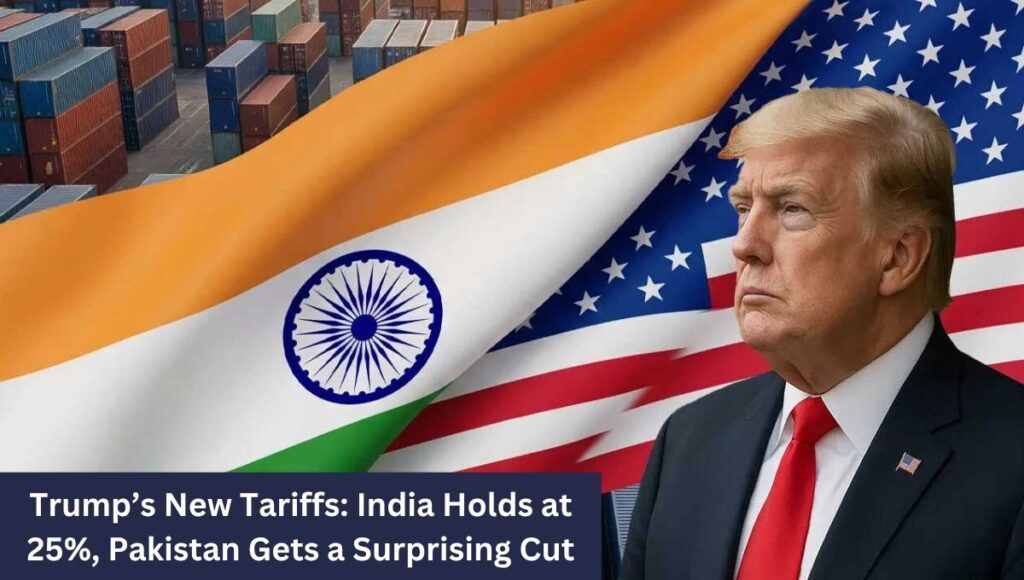
Revised Trump’s New Tariffs: India Holds at 25%, Pakistan Gets a Surprising Cut. In a sweeping move that underscores his hardline approach to global trade, US President Donald Trump has signed a new executive order imposing sharply revised tariff rates on 69 countries and trade blocs. The rates range from 10% to a steep 41%, with a particular focus on resetting “reciprocal” terms of trade.
While India’s import tariff into the US has been held steady at 25%, Pakistan’s duty rate has been unexpectedly reduced from 29% to 19%, drawing sharp political and economic reactions in South Asia. These changes are set to take effect from August 7, 2025, giving trading partners a narrow window to renegotiate deals and avoid the new tariff rates.
Trump’s New Tariffs: India Holds at 25%, Pakistan Gets a Surprising Cut
India Hit with 25% Tariff: Trade Talks Stalled
Despite ongoing negotiations, India will continue to face a 25% import tariff, as talks over access to its agriculture sector reached an impasse.
The US administration has taken issue with India’s reluctance to liberalize its farm markets and reduce its energy ties with Russia two sticking points that have hardened Trump’s stance.
A senior official from the Trump administration indicated that the 25% tariff remains a pressure tactic to push New Delhi toward more favorable trade terms.
The policy has caused a slump in the Indian rupee and criticism from opposition parties that accuse the government of failing to shield the economy from US pressure.
“We will not sacrifice our farm sector for short-term trade concessions,” an Indian trade official said in New Delhi, emphasizing the country’s focus on protecting millions of rural livelihoods.
Pakistan Gets a Reprieve: Tariff Down to 19%
In a move that stunned analysts, Trump slashed tariffs on Pakistani goods from 29% to 19%, citing progress in trade negotiations and improved cooperation on national security and drug enforcement.
While details of the agreement remain scant, US officials hinted at ongoing deals behind the scenes.
This reduction comes at a time when Islamabad is aggressively trying to boost exports to combat a widening trade deficit and revive its struggling economy.
Pakistani officials hailed the move as a “positive signal” from Washington that could open doors to more favorable trade discussions in the future.
Canada Targeted: Tariffs Raised to 35%
Not all US allies were spared. Canada, the second-largest US trading partner after Mexico, was hit with a tariff increase from 25% to 35% on selected goods, primarily those linked to the fentanyl crisis.
The White House accused Ottawa of “failing to cooperate” in addressing the flow of illicit drugs into the US.
While Canadian officials pushed back, stating that cooperation has been ongoing, the move marks a sharp escalation in trade tensions between the two neighbors.
“Canada’s lax border controls on synthetic opioids are costing American lives,” Trump posted on Truth Social, justifying the increase.
Mexico Granted 90-Day Reprieve Amid Broader Talks
Mexico, meanwhile, escaped immediate tariff hikes, with Trump offering a 90-day extension to continue negotiations.
The threatened 30% tariff on many non-automotive and non-metal Mexican goods has been put on hold, though tariffs of 50% on steel, aluminum, and copper remain in place.
President Trump credited a phone call with Mexican President Claudia Sheinbaum for the delay and praised Mexico for agreeing to terminate various non-tariff trade barriers.
While specifics were not released, Trump’s post hinted at a comprehensive trade overhaul in the works.
China’s Deadline Looms: August 12 Showdown
While not on the finalized list, China faces a looming August 12 deadline to finalize a long-term tariff agreement.
Recent talks in Stockholm between US and Chinese officials were described as “constructive,” but Trump has warned that if a deal isn’t reached, a 30% tariff on most Chinese imports will be enacted.
“China must show good faith and deliver a real agreement, not more empty promises,” Trump said, signaling that Beijing’s response in the next few days will be crucial for future trade dynamics.
The European Union managed to avoid harsh blanket tariffs thanks to its existing agreements. Under the new plan:
- EU goods with an existing tariff above 15% will face no new tariffs.
- Goods with less than 15% duty will see a tariff equal to 15% minus the existing rate, resulting in minimal adjustments.
Japan, too, has secured a modest 15% tariff rate across the board, down from a threatened 25%, as part of a broader investment commitment to US industries.
Full Tariff Breakdown: Who Got What?
Below are some highlights from the newly adjusted Trump tariffs 2025 list:
- Brazil: 50%, but aircraft, energy, and orange juice are exempted.
- Switzerland: Increased to 39%, up from 31%.
- Syria: Highest rate at 41%.
- Myanmar and Laos: Both hit with 40%.
- South Korea: Negotiated down to 15% with a $350B investment pledge.
- Vietnam, Indonesia, Philippines: All fall in the 19–20% range.
- UK and Australia: Receive a baseline 10% tariff.
The full list represents a major recalibration of global trade, with the US using tariff policy not just as an economic tool, but a diplomatic lever.
What the Experts Say: A Puzzle with No Pattern
Trade experts are still trying to decipher Trump’s logic. While some countries that lobbied hard secured better outcomes, others saw rate increases without clear explanations.
“The numbers are all over the place,” said Deborah Elms of the Hinrich Foundation. “There’s no unifying economic logic, just Trump’s view of the country’s alignment with US interests.”
Steve Okun of APAC Advisors echoed that sentiment, noting the individualized, erratic nature of Trump’s trade doctrine. “Each country gets its own rate based on what Trump wants at that moment whether for trade, politics, or personal reasons.”
Time Is Ticking: August 7 Implementation
Countries have until August 7 to finalize new agreements or face the consequences.
Experts like Inu Manak from the Council on Foreign Relations believe that many governments will rush to renegotiate in the days ahead to avoid the looming duties.
“The incentive is high for countries staring at 15% or more. It’s now or never,” Manak said.
Transshipment Crackdown Coming Next
In a parallel move, the US is also preparing new rules of origin for transshipped goods, targeting countries using third-party routes to bypass US tariffs.
A Trump official told Reuters these rules aim to close loopholes that allow tariff evasion through intermediaries.
The technical specifics of this policy are expected to be unveiled in the coming weeks, but it’s already sending shockwaves through global logistics and supply chains.
Conclusion: A Hard Reset on Trade
President Trump’s latest tariff offensive is a calculated gamble to force trading partners into “reciprocal” trade relationships under US-defined rules. While some countries like Pakistan and Mexico may benefit from temporary relief or reductions, others like India, Canada, and Switzerland are facing steeper costs.
The ripple effects are likely to be felt across global markets, supply chains, and foreign policy discussions for months if not years to come.As the world watches Trump reshape global trade on his own terms, one thing is clear: This is only the beginning.
Also Read: Thai, Cambodian Leaders Hold Ceasefire Talks in Malaysia After Trump Threatens Trade Tariffs
Also Read: Trump-Modi ties hit rock bottom with new tariffs on India over Russian oil
Related Posts:
- Can the EU and NATO Impose Tariffs on India and…

- 11 Explosive Revelations From Ted Cruz’s Leaked…

- Trump Targets Sri Lanka, BRICS with Sweeping Tariffs
- Trump’s 2025 Gaza Peace Plan Signing and Historic…

- 9 Explosive Revelations as Trump Declares His Health…

- 5 Key Signals from PM Modi’s Virtual ASEAN Summit Appearance