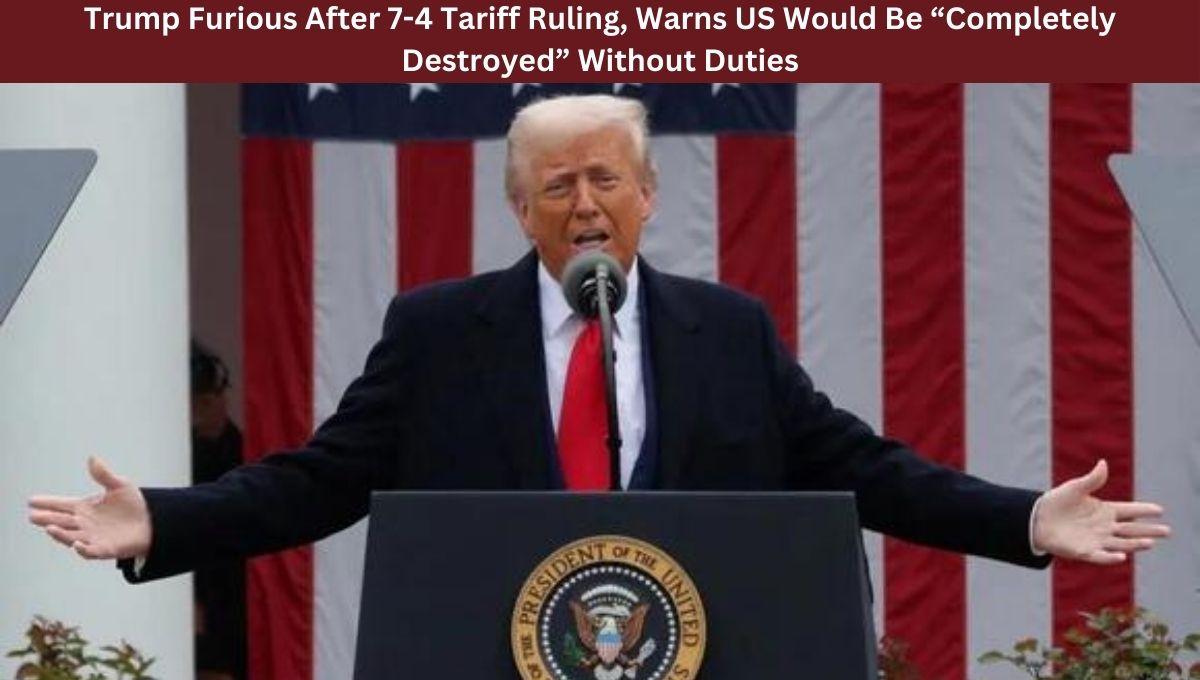
Federal appeals court made Trump Furious After 7-4 Tariff Ruling, Warns US Would Be “Completely Destroyed” Without Duties. US President Donald Trump has once again ignited a political and economic storm, lashing out at a federal appeals court ruling that limited his sweeping tariff powers.
The 7-4 decision by the US Court of Appeals for the Federal Circuit concluded that Trump had overstepped his authority under the International Emergency Economic Powers Act (IEEPA) when imposing broad tariffs on nearly every country earlier this year.
In a fiery post on Truth Social, Trump warned that without tariffs, America would collapse both economically and militarily. He denounced the court’s ruling as the work of a “Radical Left group of judges” while unexpectedly praising one dissenting judge, an Obama appointee, for siding with him.

Trump Furious After 7-4 Tariff Ruling, Warns US Would Be “Completely Destroyed” Without Duties
Trump’s Tariff Defense: “Our Military Would Be Instantly Obliterated”
In his Truth Social post, Trump painted a doomsday picture of what he believes would happen without tariffs.
“Without Tariffs, and all of the TRILLIONS OF DOLLARS we have already taken in, our Country would be completely destroyed, and our military power would be instantly obliterated,” Trump wrote.
The former president framed tariffs not merely as economic tools but as pillars of national security, suggesting that revenue from duties directly supports America’s defense capabilities.
He also singled out one Obama-appointed judge who dissented from the majority opinion:
“In a 7 to 4 Opinion, a Radical Left group of judges didn’t care, but one Democrat, Obama appointed, actually voted to save our Country. I would like to thank him for his Courage! He loves and respects the U.S.A.”
The Federal Appeals Court Ruling: A Landmark Check on Presidential Power
The decision by the US Court of Appeals for the Federal Circuit represents one of the most significant checks on presidential trade authority in decades.
Key Points of the Ruling:
- The court ruled 7-4 against Trump’s use of IEEPA to impose broad reciprocal tariffs.
- Judges said Congress, not the President, holds constitutional authority to impose taxes and tariffs.
- The ruling upheld a May 2025 decision by the Court of International Trade that rejected Trump’s claims.
- Importantly, the court did not immediately strike down tariffs, instead delaying enforcement until October 14, 2025, to give the administration time to appeal.
In its unsigned opinion, the court called Trump’s actions an “unprecedented overreach of executive authority”, stressing that the IEEPA was intended for sanctions and financial restrictions during national emergencies not for wholesale tariff regimes.
What Tariffs Are Affected?
Trump’s controversial reciprocal tariffs were at the heart of the ruling. These included:
- A 10% baseline levy on most imports.
- Up to 50% tariffs on countries running trade deficits with the US.
- Duties that targeted nearly every trading partner, from allies like the UK, Japan, and the EU to rivals like China.
However, the court made clear that not all tariffs are impacted:
- Steel and aluminum tariffs remain in place under a different law.
- Auto tariffs and China-specific levies introduced during Trump’s earlier presidency also remain, many of which the Biden administration has since maintained.
Trump’s “National Emergency” Justification
Trump invoked the International Emergency Economic Powers Act (IEEPA) a 1977 law to justify his tariff regime.
Originally intended to allow presidents to impose sanctions during foreign emergencies, the IEEPA does not explicitly authorize tariffs.
Trump stretched its scope by declaring longstanding US trade deficits a national emergency. He also linked the law to national security threats, such as illegal immigration and the influx of fentanyl from Mexico, Canada, and China.
Legal experts, however, argued that this interpretation was far outside congressional intent, leading to the court’s rejection.
Former White House trade adviser Peter Navarro came to Trump’s defense after the ruling, slamming the decision as a “weaponized partisan injustice.”
In an interview with Fox News, Navarro insisted:
“…but we never said they (tariffs) were permanent… you can’t find Lutnick, Bessent, Greer, myself or the President saying that.”
Navarro, a long-time advocate of Trump’s tariff strategy, warned that without them, America’s economy and global standing would collapse.
He also expressed optimism that the Supreme Court will side with Trump, pointing to strong dissenting opinions in the appeals court ruling.
Economic Implications: A Blow to Businesses and Global Markets
Domestic Impact
Economists say the ruling injects uncertainty into the business environment.
- Tariffs act as taxes on imports, raising costs for companies and consumers.
- Some businesses delayed deals or altered supply chains, unsure whether tariffs will remain in place.
- The threat of reversal could “dampen down economic activity,” according to Dr. Linda Yueh, an economist at Oxford University and London Business School.
International Fallout
Global partners are watching closely:
- The UK, Japan, and the EU renegotiated trade terms under pressure from Trump’s tariffs.
- India, China, and Mexico faced harsher penalties, sparking diplomatic and economic tensions.
- If the Supreme Court upholds the lower courts, many of these deals could be thrown into chaos.
What Happens Next: Supreme Court Showdown Looms
The Trump administration has until October 14, 2025, to appeal the ruling to the US Supreme Court.
Possible Outcomes:
- If the Supreme Court strikes down the tariffs –
- Broad reciprocal tariffs would end.
- Billions in import taxes collected could be subject to legal challenges.
- Global trade relationships may need to be recalibrated.
- If the Supreme Court upholds Trump’s use of IEEPA –
- It would set a powerful precedent expanding presidential authority.
- Future presidents could wield emergency powers to reshape trade unilaterally.
- Trump would claim a major political victory ahead of the 2026 midterms.
Given the Supreme Court’s 6-3 conservative majority (including three justices Trump himself appointed), many analysts believe Trump has a chance.
However, the Court has also been wary of executive overreach, as seen in its rulings against Biden’s climate and student loan initiatives.
India and Global South: Waiting for Relief
For countries like India, the stakes are high. Trump imposed 50% tariffs on Indian goods, which he linked to India’s purchase of Russian oil.
Trade experts argue the move was more about personal grievances than economic logic.
Abhijit Das, former head of the Centre for WTO Studies, explained:
“Relief for India and other affected countries will depend on the Supreme Court outcome.”
Dr. Rajan Sudesh Ratna of the UN ESCAP office in Asia called the verdict a “moral victory” against Trump’s tariff policy, but warned that exporters would still face duties until at least late 2025.
Political Stakes: Trump’s Image as a Deal-Maker
Tariffs have been central to Trump’s political brand, allowing him to claim he is fighting for “fair trade” and protecting American workers.
- If overturned, the ruling would deal a serious blow to Trump’s reputation as a master negotiator and strongman president.
- If upheld, Trump would tout it as proof that only he can defend America’s economic and military strength.
Trump has already framed the ruling as a partisan attack, insisting that the “Radical Left” is trying to weaken the nation. His rhetoric suggests he will use the battle as a campaign issue heading into 2026.
Conclusion: A Pivotal Moment in US Trade Policy
The clash over Trump’s tariffs is not just about economics it’s about the limits of presidential power.
- The appeals court ruling reaffirmed that Congress, not the president, controls tariffs.
- Trump’s defiance highlights his belief in a broad interpretation of executive authority.
- The Supreme Court’s eventual ruling will determine whether tariffs remain a matter of lawmaking or presidential geopolitics.
Until then, businesses, global partners, and American consumers face uncertainty. One thing is clear: Trump is not backing down.
As he declared on Truth Social:
“Now, with the help of the United States Supreme Court, we will use [tariffs] to the benefit of our Nation, and Make America Rich, Strong, and Powerful Again!”
Also Read: US Court Blocks Trump’s Sweeping Import Tariffs in Landmark Ruling
Also Read: US court blocks Trump tariffs: Why, what it means, and what comes next