

Commenting at the SPIEF Putin: Russia Doesn’t Seek Ukraine’s Surrender but Demands Recognition of ‘Reality’. Russian President Vladimir Putin declared on Friday that Moscow is not seeking Ukraine’s unconditional surrender, but instead expects Kyiv to acknowledge the “realities on the ground” a euphemism for Russia’s control over large swaths of Ukrainian territory.
His comments, made during a plenary session at the St. Petersburg International Economic Forum (SPIEF), sparked alarm in Kyiv and drew condemnation from Ukraine’s allies. Speaking during a Q&A session at SPIEF, Putin rejected parallels between his demands and U.S. President Donald Trump’s call for Iran’s unconditional surrender, stating, “We are not seeking the surrender of Ukraine.
We insist on recognition of the realities that have developed on the ground.” This carefully worded statement is widely interpreted as an ultimatum for Ukraine to accept Russia’s annexation of roughly 20% of its territory, including Crimea, Donetsk, Luhansk, Zaporizhzhia, and Kherson, and possibly more to come.
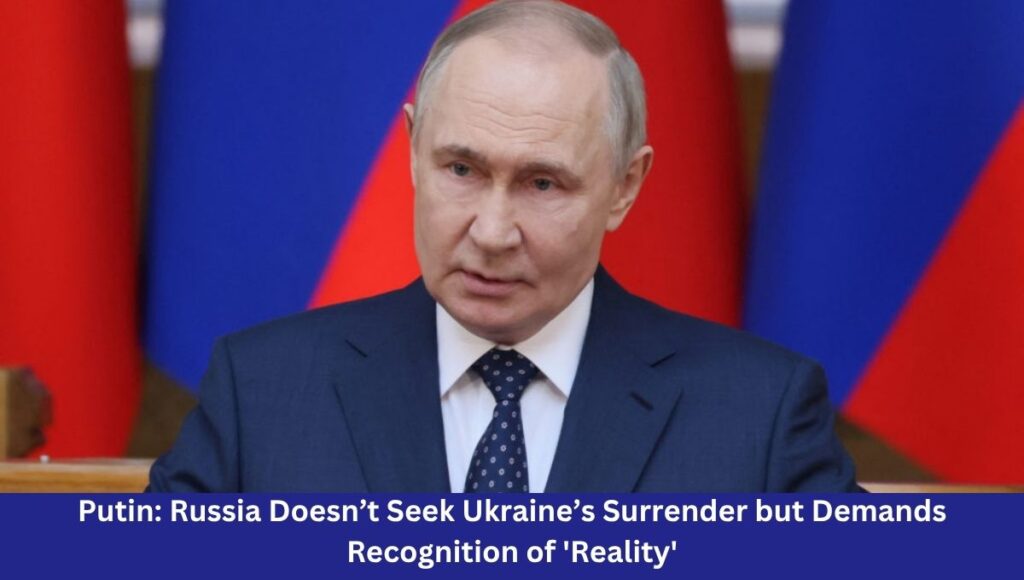
Putin: Russia Doesn’t Seek Ukraine’s Surrender but Demands Recognition of ‘Reality’
‘Whole of Ukraine Is Ours in Spirit’: Putin Hints at Expansion
Putin’s comments also reignited concerns about Russia’s long-term ambitions. Although he claimed Moscow is not currently seeking to capture Sumy, a major Ukrainian city near the Russian border, he notably did not rule it out.
“We don’t have the goal of taking Sumy, but in principle, I don’t rule it out,” Putin said. He asserted that Russian forces are building a “buffer zone” about 10 to 12 kilometers deep in Ukraine’s Sumy region, allegedly to protect Russian territory from cross-border attacks.
What alarmed many observers further was Putin’s remark: “In this sense, the whole of Ukraine is ours. Where the foot of a Russian soldier steps, that is ours.”
This assertion, which received loud applause at the forum, underscores the expansionist undertone of Russia’s military operations despite public claims of self-defense.
Kyiv Slams Putin’s Statements as ‘Cynical’ and Expansionist
Ukrainian leaders reacted strongly to Putin’s comments. Foreign Minister Andrii Sybiha described Putin’s remarks as a “cynical demonstration of Russia’s disdain” for international peace efforts, especially ongoing American and European mediation.
“Putin’s statements show that Russia is bent on seizing more Ukrainian territory and killing more civilians,” Sybiha said on social platform X.
Ukrainian President Volodymyr Zelensky, in his nightly address, said Russia had made it “openly and utterly clear” that it is not interested in a ceasefire and remains committed to continuing its invasion. “We are holding them back and eliminating these killers, defending our Sumy region,” Zelensky said.
Legitimacy of Peace Talks Questioned: Putin Challenges Zelensky’s Authority
In a separate but related development, Putin questioned Zelensky’s legitimacy as a negotiating partner. Since Zelensky’s term officially expired last year and elections have been postponed due to martial law, Russia claims that any treaty signed by him may not be valid under international law.
“The signature must come from legitimate authorities. Otherwise, whoever comes after him will toss it to the dumpster,” Putin remarked.
While Zelensky argues he remains in office under wartime constitutional provisions, Russia’s stance raises further uncertainty over the feasibility of peace negotiations.
Russian Military Advances and the Future of Sumy
Russia’s possible intentions to take over Sumy, a city located just 18 km from the current front line, were made more tangible by recent military activities.
Russian troops have reportedly captured multiple towns in the Sumy region over the past year, especially following a Ukrainian attack on Russia’s Kursk region in 2024, which Moscow claims resulted in heavy Ukrainian losses.
Putin claimed that Ukraine lost 76,000 troops during that failed operation and that Kiev’s military is currently operating at just 47% capacity. These numbers, though impossible to independently verify, were used by the Russian president to justify the creation of a buffer zone as a defensive necessity.
Throughout his remarks, Putin repeated his oft-stated belief that Russians and Ukrainians are “one people.” This ideological framing continues to be one of the cornerstones of the Kremlin’s justification for the war.
“I have said many times that I consider Russians and Ukrainians to be one people, in fact,” Putin said. “All of Ukraine is ours.” This narrative has been flatly rejected by Ukraine, whose citizens overwhelmingly oppose Russian rule and support continued resistance even under extreme hardship.
No Signs of De-escalation Amid Stalemate
Despite raising the possibility of talks, Putin gave no indication that Russia is willing to withdraw from occupied territories or recognize Ukrainian sovereignty over annexed regions.
Western leaders have called Putin’s peace formula a “thinly veiled surrender demand,” since it effectively asks Ukraine to legitimize its own partition. Meanwhile, Zelensky has repeatedly stated that Ukraine will not concede territory in exchange for peace and views any such deal as capitulation.
Where the Conflict Stands Now
As of June 2025, Russia controls:
- All of Crimea (annexed in 2014)
- Over 99% of Luhansk
- About 70% of Donetsk, Zaporizhzhia, and Kherson
- Fragments of Kharkiv, Dnipropetrovsk, and Sumy
Ukraine has been able to mount localized counteroffensives but is heavily reliant on Western military aid, much of which has slowed in recent months due to political gridlock in Washington and Brussels.
Putin’s St. Petersburg address, while billed as a signal of openness to dialogue, was instead widely seen as a rationalization of Russia’s ongoing territorial grabs and a warning that more may be coming.
Conclusion: Peace on Putin’s Terms?
Despite his repeated insistence that Russia is not seeking Ukraine’s full surrender, Putin’s “peace” offer demands that Kyiv cede a massive portion of its territory a condition that Ukraine and its Western allies have firmly rejected.
While diplomatic channels remain technically open, the path to peace remains obstructed by deep mistrust, disputed legitimacy, and irreconcilable positions on territorial sovereignty. Unless there is a dramatic shift in military momentum or diplomatic engagement, the war is likely to grind on with Sumy possibly next on Russia’s list.
Also Read: Putin Warns of Escalation After Ukraine Drone Strike as Trump Seeks Diplomatic Breakthrough
Also Read: Putin tells national economic forum ‘all of Ukraine is ours’
Related Posts:
- 7 Critical Revelations: Putin’s Hardline Ukraine…
- Impacts of the Trump-Putin Call on Ukraine’s 2025 Strategy
- 7 Critical Shifts in Trump’s Ukraine Peace Plan…

- In 8 Moves, EU Targets China-Linked Refineries and…

- 3 Key Signals Putin Envoy Dmitriev Says Show US,…
- Putin’s Shocking Risks Ahead of Trump–Hungary Summit 2025
