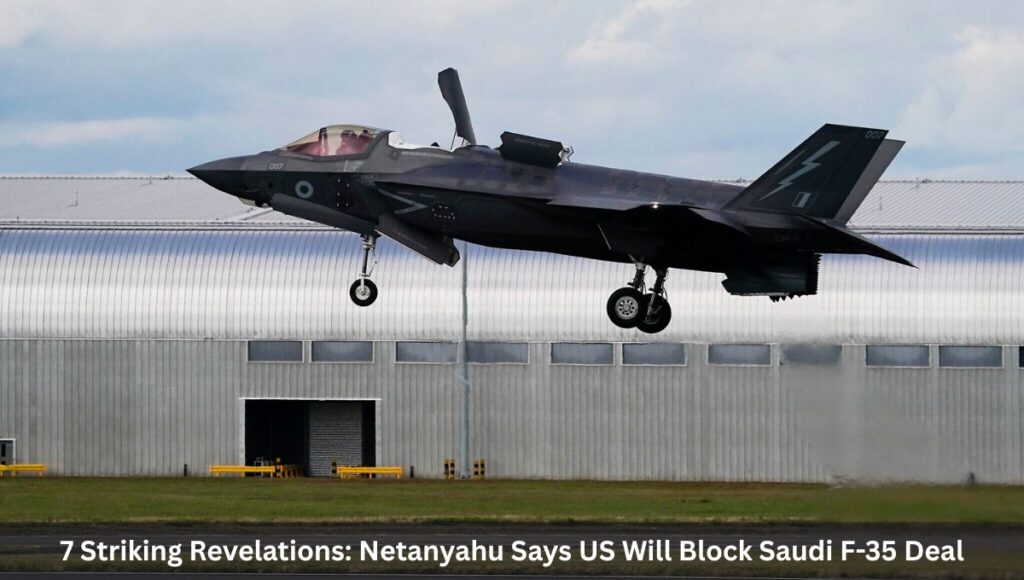
7 Striking Revelations: Netanyahu Says US Will Block Saudi F-35 Deal, contradicting Donald Trump and reaffirming Israel’s qualitative military edge. Israeli Prime Minister Benjamin Netanyahu has delivered one of his most consequential security statements of the year, declaring that the United States will prevent Saudi Arabia from obtaining the most advanced F-35 stealth fighters—despite assurances previously given by former U.S. President Donald Trump.
Netanyahu’s remarks, backed by U.S. Secretary of State Marco Rubio, underline the intense geopolitical struggles shaping American arms sales in the Middle East and the enduring U.S. commitment to preserving Israel’s Qualitative Military Edge (QME).
The issue is not merely about aircraft sales—it strikes at the heart of shifting alliances, regional rivalries, Israel’s relations with Turkey, the future of normalization with Saudi Arabia, and the wider strategic balance in a post-Assad Middle East.
7 Striking Revelations: Netanyahu Says US Will Block Saudi F-35 Deal
Netanyahu Claims U.S. Will Block Saudi F-35 Purchase
Netanyahu revealed that Secretary of State Marco Rubio reassured him that U.S. law will prevent Riyadh from receiving the most advanced F-35 configurations.
In a widely circulated Hebrew-language interview, Netanyahu said:
“Secretary Rubio reiterated his commitment that the United States will preserve Israel’s qualitative military edge in everything related to supplying weapons to the Middle East.”
Rubio reportedly confirmed that Israel’s advantage in F-35 capabilities would remain intact, contradicting Trump’s public comments suggesting Saudi Arabia would receive jets of comparable sophistication.
The statement establishes Rubio as a central advocate for maintaining Israel’s supremacy in American weapons systems—a policy embedded in decades of bipartisan U.S. doctrine.
Trump Wanted Saudi Arabia and Israel to Receive “Top of the Line” Jets
Netanyahu’s claim directly contradicted remarks Trump made earlier this week during an Oval Office meeting with Crown Prince Mohammed bin Salman.
Trump told the crown prince:
“Israel would like you to get planes of reduced caliber. I don’t think that makes you too happy… I think both Saudi Arabia and Israel should get top of the line.”
This stark difference exposes a widening policy gap between the Trump and Netanyahu administrations over how F-35 sales should be handled in the region.
While Trump has emphasized creating military parity between Saudi Arabia and Israel, Netanyahu insists such parity represents an existential threat.
What Is Israel’s Qualitative Military Edge—and Why It Matters
The concept of an Israeli Qualitative Military Edge (QME) dates back to the Cold War era, when the U.S. sought to ensure that Israel retained superior military capabilities over any combination of regional adversaries.
Origin of QME
- Established after the 1973 Yom Kippur War
- Aimed to compensate Israel for peace treaties with Egypt
- Ensured U.S. weapons sold to Arab states were less advanced
Codified in U.S. Law
In 2008, Congress formalized QME requirements, mandating:
- routine assessments of Middle Eastern arms sales
- ensuring Israel’s military retains technological superiority
- allowing Israel greater access to upgrade American systems
How the F-35 Fits into QME
The F-35 stealth fighter is modular; its capabilities can be upgraded or downgraded via:
- radar packages
- stealth coatings
- electronic warfare systems
- weapons integration
Israel is the only country allowed to customize the F-35, creating the F-35I Adir variant fitted with:
- electronic warfare tools
- external fuel compartments
- indigenous weapons systems
This modification allowed Israel to strike Iran earlier this year without mid-air refueling, demonstrating the aircraft’s strategic value.
Why Israel Prefers a Downgraded Saudi F-35
U.S. officials confirmed that the jets planned for Saudi Arabia would be less advanced than Israel’s. They would lack key systems, including:
- advanced electronic warfare suites
- radar-jamming tools
- platform integration privileges
- certain weapons configurations
Despite these assurances, Israeli officials remain wary.
An Israeli Air Force (IAF) position paper recently warned that Riyadh flying identical jets could:
- undermine Israel’s long-range strike capability
- impact operational secrecy
- delay Israel’s own procurement orders
- complicate modernization efforts
The IAF assessment underscores the strategic implications of allowing another major Middle Eastern power to operate F-35 squadrons.
Netanyahu Says Turkey Receiving F-35s Would Be “Opposed on Steroids”
Perhaps the most forceful part of Netanyahu’s interview was his stance on Turkey’s attempt to rejoin the F-35 program.
Netanyahu said bluntly:
“This possibility is extremely distant, if it even exists at all.”
He added that any U.S. move to supply F-35s to Turkey would face Israeli opposition “multiplied on steroids.”
This reflects profound strategic mistrust between Israel and Turkey following:
- President Erdogan’s support for Hamas
- Ankara’s accusations of Israeli “genocide” in Gaza
- Turkey’s 2019 purchase of Russian S-400 air defense systems
- Israeli strikes on Syrian positions to block Turkish expansion
Turkey Paid $1.4 Billion Into the F-35 Program
Before its removal in 2019, Turkey:
- invested heavily in the Joint Strike Fighter program
- planned to purchase up to 134 jets
- manufactured key components
Yet its S-400 purchase led to expulsion—over U.S. concerns that Russia could compromise the F-35’s stealth secrets.
Despite recent diplomatic overtures during Erdogan’s White House visit, the U.S. has not signaled readiness to reverse the ban.
Netanyahu Sees Saudi Deal as Less Threatening Than a Turkey Sale
Netanyahu made a clear distinction:
- Saudi Arabia is not an enemy state, despite disagreements.
- Turkey under Erdogan is seen as a potential regional threat.
He said:
“Our position on Saudi F-35s would be that stance multiplied on steroids when it comes to Turkey.”
This statement reinforces his belief that Turkey—given its location, military ambitions, and hostility—poses a larger strategic concern than Saudi Arabia.
Netanyahu Downplays Threat From Saudi Arabia, Says MBS “Didn’t Get Everything”
While Israel has objected to parts of the Saudi F-35 package, Netanyahu downplayed concerns, claiming:
“Crown Prince Mohammed bin Salman didn’t get everything he wanted.”
This implies the sale includes:
- fewer advanced weapons packages
- stripped-down systems
- lower-tier electronics and sensors
Nevertheless, Israel formally asked the U.S. to condition the deal on:
- Saudi normalization with Israel
- security guarantees
- restrictions on aircraft usage
Trump declined to confirm whether normalization is part of the framework.
Israel Exploring New Security Arrangements With Syria
In a rare and surprising development, Netanyahu hinted that Israel and Syria—now effectively in a post-Assad transition—may share mutual interests.
He claimed:
“Syria has as much interest as Israel—perhaps even more—in reaching a security arrangement.”
The potential deal reportedly focuses on:
- demilitarizing southwestern Syria
- preventing Iranian entrenchment
- protecting the Druze population
- preventing border friction
If successful, this would represent a historic shift in Israel-Syria relations.
Netanyahu Again Rejects Palestinian Statehood as “Existential Threat”
In the interview, Netanyahu reiterated his consistent opposition to a Palestinian state, calling it:
“An existential threat to Israel.”
He argued that:
- Palestinian governance reforms are “unrealistic”
- terrorism cannot be contained through statehood
- Israel will not permit a sovereign Palestinian entity
This stand toughens Israel’s position at a time when Washington and Saudi Arabia have both indicated that progress toward Palestinian aspirations is essential for broader regional normalization.
Implications for Middle East Power Dynamics
Netanyahu’s remarks reveal a complex geopolitical landscape shaped by shifting alliances, rivalries, and U.S. strategic calculations.
Winners
- Israel, which retains firm guarantees of military superiority
- U.S.–Israel relations, strengthened under Rubio
- IAF modernization, protected from potential delays
Potential Losers
- Saudi Arabia, receiving downgraded jets
- Turkey, still barred from the F-35 program
- Trump’s policy of parity, openly contradicted
- Iran, which faces sustained Israeli long-range capabilities
What Happens Next?
Key questions remain:
- Will Saudi Arabia accept downgraded jets without full normalization?
- Will Turkey intensify pressure to re-enter the F-35 program?
- Will Trump respond to Netanyahu’s contradictions?
- Will the U.S. impose new conditions on regional arms transfers?
The coming months may reshape power distribution across the Middle East.
Conclusion — A Region Redefined by Air Power and Alliances
The F-35 is more than a fighter jet—it is the single most consequential weapons system shaping Middle Eastern security dynamics.
Netanyahu’s declaration that the U.S. will block advanced F-35 sales to Saudi Arabia, and most certainly to Turkey, underscores:
- Israel’s continued dominance in regional air power
- the unwavering U.S. commitment to Israel’s military edge
- the strategic distrust between Israel and Turkey
- the delicate balancing act with Saudi Arabia
- and the broader struggle to shape a post-war Middle East
With new diplomatic openings in Syria and hardened positions on Palestinian statehood, Israel is recalibrating its strategic doctrine while navigating a rapidly changing region.
Also Read: 7 Powerful Reasons Trump’s F-35 Deal with Saudi Arabia Is Rewriting Middle East Geopolitics
Also Read: Why Trump’s plan to sell F-35 jets to Saudi Arabia is so controversial
Related Posts:
- 7 Crucial Insights Into Trump and Xi’s High-Stakes…
- 5 Shocking Reasons Trump Paused Iran Strikes and…
- 7 Shocking Facts About Trump’s $1 Million Gold Card…

- 8 Explosive Takeaways as Netanyahu Says No One Can…
- 7 Powerful Reasons Trump’s F-35 Deal with Saudi…
- 11 Explosive Facts as Trump Declares Iran War ‘Over’…