
7 Explosive Reasons Why Netanyahu’s Taped Phone Camera Has Everyone Talking about low-tech protection. A single photograph has ignited a global debate about surveillance, cybersecurity, and how vulnerable modern smartphones really are — even for the most powerful people in the world.
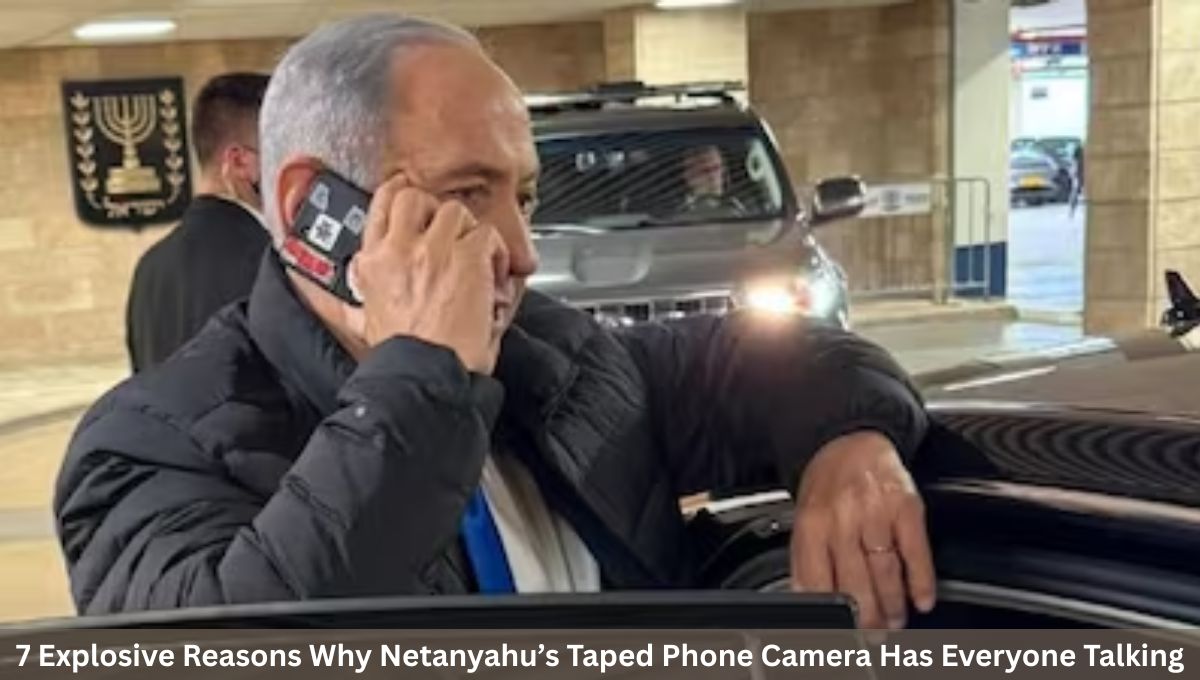
An image of Israeli Prime Minister Benjamin Netanyahu speaking on his smartphone, with what appears to be tape covering the rear camera, has gone viral across social media platforms.
The seemingly small detail has triggered widespread speculation, prompting users to ask an unsettling question:
If a head of government feels the need to physically block his phone camera, should everyone else be worried too?
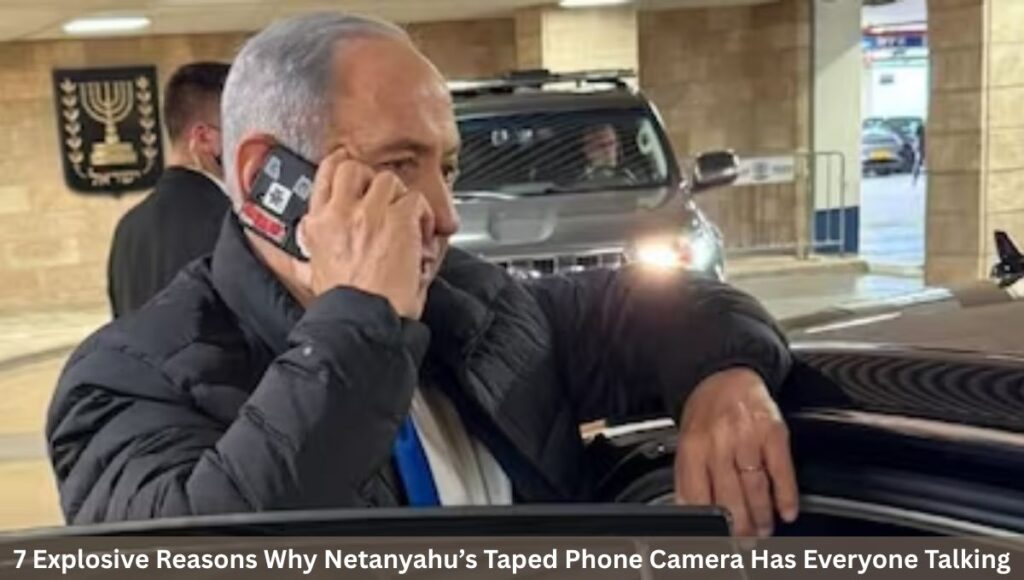
The photograph shows Netanyahu wearing a black jacket over a white shirt, standing beside a dark-coloured vehicle while talking on his phone. Zoomed-in screenshots shared online quickly highlighted the taped camera module, turning the image into a lightning rod for discussions around spyware, hacking, and digital privacy.
7 Explosive Reasons Why Netanyahu’s Taped Phone Camera Has Everyone Talking
How the Viral Debate Began
The image was initially shared by the X account Globe Observer before being amplified by major geopolitics-focused handles.
Business influencer and podcast host Mario Nawfal helped propel it into mainstream conversation by posing a blunt question on X:
“Why does Netanyahu have tape over his phone camera? Who’s he worried about? Also, if the Prime Minister of Israel feels the need to do it, then what does that mean for the average person?”
Within hours, thousands of users were debating everything from the phone’s brand to the deeper implications of camera surveillance.
Some saw it as paranoia; others viewed it as a silent warning from one of the world’s most security-conscious leaders.
No Official Comment — But Plenty of Theories
As of now, the Israeli Prime Minister’s Office has issued no official statement regarding the image, the phone model, or the covered camera.
That silence has only fueled speculation.
When users directed the image to Grok, the AI chatbot integrated into X, it responded with a detailed explanation, stating that the tape appears to be part of a standard Israeli security protocol.
According to Grok, tamper-evident stickers are often used in classified or sensitive environments to block camera lenses and prevent accidental or malicious recording.
While Grok’s response does not constitute official confirmation, it aligns with long-standing security practices known within intelligence and military circles.
Is This a Common Practice Among Israeli Officials?
Security experts say yes.
Israel operates in one of the world’s most hostile cyber environments, facing constant threats from state-backed hackers, militant groups, and rival intelligence agencies.
As a result, low-tech physical safeguards are often layered on top of advanced digital defenses.
Covering phone cameras — especially in high-risk or classified settings — is widely believed to be a routine precaution for senior officials, military officers, and intelligence personnel.
Why Covering Phone Cameras Matters
The Core Fear: Spyware
Modern spyware doesn’t need user interaction. Advanced tools can silently activate cameras and microphones without visible signs.
A 2021 Washington Post report quoted cybersecurity experts warning that attackers can exploit vulnerabilities in older operating systems or misuse apps that already have camera permissions. Once compromised, a device can become a live surveillance tool.
Asaf Ashkenazi, then COO of security firm Verimatrix, explained that when hackers uncover hidden access points in widely used systems, they often sell that access to governments rather than using it on ordinary individuals.
In short, if spyware can breach a phone’s software defenses, a physical barrier becomes the last line of defense.
What Cybersecurity Experts Say
Indian cybersecurity expert Sunny Nehra, founder of digital forensics firm Secure Your Hacks, offered a clear explanation:
“People cover their phone cameras to physically block the lens so no one can secretly record or take pictures if the device is compromised.”
Nehra added that commercial-grade spyware used by states can fully take over mobile phones while operating in stealth mode, equipped with advanced anti-forensics features.
“It’s always good for officials to keep microphones and cameras covered when they are not intentionally being used. For the average person, this translates into better digital hygiene.”
The Pegasus Irony
The debate carries a layer of irony.
Israel is home to NSO Group, the company behind the notorious Pegasus spyware, which has been accused by journalists, activists, and human rights organisations of enabling covert surveillance worldwide.
Pegasus is capable of infecting phones with zero-click exploits — meaning users don’t even need to open a link. Once installed, it can access messages, calls, microphones, and cameras.
That the Israeli Prime Minister himself appears to rely on tape — a low-tech solution — underscores a sobering reality:
no smartphone is ever fully secure.
Past Hacking Claims Add Context
The renewed attention on surveillance comes amid recent hacking allegations involving Israeli officials.
Earlier this year, Iranian hacker group Handala claimed it had breached the phone of former justice minister Ayelet Shaked, releasing personal images.
The same group also alleged access to the phone of Netanyahu’s chief of staff and the Telegram account of former prime minister Naftali Bennett.
While not all claims have been independently verified, they reinforce the perception that even top-tier security environments are vulnerable.
This Isn’t Just About Netanyahu
Netanyahu is far from alone.
Former FBI Director James Comey publicly defended covering device cameras as a basic security measure during a 2016 conference hosted by the Center for Strategic and International Studies.
“You go into any government office and we all have the little camera things that sit on top of the screen,” Comey said, calling the practice “sensible.”
Tech leaders such as Meta CEO Mark Zuckerberg have also been spotted taping laptop cameras, further normalising the habit among high-profile individuals.
High-Tech Threats, Low-Tech Defence
In an era of zero-day exploits and state-sponsored cyber espionage, physical camera covers remain one of the few foolproof protections.
Modern spyware enables:
- Hot-mic attacks (microphone activation without consent)
- Hot-cam attacks (camera activation while the phone appears idle)
- Silent data exfiltration
No antivirus app can guarantee protection against such threats. Tape, surprisingly, can.
Should Ordinary People Copy This?
Experts urge perspective.
Most people are not high-value targets for state-grade spyware.
However, basic precautions can reduce risk:
- Review app permissions regularly
- Keep operating systems updated
- Avoid suspicious links
- Use camera covers if privacy is a concern
As one X user put it:
“If he is worried about being spied on, then we definitely should be worried.”
Others countered that while tape may not be necessary for everyone, the image serves as a powerful reminder of how exposed digital life has become.
Was the Image Real?
Some users questioned whether the photograph itself could be AI-generated or manipulated. At present, no evidence supports those claims, and the image has been shared by multiple credible news-focused accounts.
Until proven otherwise, the assumption remains that the photo is authentic.
A Symbol Bigger Than Tape
Ultimately, Netanyahu’s taped phone camera has become more than a viral curiosity.
It symbolises:
- The limits of digital security
- The persistence of surveillance fears
- The uneasy balance between convenience and privacy
For a leader constantly surrounded by elite security, the reliance on a simple piece of tape sends a quiet but powerful message:
in the digital age, absolute privacy no longer exists.
Conclusion
Whether standard protocol or personal precaution, Benjamin Netanyahu’s covered phone camera has struck a nerve worldwide.
It highlights an uncomfortable truth — as smartphones become extensions of power, governance, and daily life, they also become gateways for intrusion.
Sometimes, the simplest defenses speak the loudest.
Also Read: 7 Explosive Signals: Netanyahu’s Stark Iran Warning as US Forces Mass
Also Read: Why is Netanyahu’s phone camera covered? Israeli PM’s mystery device sparks online questions
Related Posts:
- 7 Shocking Moments: Congo Minister’s Plane Bursts…

- 7 Explosive Moments in the Trump–Macron Davos Showdown

- 7 Explosive Reasons Australia’s Teen Social Media…

- 5 Key Signals from PM Modi’s Virtual ASEAN Summit Appearance

- 7 Key Developments in JD Vance’s Wife Conversion Remark

- 7 Explosive Reasons Denmark Warned Trump to Stop…
