

Thousands gather in Tehran as Iran Holds Grand State Funeral for Slain Commanders, Scientists Amid Rising Tensions. In a powerful display of national mourning and defiance, Iran held a state funeral on Saturday for 60 individuals among them top military commanders, nuclear scientists, and civilians killed during the intense 12-day war with Israel. The capital city of Tehran transformed into a sea of black and red, as thousands of mourners gathered, chanting “Death to America” and “Death to Israel.”
The ceremony, broadcast live on state TV, marked the most significant public funeral for Iranian leaders since the assassination of General Qassem Soleimani in 2020. It also underscored deepening hostilities with the United States, after former President Donald Trump made controversial comments targeting Supreme Leader Ayatollah Ali Khamenei.
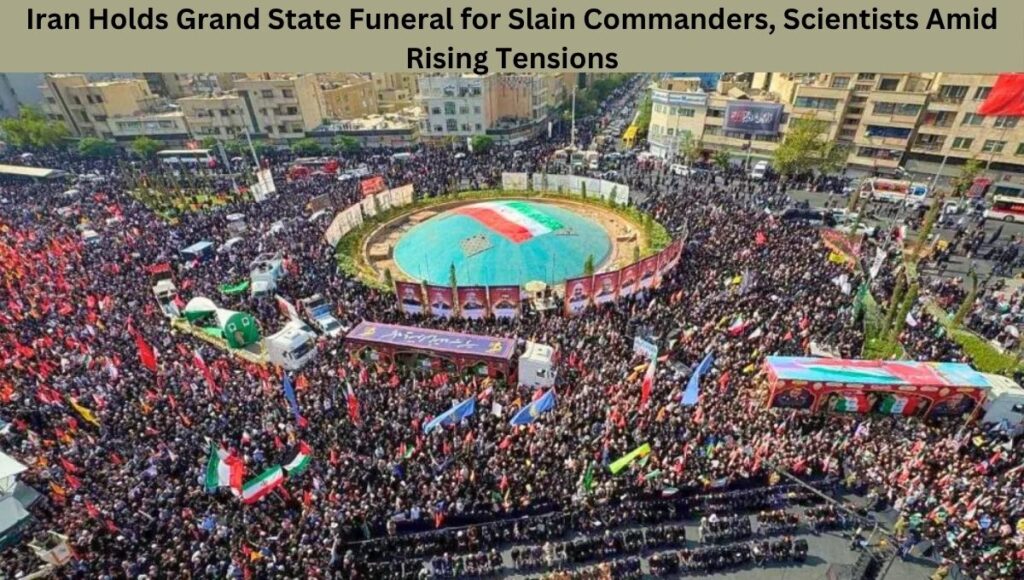
Iran Holds Grand State Funeral for Slain Commanders, Scientists Amid Rising Tensions
Enqelab Square to Azadi: Streets Flooded with Mourners
Beginning early Saturday morning, Enqelab Square and Azadi Street in downtown Tehran were filled with flag-waving crowds. Coffins draped in the Iranian flag were driven on military trucks through the city.
Many bore images of the deceased in uniform, showered with rose petals, as chants echoed across the capital.
Government offices were shut, and public transportation was made free to allow widespread attendance. The ceremony was officially declared by the state as “The Funeral Procession of the Martyrs of Power.”
Who Were the Fallen?
Among the most prominent figures laid to rest were:
- General Hossein Salami, commander-in-chief of the Islamic Revolutionary Guard Corps (IRGC)
- General Amir Ali Hajizadeh, head of the IRGC’s ballistic missile program
- Major General Mohammad Bagheri, second-in-command of Iran’s armed forces
- Dr. Mohammad Mehdi Tehranchi, a top nuclear scientist and head of Azad University in Tehran
- Several women and children, including Bagheri’s wife and journalist daughter
All were reportedly killed during the first Israeli strike on June 13, when Israel launched a multi-targeted assault on Iran’s military and nuclear infrastructure.
Iran Confirms Casualties; HRANA Gives Higher Estimate
Iran’s Health Ministry has confirmed 627 deaths, including dozens of women and children. The Washington-based Human Rights Activists group (HRANA) reported an even higher toll: 974 dead, including 417 civilians.
Israeli officials claimed responsibility for killing around 30 commanders and 11 nuclear scientists, while striking eight nuclear facilities and 720+ military sites.
Iran, for its part, launched over 550 ballistic missiles at Israeli territory, with 28 people killed and 3,200+ injured according to Israeli reports.
Khamenei Missing, Quds Force Commander Spotted
While President Masoud Pezeshkian and senior Iranian officials attended the funeral, Supreme Leader Ayatollah Ali Khamenei was notably absent.
This absence was particularly striking, as Khamenei typically leads prayers over fallen commanders. Khamenei’s last public appearance was on June 11, two days before the war began.
However, he did release a pre-recorded video statement after the ceasefire, downplaying US airstrikes and claiming “victory” over Israel.
Interestingly, General Esmail Qaani, commander of the elite Quds Force, was reportedly seen at the funeral. The New York Times had earlier suggested he may have been killed, though Israel never officially confirmed this.
Trump Sparks Diplomatic Firestorm Over Khamenei Remarks
Former US President Donald Trump injected further tension into the situation on Truth Social, stating he knew “EXACTLY where [Khamenei] was sheltered” and had “saved him from a very ugly and ignominious death.”
Trump added that he had been working on lifting sanctions on Iran in recent days but “immediately dropped all work” after Khamenei’s “statement of anger, hatred, and disgust.”
These comments caused uproar in Tehran, with Foreign Minister Abbas Araghchi calling Trump’s tone “disrespectful and unacceptable.”
Iran’s Response: “No Room for Threats or Insults”
Responding via social media platform X, Araghchi warned that “The Great and Powerful Iranian People… do not take kindly to threats and insults.”
He emphasized Khamenei’s religious and political role as Supreme Leader, stating that anyone familiar with Shia political theology would avoid such remarks publicly.
Araghchi also dismissed Trump’s claim that he was preparing for a nuclear deal, saying no new negotiations are planned.
A Message Beyond Mourning
The state funeral doubled as a strategic message to Iran’s adversaries. Coffins of the fallen commanders were paraded through the city not only as a show of national grief but also as a symbol of resistance.
Many in Iran believe that these leaders died defending the Islamic Republic’s sovereignty and security.
Officials like Ali Shamkhani, Khamenei’s top adviser who was reportedly wounded during the war, also attended.
Missile displays were shown during the procession, a visual reminder of Iran’s military capabilities.
The Damage: Nuclear Program Set Back?
While Iranian leaders claim their nuclear facilities remain largely intact, others suggest the damage was severe.
According to IAEA chief Rafael Grossi, the strikes on Iran’s Fordo facility were “very, very, very considerable,” despite Iranian efforts to downplay the impact.
Israel and the US say the joint operation has set Iran’s nuclear ambitions back by years, though Iran continues to insist its program is for civilian purposes only.
What Comes Next?
With both Israel and Iran claiming victory, Middle East analysts warn that this war has opened a new chapter in a decades-long conflict.
The absence of trust, deepening US-Iran animosity, and collapsed nuclear diplomacy now create an extremely fragile balance.
Trump’s remarks have only made diplomacy more complicated. Araghchi’s rebuttal signals that Iran may further harden its stance in upcoming months.
Meanwhile, the IAEA continues to assess whether enriched uranium or centrifuges were destroyed or moved a key factor in judging the war’s actual impact on Iran’s nuclear capacity.
Conclusion: Tehran’s Funeral Sends a Global Message
Saturday’s state funeral in Tehran was more than just a somber event. It was a political declaration one that conveyed resilience, martyrdom, and national pride, as well as a stark warning to Israel and the United States.
In a single moment of synchronized mourning, the Iranian state mobilized its people and leaders to signal to the world that Iran may have lost lives, but not its resolve.
As images of flag-draped coffins, ballistic missiles, and chants of defiance circulate globally, one thing is clear: this is not the end of the story, but the beginning of a new and more dangerous phase in the Iran-Israel-US triangle.
Also Read: Trump Floats $30 Billion Civil Nuclear Deal to Iran Amid Ceasefire
Also Read: Hundreds of thousands mourn top Iranian military commanders and scientists killed in Israeli strikes
Related Posts:
- 7 Powerful Facts About Ayatollah Ali Khamenei’s…
- 5 Major Takeaways from the US Supreme Court's…

- 3 Explosive Conditions Iran Sets to End War with US…
- 7 Heartbreaking Facts About Venezuela's Earthquake Disaster
- 9 Explosive Claims as Trump Says US Winning Iran War

- 7 Dead in Explosive Iran Protests as Economic Anger…
