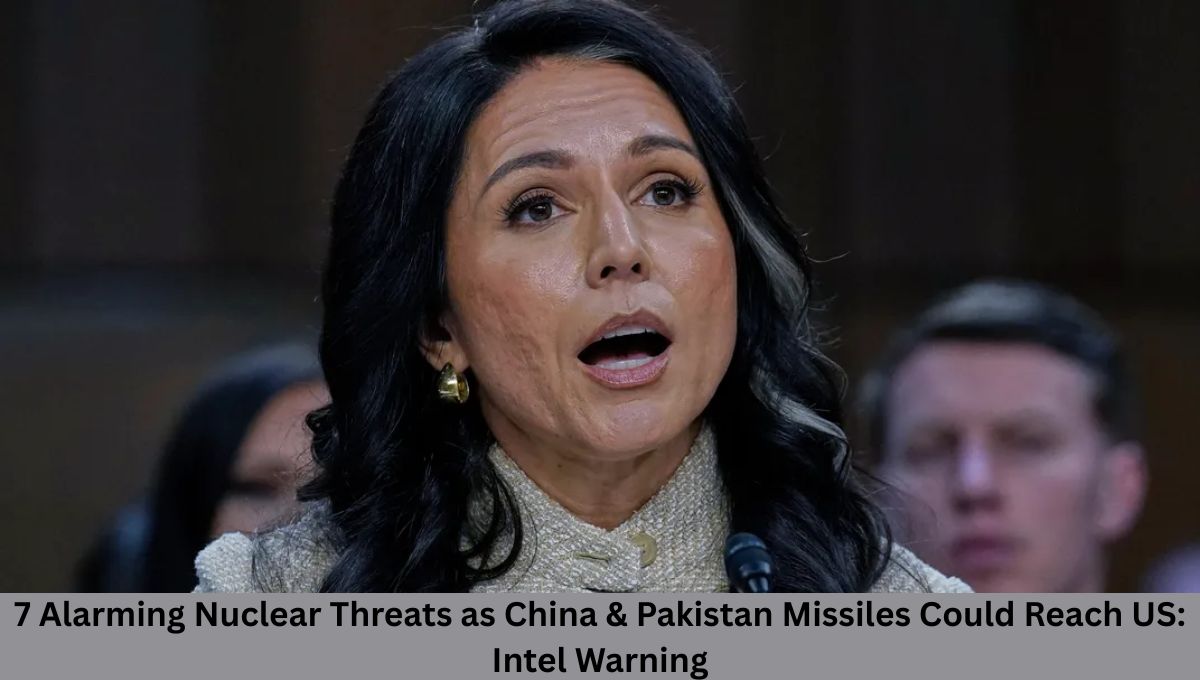
7 Alarming Nuclear Threats as China & Pakistan Missiles Could Reach US: Intel Warning amid surging global risks. The global security landscape is entering a volatile new phase, with rising concerns over nuclear capabilities and long-range missile systems.
In a stark warning to lawmakers, US Director of National Intelligence Tulsi Gabbard revealed that countries including China and Pakistan are advancing missile technologies that could potentially bring the United States within striking range.
Her testimony, delivered during the 2026 Annual Threat Assessment before the Senate Intelligence Committee, underscores a rapidly evolving threat environment—one where traditional deterrence strategies are being challenged by emerging technologies, shifting alliances, and expanding arsenals.
7 Alarming Nuclear Threats as China & Pakistan Missiles Could Reach US: Intel Warning
A Dramatic Surge in Global Missile Threats
One of the most striking revelations from the intelligence report is the projected explosion in the number of missiles capable of striking the United States.
According to Gabbard, the number of such threats is expected to rise from approximately 3,000 in 2025 to over 16,000 by 2035.
This dramatic increase highlights a fundamental shift in global military capabilities. Nations are no longer just modernizing their arsenals—they are scaling them at unprecedented rates.
The implication is clear:
the United States could face a far more complex and saturated threat environment in the coming decade, where missile defense systems may be tested beyond their limits.
China’s Expanding Military Reach
China remains one of the most significant strategic concerns for US intelligence agencies.
Gabbard emphasized that China is developing advanced missile delivery systems designed specifically to penetrate or bypass US missile defense systems.
These systems are not just incremental upgrades but represent next-generation technologies aimed at overcoming traditional defensive barriers.
China’s military modernization includes:
- Hypersonic glide vehicles capable of evading radar detection
- Advanced ballistic missile systems with extended ranges
- Dual-use technologies combining nuclear and conventional capabilities
This evolution signals a move toward a more assertive global military posture, raising concerns among policymakers and defense analysts worldwide.
Pakistan’s Missile Program Raises New Alarms
Pakistan has also emerged as a significant concern in the latest threat assessment.
Gabbard warned that Pakistan’s long-range ballistic missile program could evolve to include intercontinental ballistic missiles (ICBMs)—weapons capable of striking targets thousands of kilometers away, including the US homeland.
While Pakistan’s missile program has historically focused on regional deterrence, particularly in South Asia, this shift suggests a potential expansion of its strategic reach.
Key concerns include:
- Development of longer-range missile systems
- Increasing sophistication in delivery mechanisms
- Potential transition toward intercontinental capabilities
This marks a notable escalation in global nuclear dynamics, especially as new players expand beyond regional defense frameworks.
Russia and Advanced Missile Technologies
Russia continues to be a central player in global nuclear strategy.
According to the assessment, Russia is working alongside China in developing advanced delivery systems capable of bypassing US defenses.
These include:
- Hypersonic missiles
- Maneuverable re-entry vehicles
- Advanced cruise missile platforms
Russia’s continued investment in these technologies reflects its long-standing focus on maintaining strategic parity with the United States.
North Korea’s Immediate Threat Capability
North Korea represents a more immediate and tangible threat.
Gabbard confirmed that North Korea already possesses ICBMs capable of reaching US territory, and is actively expanding its nuclear arsenal.
What makes this particularly concerning is North Korea’s growing alignment with China and Russia.
This emerging cooperation could lead to:
- Shared technological advancements
- Coordinated strategic planning
- Increased global instability
The convergence of these relationships introduces new complexities into global security calculations.
Iran’s Nuclear Program: Degraded but Not Eliminated
Iran remains a critical component of the global threat landscape, though its position has shifted following recent military actions.
Gabbard stated that Iran’s nuclear enrichment program was “obliterated” during the June 2025 US-Israeli strikes, part of an operation aimed at dismantling its nuclear capabilities.
However, she also cautioned that:
- Iran’s regime remains intact
- Its military capabilities are degraded but not destroyed
- It could rebuild over time if conditions allow
Interestingly, her assessment appeared to contradict statements made by Donald Trump, who has previously framed Iran as an ongoing imminent nuclear threat.
A Strategic Contradiction Within the US Leadership
One of the more notable aspects of Gabbard’s testimony was her divergence from the narrative presented by President Trump.
While Trump has emphasized the urgency of confronting Iran’s nuclear ambitions, Gabbard indicated that:
- There is no evidence of Iran attempting to rebuild enrichment capabilities
- The threat, while real, is currently diminished
This discrepancy highlights internal differences in how intelligence assessments are interpreted and communicated at the highest levels of government.
Rising Threats Beyond Nation-States
The report also underscores that global threats are not limited to state actors.
Groups such as:
- Al-Qaeda
- ISIS
continue to pose significant risks to US interests, particularly across:
- Africa
- The Middle East
- South Asia
These organizations maintain operational capabilities and continue to exploit instability in fragile regions.
Shifting Global Alliances and Strategic Implications
A key theme in the assessment is the emergence of new geopolitical alignments.
The strengthening ties between:
- China
- Russia
- North Korea
signal a shift toward a more coordinated opposition to US influence.
This alignment could result in:
- Shared military technologies
- Joint strategic initiatives
- Increased pressure on US global dominance
Such developments suggest that future conflicts may not be isolated but could involve coordinated multi-state actions.
India-Pakistan Dynamics and Nuclear Risk
The report also touches on the fragile relationship between India and Pakistan.
While both nations are assessed as not seeking direct conflict, the presence of terrorist actors continues to pose a risk of escalation.
This dynamic creates a persistent risk of:
- Sudden military confrontations
- Nuclear escalation in worst-case scenarios
- Regional instability with global implications
The Role of Emerging Technologies
Another critical dimension of the evolving threat landscape is the role of emerging technologies.
Countries are increasingly combining:
- High-end missile systems
- Low-cost drones
- Cyber warfare capabilities
This hybrid approach is designed to:
- Overwhelm defense systems
- Reduce costs of warfare
- Increase unpredictability
Such strategies complicate traditional defense planning and require adaptive responses.
What This Means for Global Security
The implications of the 2026 threat assessment are far-reaching.
Key takeaways include:
- The global missile threat is expanding rapidly
- Multiple nations are developing capabilities to strike the US
- Traditional defense systems may face increasing pressure
- Alliances among US adversaries are strengthening
This combination creates a more complex and uncertain security environment than at any point in recent history.
A World Entering a New Strategic Era
The testimony by Tulsi Gabbard serves as a warning that the world is entering a new era of strategic competition.
Unlike the Cold War, where two superpowers dominated the nuclear landscape, today’s environment involves multiple actors with varying capabilities and intentions.
This multipolar threat structure introduces:
- Greater unpredictability
- Increased risk of miscalculation
- Higher stakes in global diplomacy
Conclusion
The latest US intelligence assessment paints a sobering picture of the future.
With China and Pakistan advancing missile technologies, North Korea expanding its arsenal, and Russia refining its capabilities, the global nuclear balance is shifting rapidly.
At the same time, weakened but resilient actors like Iran—and persistent threats from extremist groups—add further complexity to an already fragile system.
As the number of potential missile threats surges toward 16,000 by 2035, the challenge for global leaders will be not just deterrence, but adaptation in an increasingly unpredictable world.
The message from Washington is clear:
the era of limited nuclear threats is over, and a far more complex strategic landscape is emerging.
Also Read: 7 Explosive Warnings: Trump’s Iran Nuclear Gamble That Could Ignite the Middle East
Related Posts:
- Trump Accuses Obama of Treason Over 2016 Russia Probe

- 7 Big Takeaways: Macron’s High-Stakes China Visit…

- 5 Major Takeaways from the US Supreme Court's…

- 7 Powerful Facts About Ayatollah Ali Khamenei’s…

- 3 Explosive Conditions Iran Sets to End War with US…

- 7 Powerful Shifts: Venezuela to Supply Up to 1,000…