
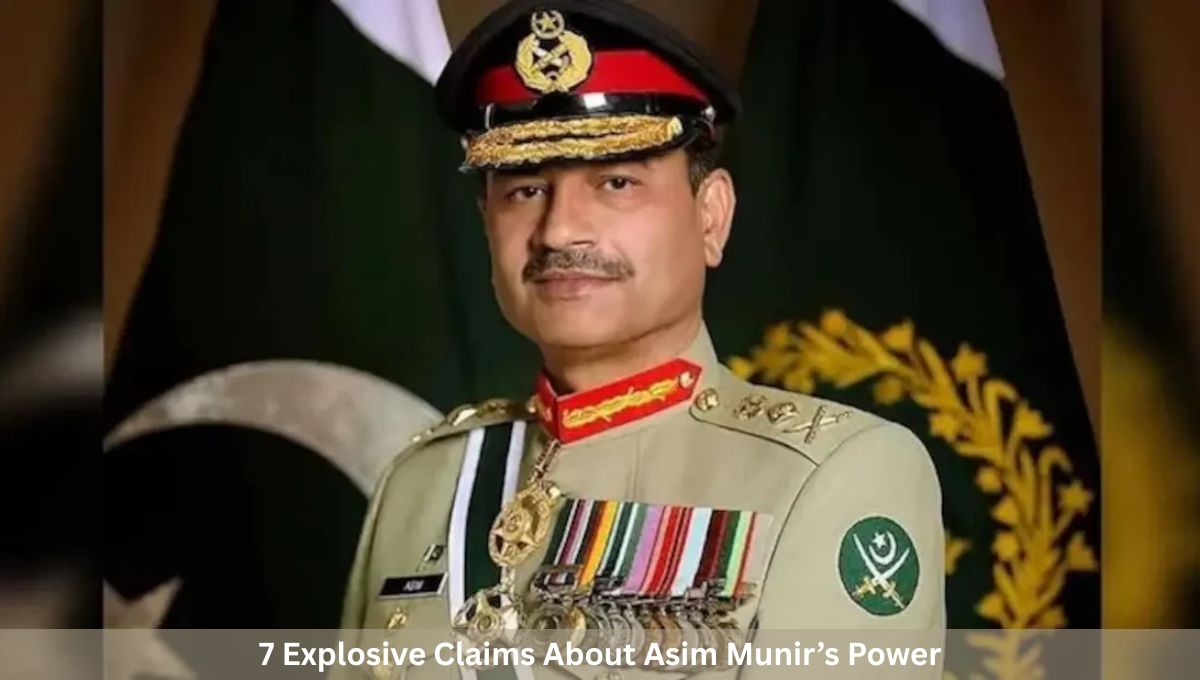
7 Explosive Claims About Asim Munir’s Power amid his growing influence over Prime Minister Shehbaz Sharif. The political landscape in Pakistan has once again come under intense global scrutiny after former Information Minister Fawad Chaudhry made a striking assertion: the country is effectively being run by its Army Chief, Asim Munir, rather than its elected Prime Minister, Shehbaz Sharif.
His remarks, delivered during a media interaction, have sparked fresh debate about the balance of power within Pakistan — a debate that has existed for decades but has now resurfaced with renewed intensity due to recent geopolitical developments.
At the center of this controversy lies not just domestic politics, but Pakistan’s increasingly prominent role in mediating sensitive international negotiations, particularly between the United States and Iran.
7 Explosive Claims About Asim Munir’s Power
What Exactly Did Fawad Chaudhry Say?
Fawad Chaudhry did not mince words when describing Pakistan’s current leadership structure.
He stated clearly that:
- There is “no two opinions” about who holds real power
- Decision-making authority lies with the Army Chief
- Civilian leadership appears sidelined
According to Chaudhry, Asim Munir has emerged as the “de facto leader” of Pakistan — a term that implies actual control regardless of formal titles.
He also pointed to remarks by Donald Trump, claiming that the US President referred to Munir as Pakistan’s leader while failing to mention Prime Minister Sharif.
While Trump has praised both leaders in different contexts, the perception created by selective references has added fuel to the ongoing debate.
The Timing: Why This Debate Matters Now
This controversy is not emerging in isolation. It coincides with a period when Pakistan is playing a crucial diplomatic role on the global stage.
Pakistan as a Mediator
In recent weeks, Pakistan has positioned itself as a mediator in high-stakes talks between:
- The United States
- Iran
These discussions, aimed at reducing tensions amid an ongoing conflict in the Middle East, have placed Islamabad at the center of global diplomacy.
Notably, Asim Munir has been:
- Personally receiving foreign delegations
- Engaging directly with senior US officials like JD Vance
- Traveling to Tehran for diplomatic outreach
Such visibility has reinforced the perception that the military — rather than the civilian government — is steering Pakistan’s foreign policy.
Munir’s Expanding Diplomatic Role
One of the strongest arguments supporting Chaudhry’s claim is Munir’s increasingly visible presence in international diplomacy.
Direct Engagement with Global Powers
Munir has taken on roles traditionally reserved for elected leaders, including:
- Hosting US and Iranian delegations
- Facilitating dialogue between rival nations
- Acting as an intermediary for sensitive communications
His recent visit to Tehran further highlights his involvement in shaping regional diplomacy.
Leadership Optics
Diplomacy is not just about negotiations — it’s also about optics.
And Munir’s actions have sent strong signals:
- He is often the first point of contact for foreign delegations
- He engages in strategic discussions directly
- He represents Pakistan in critical global conversations
This level of involvement naturally raises questions about where the real authority lies.
Trump’s Remarks: A Diplomatic Signal?
Much of the controversy stems from how international leaders, especially Donald Trump, have publicly framed Pakistan’s leadership.
Trump reportedly:
- Praised Asim Munir as a “fantastic leader”
- Expressed confidence in his ability to manage diplomacy
- Did not prominently reference Shehbaz Sharif in certain remarks
Even if not intentional, such statements can shape global perceptions.
Why It Matters
In international politics:
- Recognition equals legitimacy
- Leaders acknowledged by global powers gain influence
- Diplomatic engagement often reflects real power structures
Trump’s comments, therefore, are being interpreted as a subtle acknowledgment of Munir’s influence.
Pakistan’s Historical Context: Military vs Civilian Power
To understand why these claims resonate, one must look at Pakistan’s political history.
A Pattern of Military Influence
Pakistan’s military has:
- Ruled directly for nearly half of the country’s existence
- Maintained control over foreign policy even under civilian governments
- Played a decisive role in national security and strategic decisions
Civil-Military Dynamics
Even during democratic periods:
- Prime Ministers often share power with the military
- Key decisions, especially in foreign affairs, involve military input
- The Army Chief is one of the most powerful figures in the country
In this context, Chaudhry’s remarks are not entirely unprecedented — but they are unusually direct.
The “Dress Diplomacy” Factor
An interesting dimension of Munir’s growing influence is what analysts are calling “dress diplomacy.”
Two Different Appearances
- When meeting Iranian officials, Munir wore military uniform
- When engaging with US representatives, he appeared in a formal suit
Interpreting the Signals
Experts suggest:
- The uniform signals military authority and strength
- The suit projects statesmanship and diplomatic balance
This dual messaging reflects a calculated approach to international engagement — reinforcing Munir’s multifaceted role.
Where Does Shehbaz Sharif Stand?
While Munir’s influence appears to be growing, it’s important not to overlook Prime Minister Shehbaz Sharif entirely.
The Civilian Role
Sharif continues to:
- Lead the elected government
- Manage domestic policy and governance
- Represent Pakistan in formal political structures
Perception vs Reality
However, perception often matters more than formal authority.
The current narrative suggests:
- Sharif is less visible in high-stakes diplomacy
- Munir is increasingly seen as the decision-maker
- International engagement is tilted toward military leadership
This imbalance is what fuels the “de facto leader” argument.
Economic Pressures Add to the Debate
Fawad Chaudhry also linked the leadership debate to Pakistan’s economic challenges.
Rising Costs and Global Tensions
The ongoing Middle East conflict has:
- Increased oil and gas prices
- Strained Pakistan’s foreign reserves
- Raised import costs
Impact on Citizens
According to Chaudhry:
- The middle class is feeling the pressure
- Fuel and food costs are rising
- Economic stability is under threat
These challenges make leadership clarity even more critical.
Global Implications of Pakistan’s Power Structure
The question of who leads Pakistan is not just a domestic issue — it has global implications.
Why the World Is Watching
Pakistan’s role in:
- Nuclear security
- Regional stability
- US-Iran diplomacy
makes its internal power dynamics highly relevant.
Strategic Importance
If the military is indeed leading:
- Foreign governments may engage directly with the Army Chief
- Diplomatic channels could bypass civilian institutions
- Policy decisions may reflect security priorities over political ones
Are Chaudhry’s Claims Entirely Accurate?
While the claims are dramatic, they require careful evaluation.
Points Supporting His Argument
- Munir’s visible diplomatic leadership
- Trump’s praise and references
- Historical military dominance
Points That Complicate the Narrative
- Pakistan still has a functioning civilian government
- Sharif remains the official head of government
- Trump has also praised Sharif in other contexts
The Reality
The truth likely lies somewhere in between:
- Pakistan operates with shared power
- The military holds significant influence
- Civilian leadership remains institutionally important
The Bigger Question: Who Really Runs Pakistan?
This debate ultimately comes down to a fundamental question:
Is Pakistan a civilian-led democracy with military influence, or a military-led system with civilian representation?
Indicators of Military Dominance
- Control over foreign policy
- Direct engagement with global leaders
- Strategic decision-making authority
Indicators of Civilian Governance
- Democratic elections
- Parliamentary system
- Formal executive authority
Pakistan’s system appears to blend both — but the balance may be shifting.
What Happens Next?
The coming weeks could provide more clarity.
Key Developments to Watch
- Future US-Iran talks in Pakistan
- Munir’s continued diplomatic role
- Sharif’s visibility in global engagements
Possible Outcomes
- Military dominance becomes more explicit
- Civilian leadership reasserts visibility
- Hybrid power structure continues
Conclusion: A Debate Far From Settled
Fawad Chaudhry’s remarks have reignited a long-standing debate — one that goes to the heart of Pakistan’s political identity.
Whether Asim Munir is truly the “de facto leader” or simply a powerful military figure operating alongside civilian leadership remains open to interpretation.
What is clear, however, is this:
- Pakistan’s military continues to wield significant influence
- Global diplomacy is amplifying that visibility
- The line between civilian and military authority is increasingly blurred
As geopolitical tensions rise and Pakistan’s role on the world stage expands, this question will only become more important — not just for Pakistan, but for the global community watching closely.
Also Read: Trump Hosts Pakistan’s Munir, Claims Credit for Averting War
Also Read: Truth about Pakistan, Munir revealed: Iran visit video spills beans
Related Posts:
- 7 Shocking Reasons US Sees Asim Munir as a Strategic…
- 7 Urgent Revelations as Imran Khan’s Isolation…
- 9 Critical Pressures Trapping Pakistan’s Army Chief…

- Trump Keeps Pakistan PM Shehbaz Sharif & Army Chief…

- 12 Explosive Claims as Donald Trump Says Iran War…
- 9 Powerful Signals Behind Saudi Arabia Honoring…
