
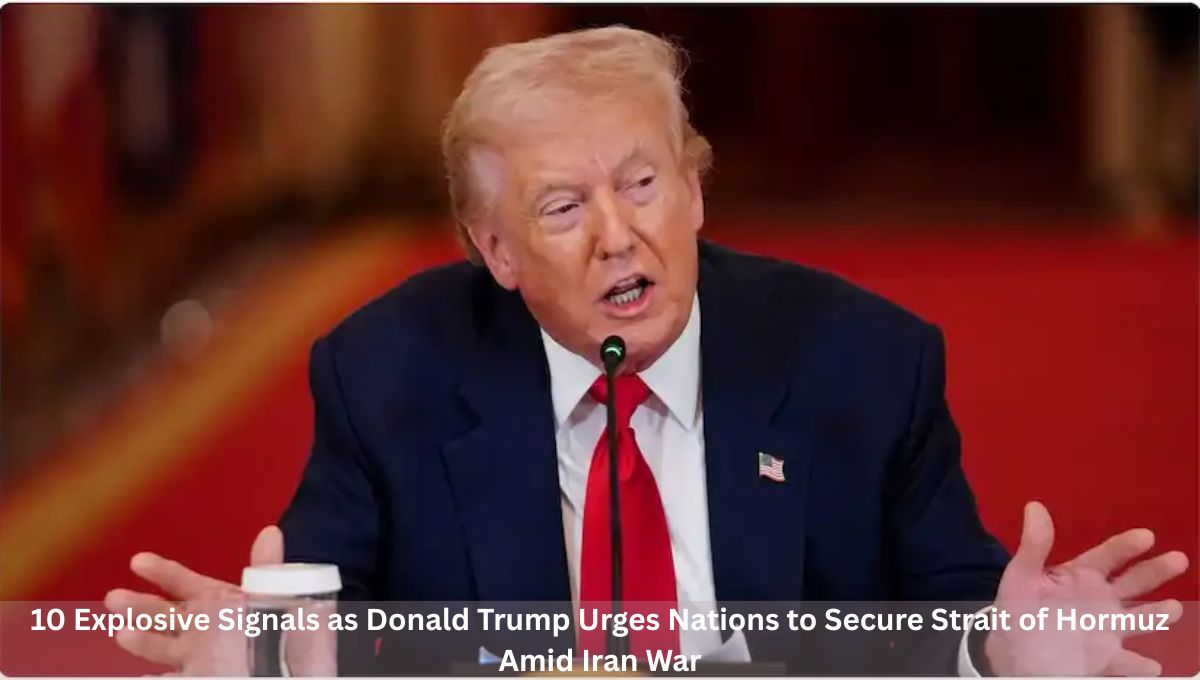
10 Explosive Signals as Donald Trump Urges Nations to Secure Strait of Hormuz Amid Iran War and oil supply disruptions. U.S. President Donald Trump has called on several countries to help secure the vital maritime chokepoint known as the Strait of Hormuz, arguing that nations heavily dependent on Middle Eastern oil should shoulder more responsibility for protecting the shipping route.
Thank you for reading this post, don't forget to subscribe!Speaking to reporters aboard Air Force One, Trump said countries such as China and other major oil importers should deploy warships to protect tanker traffic moving through the strategic waterway. The remarks come as the ongoing war involving the United States, Israel, and Iran continues to disrupt energy markets and global trade routes.
The situation has already pushed oil prices above $100 per barrel and caused major disruptions to maritime traffic through one of the most important shipping corridors in the world.
Trump’s demand for international participation highlights both the geopolitical stakes of the conflict and the growing pressure on governments to prevent a prolonged global energy crisis.
10 Explosive Signals as Donald Trump Urges Nations to Secure Strait of Hormuz Amid Iran War
The Strategic Importance of the Strait of Hormuz
A Narrow Passage With Global Impact
The Strait of Hormuz is one of the most strategically significant maritime passages on the planet.
Located between the Persian Gulf and the Gulf of Oman, the narrow waterway acts as a gateway for oil exports from some of the world’s largest energy producers.
Countries that rely heavily on the route include:
- Saudi Arabia
- United Arab Emirates
- Kuwait
- Iraq
- Iran
Energy analysts estimate that nearly 20 percent of the world’s total oil supply passes through this narrow shipping corridor.
This makes the Strait of Hormuz a critical artery for global energy markets and international trade.
Any disruption in the strait can quickly trigger spikes in oil prices and supply shortages across the world.
How Much Oil Flows Through the Strait
Energy shipping data shows that between 17 and 21 million barrels of oil typically pass through the strait every day.
The majority of this crude oil is destined for Asian markets, particularly major economies such as:
- China
- Japan
- South Korea
- India
Because these nations rely heavily on imported energy, disruptions to the strait could have major consequences for global manufacturing, transportation, and economic stability.
Trump’s Argument: Other Countries Benefit More Than the U.S.
Why Trump Says Others Should Defend the Strait
Trump argued that the United States depends far less on oil passing through the Strait of Hormuz than other countries do.
According to Trump, American imports represent only a small portion of the energy flowing through the waterway. Meanwhile, Asian economies rely on it far more heavily.
Trump told reporters:
“Why are we maintaining the Hormuz Strait when it’s really there for China and many other countries?”
He claimed that nearly 90 percent of China’s crude oil imports pass through the strait, while the United States relies on the route for only a small share of its energy supply.
Analysts Question Some Claims
Energy analysts have pointed out that while China is heavily dependent on Gulf oil, it has spent decades diversifying its supply chain.
Beijing has invested in:
- Pipeline routes from Russia and Central Asia
- Strategic petroleum reserves
- Alternative shipping routes
These measures are designed to reduce vulnerability to disruptions in critical chokepoints such as the Strait of Hormuz.
Oil Prices Surge as Shipping Disruptions Intensify
Global Markets React to the Crisis
Energy markets have already reacted strongly to the instability surrounding the Strait of Hormuz. Oil prices surged as fears of a prolonged blockade intensified.
At the start of the week:
- U.S. benchmark West Texas Intermediate traded near $99 per barrel
- Global benchmark Brent crude climbed above $104 per barrel
The price increase reflects growing concerns that energy supplies could face severe disruptions if tanker traffic cannot safely pass through the strait.
Impact on Consumers Worldwide
Higher oil prices affect nearly every aspect of the global economy.
Rising crude costs typically lead to:
- Higher gasoline prices
- Increased transportation costs
- Rising food prices
- Inflation across multiple industries
Because oil remains a key component of the global energy system, disruptions in the Strait of Hormuz can ripple across markets worldwide.
Limited Support From U.S. Allies So Far
Despite Trump’s calls for international support, several key allies have signaled reluctance to deploy naval forces to the region.
Japan Signals No Immediate Plan
The government of Japan has stated that it currently has no plans to send warships to escort vessels in the Strait of Hormuz.
Japanese Prime Minister Sanae Takaichi told parliament that the country must carefully consider its legal and constitutional framework before taking such action.
Japan’s pacifist constitution places strict limits on military deployments overseas.
Australia Also Declines Participation
Officials in Australia have also said there are no plans to send naval ships to the strait.
Australian Transport Minister Catherine King stated that Canberra had not received a formal request from Washington to participate in the mission.
Europe Responds With Caution
Several European countries have taken a cautious stance toward Trump’s proposal.
Leaders in the United Kingdom and France have acknowledged the importance of reopening the strait but have stopped short of committing military forces.
British Prime Minister Keir Starmer reportedly discussed the issue with Trump but did not announce immediate plans to deploy warships.
Trump Pressures Allies and NATO
Trump has also used strong rhetoric to pressure allied nations to participate in securing the Strait of Hormuz.
He suggested that the future of the North Atlantic Treaty Organization could be affected by how member states respond to the request.
“We’re always there for NATO,” Trump said. “If countries don’t respond, we will remember.”
Such remarks highlight tensions between Washington and its allies over burden-sharing in global security operations.
Reports indicate that the United States is attempting to assemble a multinational naval coalition to escort commercial vessels through the Strait of Hormuz.
The coalition could include countries such as:
- United Kingdom
- France
- Japan
- South Korea
- India
- China
However, no government has publicly confirmed its participation so far.
The Military Situation Around the Strait
Shipping Traffic Near Standstill
Commercial shipping through the Strait of Hormuz has slowed dramatically since the war began.
Many shipping companies have halted tanker operations due to fears of attacks. Some vessels have been damaged in recent weeks amid escalating hostilities in the region.
Attacks and Drone Incidents
The conflict has also seen an increase in drone and missile strikes targeting Gulf infrastructure.
Recent incidents include:
- Drone strikes near Dubai
- Missile interceptions over Israel
- Drone attacks on energy facilities in the Gulf
These incidents have further heightened concerns about the security of international shipping lanes.
Why the U.S. May Need International Support
Even though the United States has the world’s most powerful navy, securing the Strait of Hormuz is a complex task.
Challenges include:
- Protecting thousands of commercial vessels
- Monitoring a large maritime area
- Countering drones, mines, and missile threats
- Escorting tankers through narrow shipping lanes
A multinational coalition could spread the burden across several navies while ensuring continuous protection for shipping traffic.
The War With Iran: A Conflict Still Unfolding
Despite Trump’s claims that the United States has already dealt major damage to Iran’s military capabilities, the conflict shows no clear signs of ending.
Iran continues to launch drone and missile attacks across the region.
Meanwhile, the United States and Israel have carried out multiple airstrikes targeting Iranian military infrastructure.
The situation remains volatile, with analysts warning that the conflict could escalate further if shipping routes remain disrupted.
The Risk of a Global Energy Crisis
If the Strait of Hormuz remains partially closed or dangerous for shipping, the consequences could be severe.
Potential impacts include:
- A prolonged spike in oil prices
- Supply shortages in Asia and Europe
- Increased inflation globally
- Economic instability in energy-dependent economies
Because of these risks, international pressure is mounting to ensure that the waterway remains open.
China and Asia’s Stakes in the Strait
Countries in Asia are among the biggest stakeholders in the stability of the Strait of Hormuz. China alone imports millions of barrels of oil daily from the Gulf region.
Similarly, Japan, South Korea, and India rely heavily on Middle Eastern crude to power their economies.
For these nations, any prolonged disruption in tanker traffic could have serious economic consequences.
Could the Conflict Expand Further?
Military analysts warn that if tensions escalate further, the conflict could spread beyond Iran.
Potential flashpoints include:
- Gulf oil facilities
- Maritime trade routes
- U.S. military bases in the region
Such developments could transform the current crisis into a broader regional conflict.
The Diplomatic Challenge Ahead
At the same time, diplomatic efforts to de-escalate the conflict remain limited. Iran has rejected calls for unconditional surrender and says it will continue defending itself.
Meanwhile, the United States and its allies are exploring military and economic strategies to pressure Tehran.
The absence of active peace negotiations means the crisis could continue for weeks or even months.
The Global Stakes of the Hormuz Crisis
The struggle over the Strait of Hormuz is not simply a regional dispute. It is a confrontation with global consequences.
Because so much of the world’s energy passes through the narrow passage, stability in the region affects economies across every continent.
This is why the debate over who should secure the strait has become such a critical issue in international politics.
Conclusion: A Strategic Crossroads for Global Energy Security
As tensions in the Middle East intensify, the future of the Strait of Hormuz remains uncertain.
President Donald Trump’s call for other nations to deploy warships reflects both the strategic importance of the waterway and the growing pressure on governments to prevent a global energy crisis.
However, the cautious response from several allies shows that building a multinational coalition may prove difficult.
For now, the world is watching closely as geopolitical tensions, energy markets, and military operations converge around one of the most important chokepoints on the planet.
The coming weeks may determine whether the Strait of Hormuz becomes a symbol of international cooperation — or the epicenter of a much larger global crisis.
Also Read: Trump seeks naval coalition to open Strait of Hormuz: Is anyone joining?
Related Posts:
- 11 Explosive Warnings as Trump Vows to ‘Knock the…

- “Don’t Want Them To Buy Russian Oil”: Trump Urges…
- 10 Explosive Signals: Trump Rates Iran War “15/10”…
- 10 Powerful Revelations from the Trump–Putin Call on…

- Can the EU and NATO Impose Tariffs on India and…

- 5 Powerful Highlights as Trump Lands Second Nobel…
