
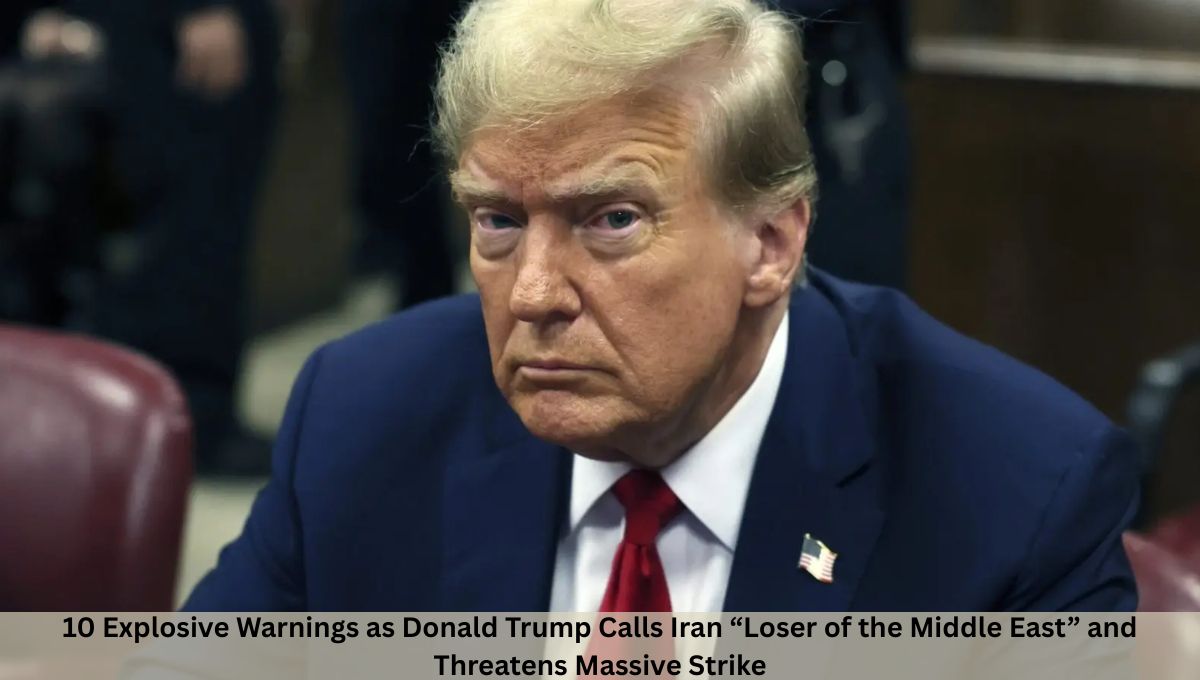
10 Explosive Warnings as Donald Trump Calls Iran “Loser of the Middle East” and Threatens Massive Strike, signaling a dangerous new phase in the conflict. The war between the United States, Israel, and Iran entered a volatile new phase this weekend after US President Donald Trump labeled Tehran the “loser of the Middle East” and warned that the country would be hit “very hard echoed across several Middle Eastern cities, including Dubai, while Iran’s president issued an apology to neighboring countries affected by missile and drone attacks launched during the escalating conflict.
The confrontation, which began after US-Israeli strikes inside Iran in late February, has already caused hundreds of deaths, triggered massive military retaliation across the region, and pushed global oil markets toward instability.
Trump’s latest warning suggests that the conflict could soon intensify further, potentially expanding beyond Iran and Israel to engulf the wider Middle East.
10 Explosive Warnings as Donald Trump Calls Iran “Loser of the Middle East” and Threatens Massive Strike
Trump Labels Iran the “Loser of the Middle East”
In a fiery message posted on his social media platform Truth Social, Donald Trump declared that Iran had lost its long-standing influence in the region.
“Iran is no longer the bully of the Middle East,” Trump wrote. “They are now the loser of the Middle East and will remain so for decades until they surrender or completely collapse.”
The US president claimed Iran had effectively backed down by apologizing to neighboring Gulf countries after attacks targeted several states hosting American military bases.
According to Trump, Iran’s apology demonstrated the success of relentless US and Israeli military pressure.
“Iran, which is being beat to hell, has apologized and surrendered to its Middle East neighbors and promised it will not shoot at them anymore,” he wrote.
Trump added that Iran’s decision to halt attacks on nearby countries came only after sustained military strikes by the United States and Israel severely weakened Tehran’s military infrastructure.
Threat of a Major Strike
Trump also issued a stark warning that Iran could face an even more devastating wave of attacks. “Today Iran will be hit very hard,” he said.
He suggested that additional targets could soon be considered for military action, including areas and groups that had not previously been targeted.
“Under serious consideration for complete destruction and certain death are areas and groups of people that were not considered for targeting up until this moment,” Trump wrote.
The comments fueled speculation that the United States may be preparing a broader military campaign aimed not only at Iran’s military assets but potentially at its leadership structure as well.
Trump Demands “Unconditional Surrender”
A day before his latest remarks, Trump demanded what he called Iran’s unconditional surrender as the only acceptable path to ending the war.
He argued that once Iran’s leadership capitulates, the United States and its allies could help rebuild the country’s economy.
According to Trump, the goal would be to bring Iran “back from the brink of destruction.”
He promised that Iran could become economically stronger than ever if a new leadership structure emerged that cooperated with Western powers.
However, his comments also suggested that the United States might continue the war until Iran’s military capacity is completely dismantled.
Speaking to reporters aboard Air Force One, Trump raised the possibility that the conflict could end only after Iran no longer has a functioning military or leadership capable of negotiating.
“At some point there might not be anybody left to say we surrender,” he said.
Iran’s President Apologizes to Gulf Neighbors
Iranian President Masoud Pezeshkian attempted to ease tensions across the region by apologizing to Gulf countries affected by Iranian attacks.
“I personally apologize to neighboring countries that were affected by Iran’s actions,” he said.
Pezeshkian emphasized that Iran has no intention of attacking its neighbors and described them as regional “brothers.”
He also announced that Iran’s temporary leadership council had agreed to halt missile and drone strikes against Gulf states unless attacks on Iran originate from their territory.
The announcement appeared aimed at preventing countries such as Saudi Arabia, the United Arab Emirates, and Kuwait from joining the US-Israeli military campaign.
However, the apology has triggered criticism among hardline political factions inside Iran, who view it as a sign of weakness during wartime.
Explosions Reported Across the Gulf
Despite the announcement, military activity continued across the region.
Residents in Dubai reported hearing several loud explosions early Saturday morning. Authorities later confirmed that air defense systems had been activated.
Passengers at Dubai International Airport, one of the world’s busiest travel hubs, were briefly moved into underground train tunnels after security alerts were triggered.
Several Gulf governments reported intercepting Iranian missiles and drones targeting their territory.
Officials in the United Arab Emirates said their air defenses intercepted multiple ballistic missiles and over one hundred drones during the latest wave of attacks.
Saudi Arabia also reported intercepting drones aimed at its massive Shaybah oil field.
The continued attacks raised concerns that the conflict could spread across the Gulf region, which hosts numerous US military bases.
Rising Casualties Across the Region
The conflict has already resulted in significant casualties across multiple countries. Officials reported that more than 1,200 people have been killed in Iran since the start of the war, with thousands more injured.
In Lebanon, where fighting between Israel and Hezbollah has intensified, more than 200 people have died in recent Israeli strikes. Israel has reported at least 10 deaths from Iranian missile attacks.
The United States has also confirmed that six American service members were killed during the conflict. The death toll could continue to rise as both sides escalate military operations.
Massive Bombing Campaign Expected
US Treasury Secretary Scott Bessent said in a recent television interview that the largest bombing campaign of the war may still be ahead.
According to Bessent, the United States and Israel are continuing to target Iran’s military infrastructure, leadership network, and nuclear facilities.
Over the past week, dozens of Iranian military bases, missile launch sites, and air defense systems have reportedly been destroyed.
Israeli officials claim they have already achieved near-complete air superiority over parts of Iran, significantly weakening Tehran’s ability to defend its airspace.
The Israeli military also said it had struck aircraft and military installations at Tehran’s Mehrabad Airport, which it described as a key hub for Iran’s Revolutionary Guards.
Iran’s Military Retaliation
Despite heavy losses, Iran has continued launching retaliatory attacks across the region. The Islamic Revolutionary Guard Corps reportedly targeted US forces stationed at a military base in Bahrain.
Iranian forces have also launched missile and drone attacks toward Israel and several Gulf countries hosting American troops.
Tehran’s strategy appears aimed at expanding the cost of the war by threatening regional energy infrastructure and international shipping routes.
Analysts say Iran may be trying to create maximum pressure on global markets and international trade in order to force a diplomatic resolution.
Strait of Hormuz Crisis Raises Global Concerns
One of the most alarming consequences of the conflict is the potential disruption of the Strait of Hormuz, one of the world’s most critical energy shipping routes.
The narrow waterway carries roughly one-fifth of global oil supplies. Reports indicate that tanker traffic through the strait has slowed significantly as security risks increase.
Oil prices have surged to multi-year highs amid fears that the conflict could shut down the passage entirely.
Several Middle Eastern countries have already begun reducing oil production as a precautionary measure.
Kuwait’s national oil company announced cuts to output, while Iraq and Qatar also reduced production levels earlier in the week.
Israel Expands War Into Lebanon
The regional conflict has also expanded into Lebanon, where Israel has intensified its military operations against Hezbollah.
Israeli airstrikes have destroyed large sections of Beirut’s southern suburbs, which are considered strongholds of the Iranian-backed militant group.
At least four people were killed in a strike on an apartment building in central Beirut, marking the first attack on the heart of the Lebanese capital since the conflict resumed.
Israeli officials warned that Lebanon would face a “very heavy price” if the government fails to rein in Hezbollah forces operating along the border.
The warning suggests that Israel may launch a broader military campaign inside Lebanon if Hezbollah continues to fire rockets toward Israeli territory.
Political Turmoil Inside Iran
Inside Iran, the war has triggered political turmoil and uncertainty about the country’s leadership.
Hardline clerics have reportedly called for the swift selection of a new supreme leader following the death of Ayatollah Ali Khamenei earlier in the conflict.
Several high-level meetings among Iran’s religious and political leadership are expected to take place in the coming days.
The outcome could shape Iran’s strategy in the war and determine whether the country moves toward negotiation or further escalation.
Attacks Beyond the Middle East
The conflict’s ripple effects have already reached beyond the Middle East. In Norway’s capital Oslo, an explosion struck the compound of the US embassy early Sunday morning.
Authorities said the blast caused minor damage but no injuries.
Officials have not yet determined the cause of the explosion, but investigators are examining whether it could be linked to the broader Iran-related tensions.
US intelligence agencies have previously warned that Iran or its allied networks could attempt retaliatory attacks against American interests worldwide.
Controversy Over Civilian Casualties
Another major controversy surrounding the conflict involves civilian casualties.
Iran’s ambassador to the United Nations has accused US and Israeli forces of killing more than 1,300 civilians during the strikes.
One of the most shocking incidents involved a strike on an Iranian girls’ school that reportedly killed dozens of children.
US officials told reporters the attack may have been carried out by American forces, although investigations are still ongoing.
However, Trump disputed that claim and suggested Iran itself may have been responsible.
“They have no accuracy whatsoever,” Trump said when discussing Iran’s missile capabilities. “They are very inaccurate with their munitions.”
The conflicting narratives have intensified global debate about the humanitarian consequences of the war.
Global Markets React to the Conflict
Financial markets around the world have been shaken by the rapidly escalating conflict. Energy prices have surged due to fears of supply disruptions from the Middle East.
Shipping routes across the Gulf have become increasingly risky, affecting international logistics and trade. Airlines have also canceled or rerouted flights across parts of the region due to security concerns.
Thousands of travelers have been stranded at airports after several Gulf states temporarily suspended flight operations following missile alerts.
What Happens Next
With military operations intensifying and diplomatic tensions rising, analysts warn that the conflict could escalate into one of the most dangerous wars in the Middle East in decades.
Several scenarios remain possible. The United States and Israel could launch a much larger bombing campaign aimed at crippling Iran’s military capabilities.
Iran could retaliate by expanding attacks across the region, potentially targeting energy infrastructure or international shipping lanes.
Another possibility is that international pressure forces both sides toward negotiations.
However, Trump’s recent statements rejecting diplomacy suggest that a negotiated settlement may not be imminent.
Conclusion
The escalating confrontation between the United States, Israel, and Iran has rapidly evolved into a regional crisis with global consequences.
Trump’s declaration that Iran is now the “loser of the Middle East” and his warning of further strikes highlight the increasingly aggressive tone of the conflict.
Meanwhile, Iran’s attempts to calm tensions with neighboring states have done little to slow the military escalation.
With missile attacks continuing, global energy markets under pressure, and multiple countries drawn into the crisis, the coming days may determine whether the conflict remains contained or spirals into a far wider war.
For now, the Middle East—and much of the world—remains on edge as the next phase of the conflict unfolds.
Also Read: 7 Stunning Strikes: Iran Claims Destruction of US THAAD Systems and Billion-Dollar Radar in Gulf War
Also Read: Trump Fires Shots On Social Media As Iran Says It will Halt Attacks On Neighbours
Related Posts:
- 11 Explosive Warnings as Trump Vows to ‘Knock the…

- 7 Powerful Facts About Ayatollah Ali Khamenei’s…

- Trump's 3 Blunt Warnings to China and Russia Over…

- 3 Explosive Conditions Iran Sets to End War with US…
- 9 Explosive Claims as Trump Says US Winning Iran War

- 5 Powerful Highlights as Trump Lands Second Nobel…
