
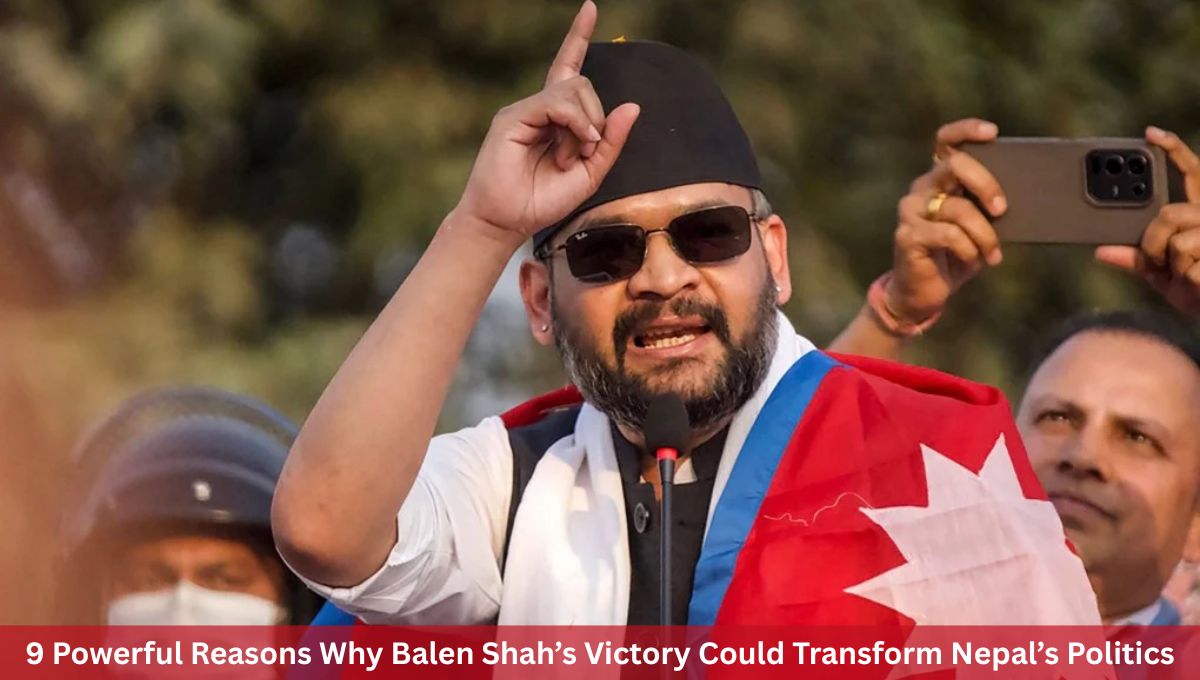
9 Powerful Reasons Why Balen Shah’s Victory Could Transform Nepal’s Politics after Gen Z protests toppled the government. Nepal’s latest general election has triggered one of the most dramatic political shifts in the country’s modern history. Early vote counts show former rapper-turned-politician Balen Shah and his relatively new political platform, the Rastriya Swatantra Party (RSP), far ahead of traditional parties that have dominated Nepalese politics for decades.
If current trends hold, Shah — a 35-year-old former mayor of Kathmandu — could soon become the youngest prime minister in Nepal’s history. His meteoric rise reflects a broader wave of political change fueled by public frustration with corruption, unemployment, and political instability.
The election marks Nepal’s first nationwide vote since massive Gen Z-led protests in September 2025 toppled the government of former Prime Minister KP Sharma Oli. Those demonstrations, sparked by anger over corruption and a controversial social media ban, ultimately forced Oli to resign and led to the formation of an interim administration.
Now, millions of voters appear to have embraced Shah’s promise of generational change.
9 Powerful Reasons Why Balen Shah’s Victory Could Transform Nepal’s Politics
Early Vote Counts Show a Landslide
Initial results from Nepal’s Election Commission suggest a commanding lead for Shah’s RSP. Early counting trends showed the party leading in dozens of constituencies and gaining momentum across the country.
Nepal’s parliament has 275 seats, with 165 filled through direct elections and 110 through proportional representation. Early counting focused on the direct constituencies, where the RSP surged ahead.
According to early figures:
- The RSP was leading in more than 100 constituencies
- The Communist Party of Nepal (Unified Marxist–Leninist), led by KP Sharma Oli, trailed far behind
- The Nepali Congress, the country’s oldest political party, also lagged behind the RSP
Political analysts described the surge as an electoral “tsunami,” signaling a powerful rejection of Nepal’s traditional political establishment.
If the trends continue, Shah’s party could secure a parliamentary majority — an extraordinary feat for a political movement only a few years old.
From Rapper to National Leader
Balen Shah’s rise to the brink of the prime minister’s office is anything but conventional.
Before entering politics, Shah was widely known in Nepal’s music scene as a rapper performing under the name “Balen.”
His songs frequently addressed corruption, social inequality, and failures in governance — themes that resonated strongly with young audiences.
His music gained popularity among Nepal’s urban youth, particularly on digital platforms. That cultural influence later translated into political capital.
Shah first entered politics in 2022, when he ran as an independent candidate for mayor of Kathmandu.
Against all expectations, he defeated candidates from established parties, positioning himself as a powerful anti-establishment figure. His mayoral victory transformed him into a national political phenomenon.
The Kathmandu Mayor Who Built a Reputation for Action
During his tenure as mayor, Shah cultivated an image as a hands-on administrator willing to take bold decisions.
His administration focused on tackling long-standing issues that had plagued Kathmandu for years, including:
- Urban waste management problems
- Illegal encroachments on public land
- Traffic congestion and poor infrastructure
- Neglected heritage sites
Working with government agencies and private companies, Shah implemented new waste-disposal arrangements that helped clear large volumes of garbage from the capital.
His administration also cleared illegal structures, restored public spaces, and initiated improvements to road systems and pedestrian infrastructure.
While supporters praised his decisiveness, critics accused him of using overly aggressive tactics — particularly during demolition campaigns targeting illegal structures and riverbank settlements.
Regardless of the controversies, his reputation as a leader willing to challenge bureaucratic inertia strengthened his political appeal.
The Gen Z Wave That Changed Nepal’s Politics
A key driver behind Shah’s rapid political rise is the powerful role of young voters.
Nepal has one of South Asia’s youngest populations, and frustration among young citizens has grown steadily in recent years due to unemployment, corruption, and the lack of economic opportunities.
In September 2025, those frustrations erupted into massive protests across the country. Thousands of young people took to the streets demanding political accountability and reforms.
The demonstrations were triggered by a government decision to impose a social media ban but quickly expanded into broader protests against corruption and economic stagnation.
The unrest resulted in clashes with security forces, casualties, and the eventual resignation of Prime Minister KP Sharma Oli.
Shah emerged as a prominent voice among young protesters, even helping to facilitate the formation of an interim government led by former Chief Justice Sushila Karki.
The protests fundamentally changed Nepal’s political environment — and set the stage for Shah’s electoral breakthrough.
A Campaign Built on Youth and Change
Shah’s election campaign successfully harnessed the energy of those protests. His rallies drew massive crowds, particularly among young voters who saw him as a symbol of generational change.
Social media played a crucial role in his campaign strategy. With millions of followers online, Shah was able to communicate directly with supporters and bypass traditional media channels.
His campaign message focused on several core themes:
- Anti-corruption reforms
- Transparent governance
- Youth empowerment
- Economic development
- Strengthening Nepal’s federal system
These themes resonated strongly with voters frustrated by decades of political instability.
Nepal has seen more than a dozen governments in the past two decades, creating a perception that traditional parties are incapable of delivering stable governance.
Shah’s outsider status allowed him to present himself as an alternative to that system.
Why His Madhesi Identity Matters
Another important dimension of Shah’s political rise is his connection to Nepal’s Madhesi community.
The Madhesis live primarily in the southern plains of Nepal, known as the Terai or Madhesh region, which borders India. They represent roughly one-third of the country’s population.
Historically, Madhesi communities have complained about underrepresentation in national politics and state institutions dominated by elites from Nepal’s hill regions.
Shah’s family originates from the Mahottari district in Madhesh Province, although he was born and raised in Kathmandu.
His political outreach to Madhesi voters became evident when he launched his prime ministerial campaign in Janakpur, the capital of Madhesh Province.
In a symbolic move, Shah began his speech in Maithili, a language widely spoken in the region and also common in parts of India’s Bihar and Jharkhand states.
This gesture resonated strongly with voters in the region and underscored Shah’s message of inclusive national leadership.
A Madhesi prime minister would represent a historic milestone for Nepal’s political system.
Nepal’s Long History of Political Instability
Nepal’s political system has struggled with instability for decades.
Since the end of the monarchy in 2008, the country has cycled through numerous coalition governments, many of which collapsed before completing their terms.
The resulting instability has slowed economic development and contributed to widespread public frustration.
Key challenges facing Nepal include:
- High youth unemployment
- Large-scale migration of workers overseas
- Weak public services
- Corruption in government institutions
Millions of Nepali citizens work abroad, particularly in the Gulf states and Southeast Asia, sending remittances that account for a large share of the country’s economy.
For many voters, the election represents an opportunity to break the cycle of unstable coalition politics and create a more effective government.
A Potential Shift in Nepal’s Foreign Policy
Shah’s rise could also reshape Nepal’s foreign relations. Situated between India and China, Nepal has long attempted to balance relations with both regional powers.
India remains Nepal’s largest trading partner and a major source of investment and development assistance.
Cultural and social ties between the two countries are also deep, with open borders allowing millions of people to move freely.
However, relations have occasionally been strained by disputes over border territories such as Kalapani, Lipulekh, and Limpiyadhura.
China has also expanded its influence in Nepal through infrastructure investments and diplomatic engagement.
Unlike some previous Nepali leaders who were seen as aligned with either India or China, Shah appears to favor a more balanced foreign policy.
His approach emphasizes what he calls “Nepal First,” focusing on maximizing national interests rather than aligning closely with any major power.
India Watching Closely
India is closely monitoring the election results due to Nepal’s strategic importance.
Officials in New Delhi have expressed hope that the formation of a stable government in Kathmandu could strengthen bilateral cooperation.
India has historically played a significant role in Nepal’s economy and infrastructure development, supporting projects in hydropower, transportation, and trade.
However, Nepal’s domestic politics often include strong nationalist rhetoric, with some leaders accusing India of interfering in internal affairs.
Shah’s supporters sometimes portray him as taking a more assertive stance toward India, although his foreign policy positions remain largely undefined.
For India, the emergence of a young and popular leader could present both challenges and opportunities.
China’s Reaction to the Election
China has also been closely observing developments in Nepal.
Beijing congratulated Nepal for conducting the election smoothly while emphasizing the importance of maintaining friendly relations between the two countries.
China has invested heavily in Nepal through infrastructure projects linked to the Belt and Road Initiative.
With Shah’s party still developing its foreign policy agenda, both China and India are likely to compete for influence in Kathmandu’s new political landscape.
The Expectations of Young Voters
Despite the excitement surrounding Shah’s electoral surge, many young Nepalis are warning that their support comes with high expectations.
Activists who participated in last year’s protests say the election result should not be treated as a blank cheque for the new leadership.
Their demands remain focused on practical reforms:
- Ending corruption
- Improving public services
- Expanding job opportunities
- Ensuring accountability for violence during the protests
For many voters, the true test of the new government will be whether it can deliver tangible improvements in daily life.
The Challenges Ahead
Even if Shah becomes prime minister, governing Nepal will be a formidable challenge.
He will need to manage:
- A complex coalition environment
- A powerful and entrenched bureaucracy
- Rising economic expectations from young voters
Nepal’s economy also faces structural problems, including heavy reliance on remittances and limited industrial development.
Reforming these systems will require sustained political leadership and institutional reforms.
A Generational Turning Point
Regardless of the final election results, the rise of Balen Shah marks a generational turning point in Nepalese politics.
For decades, the country’s political leadership was dominated by older leaders from established parties.
Shah represents a new political archetype:
a digitally savvy leader with roots in youth culture and strong connections to social media.
His success suggests that voters are increasingly willing to support unconventional candidates who promise change.
A New Chapter for Nepal
If the Rastriya Swatantra Party ultimately forms the government, Nepal could enter a new political era defined by younger leadership, anti-corruption rhetoric, and a renewed focus on development.
The election reflects the growing political power of Nepal’s younger generation, whose activism helped bring down the previous government and reshape the national conversation.
For Balen Shah, the challenge will be transforming campaign promises into effective governance.
For Nepal’s voters, the message is clear:
they are ready for change — but they expect results.
Also Read: 10 Explosive Shifts: Nepal Votes in First Election Since Gen-Z Protests Toppled the Government
Also Read: Balen Shah wins big in Nepal polls, defeats KP Sharma Oli by nearly 50,000 votes
Related Posts:
- 10 Explosive Shifts: Nepal Votes in First Election…
- Nepal Gen Z Protests Escalate: 112 Indian Tourists…

- Kathmandu Airport Reopens after Nepal Gen Z Protests…

- 9 Explosive Moments as Balen Shah Raps Unity Message…
- Nepal’s Gen Z Protests Push Sushila Karki and Kulman…

- Sushila Karki Sworn In as Nepal’s First Woman Prime…
