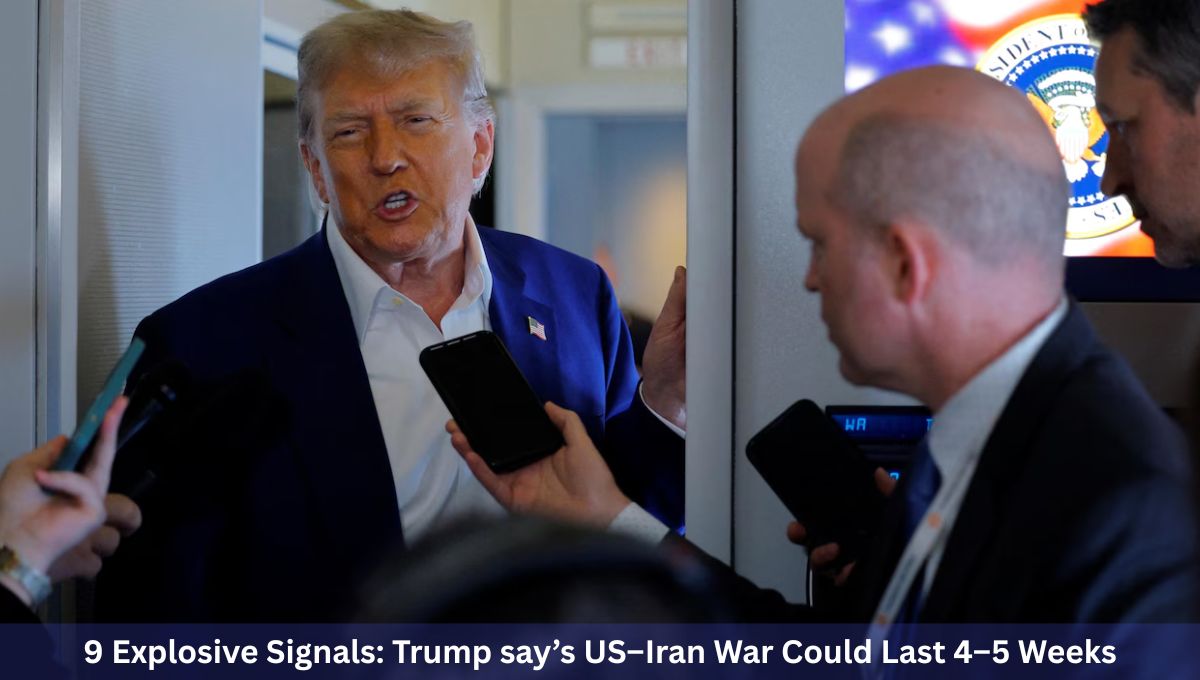
9 Explosive Signals: Trump says US–Iran War Could Last 4–5 Weeks as strikes intensify.United States President Donald Trump has signaled that Washington is preparing for weeks of sustained military operations against Iran, warning that the rapidly escalating conflict may last four to five weeks, even as he insists diplomatic channels remain nominally open.
Trump’s remarks — delivered across a series of interviews, public statements, and social media posts — come as casualties mount, oil markets shudder, global shipping falters, and fears grow that the confrontation could spiral into one of the most dangerous Middle East wars in decades.
“It’s always been a four-week process,” Trump said in remarks reported by the British newspaper Daily Mail. “As strong as it is, it’s a big country — it’ll take four weeks, or less.”
Later, Trump expanded that estimate, telling US media outlets that the conflict could last four or five weeks, while cautioning it could also be shorter — or longer — depending on battlefield conditions.
9 Explosive Signals: Trump say’s US–Iran War Could Last 4–5 Weeks
A Conflict Washington Says It Expected — But the World Did Not
Trump framed the war as a deliberate, time-bound campaign, rather than a sudden or reactive escalation.
According to the president, the US military and its Israeli ally entered the conflict anticipating prolonged operations against a large, resilient adversary.
“This was never going to be overnight,” Trump told reporters, emphasizing Iran’s size, population, and military depth.
Yet for much of the world — including US allies — the speed and scale of the escalation has been staggering, particularly after the killing of Iran’s Supreme Leader and the collapse of long-running diplomatic efforts.
Supreme Leader Killed, Iran’s Leadership Shattered
The conflict intensified dramatically after joint US–Israeli airstrikes killed Ali Khamenei, who had ruled Iran since 1989.
The killing marked one of the most consequential moments in Iranian history since the 1979 Islamic Revolution, removing the single most powerful figure in the Islamic Republic’s political system.
Alongside Khamenei, several senior military and political figures were killed, leaving Iran’s leadership structure severely disrupted. Trump claimed that 48 senior Iranian leaders were eliminated in the opening days of the campaign.
“The attack was so successful it knocked out most of the candidates,” Trump said, referring to potential successors. “It’s not going to be anybody that we were thinking of because they are all dead.”
Operation Epic Fury: A Campaign Trump Calls “Overwhelming”
The US-led assault — dubbed Operation Epic Fury — has targeted Iranian military infrastructure, naval assets, missile sites, and command centers across multiple cities, including the capital Tehran.
In a video posted on his Truth Social account, Trump described the campaign as:
“One of the most complex, most overwhelming military offensives the world has ever seen.”
“Combat operations continue at this time in full force,” he said. “And they will continue until all of our objectives are achieved.”
Trump has repeatedly argued that an Iran armed with long-range missiles and nuclear weapons would pose a dire threat to Americans and global stability, though US officials have presented no new public evidence that Iran was close to deploying such weapons.
Tehran Hits Back: Missiles, Drones, and a Regional Shockwave
Iran has responded with missile and drone strikes across the Middle East, targeting:
- Israel
- Gulf states hosting US bases
- Strategic shipping routes
Nine Israelis have been killed so far in Iranian counterstrikes, while airports in Dubai, Abu Dhabi, and Kuwait were damaged and temporarily shut, causing one of the worst aviation disruptions in years.
Iran has also claimed to have targeted the USS Abraham Lincoln, though US officials denied any damage.
US Casualties Confirmed as Trump Warns More May Die
For the first time in Trump’s second term, US combat deaths have been confirmed.
Three American service members were killed, with at least five others seriously wounded. Their identities have not yet been released.
“They’re great people,” Trump said. “And, you know, we expect that to happen, unfortunately. It could happen again.”
Trump acknowledged that further casualties were likely, calling them a tragic but expected cost of war.
“As one nation, we grieve,” he said. “But America will avenge their deaths.”
Hezbollah Enters the War, Lebanon Pulled In
As the Iran–US conflict deepened, it spilled into Lebanon, where Iran-backed Hezbollah launched rockets and drones toward northern Israel.
Israel responded with heavy airstrikes on Beirut and southern Lebanon, raising fears of a renewed Israel–Hezbollah war.
The entry of Hezbollah has heightened concerns of a multi-front regional conflict, stretching from the Mediterranean to the Persian Gulf.
Trump Open to Talks — But Timing Unclear
Despite the intensity of the fighting, Trump has repeatedly insisted he remains open to diplomacy.
“They want to talk,” Trump said in interviews with The Atlantic and other outlets. “And I have agreed to talk.”
However, he cast doubt on the immediacy and seriousness of such talks.
“They should have talked last week, not this week,” he said. “They waited too long.”
Trump has not specified who he would speak with in Tehran, noting that many of Iran’s previous negotiators were killed in the initial strikes.
Iran Rejects Negotiations, Calls War “Imposed Aggression”
Iranian officials have publicly rejected Trump’s claims that talks are imminent.
Senior Iranian security figure Ali Larijani said Tehran would not negotiate with Washington, denying reports that Iran had sought dialogue.
At the United Nations, Iran’s ambassador Amir-Saeid Iravani accused the US and Israel of deliberately targeting civilian areas.
Hundreds of civilians have reportedly been killed or injured, with Iranian state media confirming at least 165 deaths in a single bombing of a girls’ primary school in Minab.
Interim Leadership in Tehran After Khamenei’s Death
Following Khamenei’s killing, Iran announced a three-member interim leadership council, including:
- Masoud Pezeshkian
- Judiciary chief Gholam-Hossein Mohseni-Ejei
- Guardian Council member Ayatollah Alireza Arafi
Officials said the process of selecting a new supreme leader would be expedited, though no fixed timeline was announced.
Oil Prices Surge, Global Trade Disrupted
Beyond the battlefield, the war is already producing global economic shockwaves.
Oil prices have jumped after attacks near the Strait of Hormuz, through which roughly 20% of the world’s traded oil flows.
Around 150 oil tankers have reportedly dropped anchor rather than risk transit, while shipping giants MSC and Maersk suspended operations in the region.
Analysts warn the conflict could trigger:
- A global energy price spike
- Inflationary pressure worldwide
- Long-term supply chain disruptions
Trump Shrugs Off Domestic Political Risks
Despite a Reuters-Ipsos poll showing that only about one in four Americans approve of the attack on Iran, Trump dismissed concerns that the war could hurt Republicans ahead of congressional elections.
“We have the greatest economy we’ve ever had,” he claimed.
Trump also rejected the idea that economic fallout would outweigh what he called the strategic necessity of confronting Iran.
Regime Change Rhetoric Returns
In some of his strongest language, Trump openly suggested the war could create an opportunity for regime change in Iran.
He urged Iranians to “seize this moment” and offered amnesty to members of the Islamic Revolutionary Guard Corps who lay down their arms.
“The rest will be up to you,” Trump said. “We’ll be there to help.”
However, analysts caution that such rhetoric could harden resistance inside Iran and prolong the conflict.
Four to Five Weeks — Or Something Much Longer?
Trump’s estimate of a four-to-five-week conflict has become a central talking point — but few experts believe the outcome will be so neatly contained.
Iran retains:
- Large missile stockpiles
- Regional proxy networks
- Significant population and territorial depth
Meanwhile, US forces face increasing exposure across the Middle East.
As one senior analyst put it:
“Wars rarely follow presidential timelines.”
A World Bracing for What Comes Next
As fighting continues across Iran, Israel, Lebanon, and the Gulf, the world is watching anxiously.
Diplomacy remains uncertain. Casualties are rising. Markets are nervous. And the risk of escalation — deliberate or accidental — remains dangerously high.
Trump insists the campaign is “ahead of schedule.”
Iran vows it will not break. Between those two positions lies a volatile Middle East — and a global order holding its breath.
Also Read: 7 Explosive Hours That Shook Iran: Tehran Hit as Khamenei Death Sparks Regional War
Also Read: Trump says Iran war could last 4-5 weeks, offers 3 options for new leadership
Related Posts:
- 11 Explosive Warnings as Trump Vows to ‘Knock the…

- 12 Explosive Claims as Donald Trump Says Iran War…
- 10 Explosive Warnings as Donald Trump Calls Iran…
- 10 Explosive Signals: Trump Rates Iran War “15/10”…
- 10 Powerful Revelations from the Trump–Putin Call on…
- 10 Explosive Signals Trump Says Iran War Could End…