
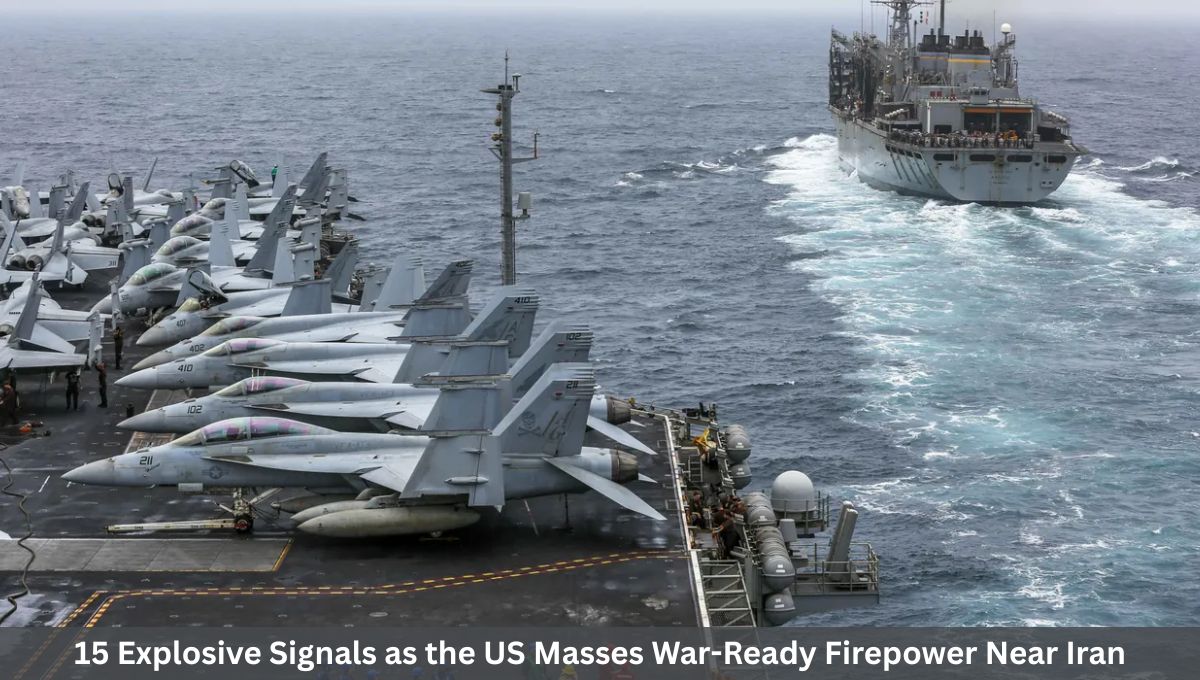
15 Explosive Signals as the US Masses War-Ready Firepower Near Iran, pushing the region to the brink again. The Middle East is edging toward one of its most dangerous inflection points in decades as the United States rapidly assembles a formidable array of military power near Iran, while diplomatic channels narrow and rhetoric hardens.
Thank you for reading this post, don't forget to subscribe!US President Donald Trump has issued Tehran a stark ultimatum:
10 to 15 days to reach a deal over its nuclear programme and ballistic missile capabilities—or face consequences he has repeatedly warned will be “really bad.”
What makes this moment uniquely perilous is not just the language, but the scale and speed of the military buildup now underway. According to open-source intelligence, satellite imagery, and flight-tracking data, the US has deployed more than 120 aircraft, multiple aircraft carriers, missile-armed destroyers, and advanced command-and-control systems to the region in a matter of days.
This is the largest surge in US air and naval power in the Middle East since the 2003 Iraq invasion, eclipsing even last year’s confrontations between Iran and Israel.
For allies, adversaries, and global markets alike, the message is unmistakable:
Washington is preparing for the possibility that diplomacy may fail.
15 Explosive Signals as the US Masses War-Ready Firepower Near Iran
Trump’s 10–15 Day Deadline — Diplomacy Under the Shadow of Force
Trump’s warning to Iran has been deliberately ambiguous, designed to keep both negotiation and military action firmly on the table.
Speaking to reporters aboard Air Force One and later at the White House, the president said the world would soon know whether a deal was reached—or whether the US would “take it a step further.”
The deadline coincides almost exactly with the timeline required for US forces now en route to reach full operational readiness in the region, suggesting a calculated alignment between diplomacy and military preparedness.
Iran, for its part, has responded with defiance tempered by caution. In a letter to the United Nations Security Council, Tehran said it does not seek war and will not initiate one—but warned that any US aggression would be met “decisively and proportionately.”
“The United States would bear full and direct responsibility for any unpredictable and uncontrolled consequences,” the letter said.
An Unprecedented Surge in US Air Power
Over 120 Aircraft Deployed in Days
Open-source analysts tracking military flights report an extraordinary surge of US air assets into the Middle East and surrounding regions.
These include:
- E-3 Sentry AWACS aircraft for battlefield command and early warning
- F-35 Lightning II stealth strike fighters
- F-22 Raptor air-superiority jets
- F-15E Strike Eagles, F-15s, and F-16s
- A dense network of aerial refuelling tankers and cargo aircraft
Flight data shows many of these aircraft departing from bases in the continental US and Europe, indicating sustained operational planning rather than routine rotation.
US Central Command has publicly framed the deployments as enhancing “regional security and stability,” but analysts see a far more pointed signal.
The Shadow of ‘Operation Midnight Hammer’
The current deployment revives memories of Operation Midnight Hammer, the US strikes on Iranian nuclear facilities ordered by Trump in June 2025 during the 12-day conflict between Iran and Israel.
During that operation, F-22s and F-35s escorted B-2 stealth bombers as they struck hardened targets inside Iran.
Military analysts say the reappearance of similar force packages is a warning sign.
“Watch any movement by B-2s,” said Mark Cancian of the Center for Strategic and International Studies. “That would indicate a possible replay of ‘Midnight Hammer’.”
Aircraft Carriers at the Centre of US Power Projection
USS Gerald R Ford Enters the Theatre
The world’s largest aircraft carrier, USS Gerald R Ford, is being redeployed from the Caribbean toward the Middle East.
Satellite transmissions recently placed the carrier off the coast of Morocco, suggesting transit through the Strait of Gibraltar into the Mediterranean before moving east.
The Ford previously supported US operations in Venezuela and represents the most advanced naval aviation platform ever built, capable of launching hundreds of sorties per day.
USS Abraham Lincoln Already in Position
The Ford will join the USS Abraham Lincoln carrier strike group, which satellite imagery shows operating in the Arabian Sea, just hundreds of miles from Iran’s coastline.
Together, the two carriers place US air power within immediate striking distance of Iranian military and nuclear infrastructure.
Destroyers, Missiles, and the Threat from the Sea
Beyond aircraft carriers, the US Navy has deployed multiple guided-missile destroyers equipped with:
- Aegis air-defence systems
- Ballistic missile interception capabilities
- Tomahawk cruise missiles capable of deep land strikes
These vessels are designed not only to strike Iran, but to defend US bases, allies, and Israel from missile retaliation.
Military planners say the current configuration would allow Washington to attack while simultaneously absorbing and countering Iranian responses.
Diego Garcia — A Strategic Flashpoint with the UK
One of the most sensitive aspects of the buildup centres on Diego Garcia, the joint UK-US military base in the Indian Ocean.
The remote base has long served as a launch pad for US strategic bombers, including B-2 stealth aircraft, during conflicts in Iraq and Afghanistan.
However, Diego Garcia is British sovereign territory leased to the United States, meaning London must approve its use for offensive operations.
UK Prime Minister Keir Starmer has reportedly told Washington that British bases—including Diego Garcia and RAF Fairford—cannot be used for strikes on Iran, citing international law.
Trump responded angrily, withdrawing US support for Britain’s agreement to transfer sovereignty of the Chagos Islands to Mauritius and warning:
“DO NOT GIVE AWAY DIEGO GARCIA!”
The dispute underscores growing allied friction as the crisis deepens.
Iran’s Military and Strategic Response
Iran is not standing still.
Drills, Warnings, and the Strait of Hormuz
Tehran has launched joint naval exercises with Russia in the Sea of Oman and northern Indian Ocean, signalling deterrence and alignment with major powers.
It has also:
- Issued NOTAMs for rocket launches
- Temporarily closed parts of the Strait of Hormuz during live-fire drills
- Increased surveillance and missile readiness
The Strait of Hormuz remains one of the world’s most critical chokepoints, carrying about one-fifth of global oil supplies.
Any disruption would have immediate global economic consequences.
Fortifying Nuclear and Military Sites
Satellite imagery published by Reuters shows Iran:
- Building concrete shields over sensitive facilities
- Burying tunnel entrances at nuclear sites
- Repairing missile bases struck in 2025
Experts say Iran has moved key assets deeper underground, complicating US strike planning.
Vali Nasr of Johns Hopkins University warned that Tehran’s strategy may be to drag the US into a protracted conflict, rather than seek a quick confrontation.
Is the US Likely to Attack Iran?
Many analysts believe the probability is high and rising.
“The United States is doing all the things it would do if it were going to conduct an attack,” Cancian said. “Aircraft, carriers, AWACS—it’s all there.”
Others caution that Trump may still prefer a limited strike aimed at forcing concessions, rather than full-scale war.
Yet history shows that once such a massive force is assembled, political pressure not to back down intensifies.
Lessons from Venezuela — And Why Iran Is Different
Some observers compare the buildup to the US deployment near Venezuela in 2025, which culminated in a dramatic raid and the capture of President Nicolás Maduro.
But Iran presents a fundamentally different challenge:
- Vast geography
- Hardened, layered defences
- A powerful missile arsenal
- Regional proxy networks
A quick decapitation strike is far less feasible.
Global Stakes — Oil, Markets, and Escalation Risks
Oil prices have already risen on fears of conflict, with markets pricing in supply disruptions.
Gulf states are quietly preparing for instability, while Europe worries about energy shocks and refugee flows.
China and Russia are watching closely—but analysts say neither is likely to directly challenge US forces militarily.
The Endgame Question — Deterrence, Degradation, or Regime Change?
Perhaps the most unsettling uncertainty is Washington’s endgame.
Is the goal:
- To force a nuclear deal?
- To degrade Iran’s military permanently?
- To trigger regime change?
Even US allies privately admit they lack clarity.
History—from Iraq to Libya—shows that military action is easier to start than to control, and far harder to translate into stable outcomes.
Conclusion: A Narrowing Window, a Dangerous Moment
As carriers converge, jets roar into forward bases, and diplomatic talks stall, the US-Iran standoff is entering its most dangerous phase in years.
Trump’s 10–15 day deadline may yet produce a deal. It may also mark the final pause before escalation.
What is certain is that the world is once again holding its breath, watching whether diplomacy can outrun the momentum of war.
Also Read: 7 Explosive Signals from Iran Fires as War Fears Intensify Near Tehran
Also Read: Trump Warns of ‘Bad Things’ If Iran Doesn’t Make a Deal, as Second US Aircraft Carrier Nears Mideast
Related Posts:
- 11 Explosive Warnings as Trump Vows to ‘Knock the…

- 3 Explosive Conditions Iran Sets to End War with US…

- 9 Explosive Claims as Trump Says US Winning Iran War

- 10 Explosive Warnings as Donald Trump Calls Iran…
- 7 Powerful Facts About Ayatollah Ali Khamenei’s…

- 10 Explosive Strikes: Israel Bombs Tehran Oil Depots…
