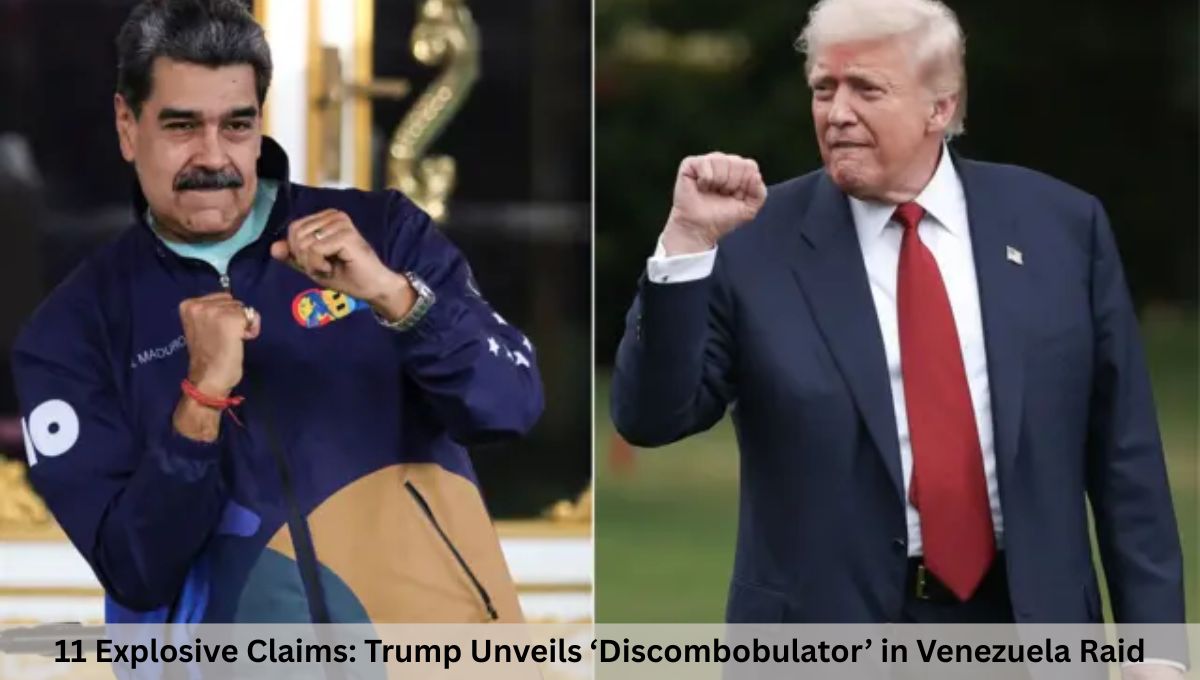
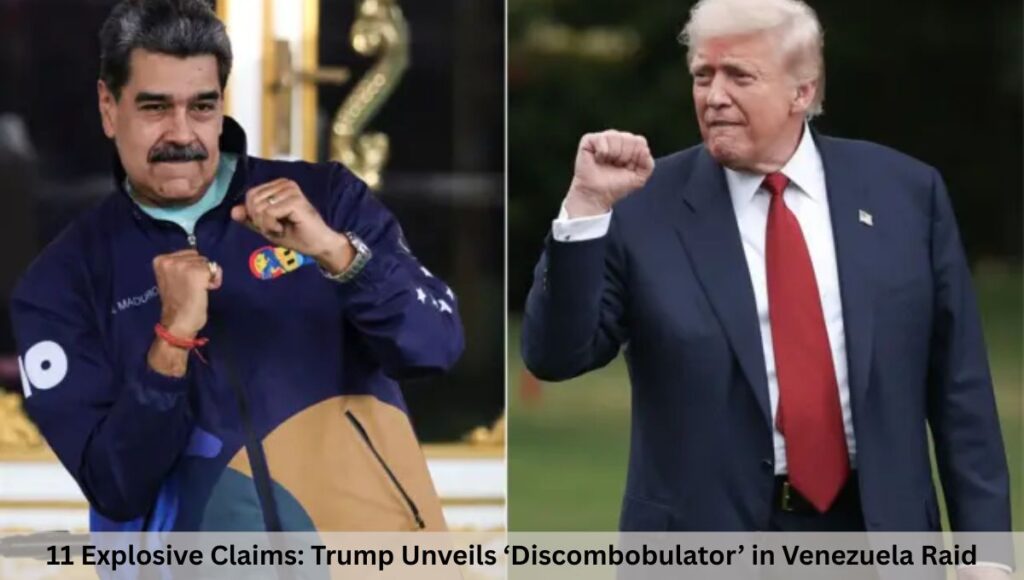
11 Explosive Claims: Trump Unveils ‘Discombobulator’ in Venezuela Raid — A claim that ignites global scrutiny. US President Donald Trump has ignited worldwide debate after publicly touting a mysterious device he dubbed the “discombobulator,” claiming it neutralized Chinese and Russian defense systems during a January US military operation in Venezuela.
Speaking before troops and military families at Fort Bragg, Trump said adversary equipment “never got a shot off” as US forces executed a rapid raid in Caracas.
The remarks marked the first time Trump discussed the alleged technology at a public event, elevating what had previously been hints in media interviews into a headline-grabbing assertion with far-reaching geopolitical implications.
11 Explosive Claims: Trump Unveils ‘Discombobulator’ in Venezuela Raid
A Night Raid in Caracas: What Trump Says Happened
According to Trump, the January 3 operation unfolded with speed and precision. US helicopters inserted elite forces under cover of darkness, overwhelming Venezuelan defenses and extracting then-president Nicolás Maduro from a heavily guarded compound.
“They never got a shot off,” Trump told the crowd, asserting that Russian- and Chinese-supplied systems simply failed. “Someday you’re going to find out why.”
Venezuelan officials later acknowledged significant casualties, with dozens killed and more than a hundred injured as US airstrikes hit military targets ahead of the ground assault.
Trump said no US service members were killed, though several pilots sustained injuries.
The Mystery Device: Signal Warfare or Rhetorical Weapon?
Trump offered no technical explanation of the so-called discombobulator, beyond claiming it rendered enemy equipment useless.
In a recent interview with NBC News, he said:
“None of their equipment works; that’s what it does.”
Defense analysts globally are divided. Some interpret the claim as shorthand for advanced electronic warfare—jamming, cyber disruption, or integrated suppression of enemy air defenses (SEAD).
Others see political theater, arguing Trump’s language is designed to project deterrence rather than disclose classified capabilities.
Regardless, the statement has fueled speculation in Beijing and Moscow about the resilience of their exported systems when facing US forces.
Fort Bragg Address: Military Praise Meets Campaign Politics
Trump’s visit to Fort Bragg blended a victory lap with unmistakable political messaging.
Before saluting the special operations units involved in the Venezuela mission, he reiterated a core theme of his presidency:
“peace through strength.”
“The entire world saw what the full military might of the United States can do,” he said, adding that America is now “feared” by its adversaries.
Yet the event also carried the tone of a campaign rally. Trump introduced Republican Senate candidate Michael Whatley, urging troops to support him in North Carolina’s upcoming election—an unusual move at a military base traditionally kept above partisan politics.
Maduro in US Custody: Legal and Diplomatic Fallout
Following his capture, Maduro was flown to New York, where he faces federal charges including drug trafficking and narco-terrorism.
He has pleaded not guilty, with his next court appearance scheduled for March 17. The arrest of a sitting—or recently deposed—head of state by US forces is rare and controversial.
Critics warn it sets a destabilizing precedent in international relations, while supporters argue Maduro’s alleged crimes justified extraordinary action.
For Washington, the move signals a hardline approach toward leaders it labels authoritarian and criminal—particularly in the Western Hemisphere.
A New Face in Caracas: Delcy Rodríguez Steps In
In a striking pivot, Trump confirmed US recognition of Delcy Rodríguez as Venezuela’s interim leader following Maduro’s removal.
Trump said the arrangement hinges on cooperation with US demands, particularly access to Venezuela’s vast oil reserves and easing domestic repression.
“We have a very good relationship,” Trump told reporters, rating bilateral ties a “10.”
The decision has drawn criticism from Venezuelan opposition figures who argue for a broader democratic transition, but it underscores Washington’s priority:
stability and energy access over prolonged political uncertainty.
Oil, Energy, and Strategic Interests
Trump’s remarks made clear that energy geopolitics are central to US policy in Venezuela.
He said major US oil companies are moving in to rehabilitate the country’s battered energy sector, with output destined for global markets.
The strategy aligns with Washington’s broader effort to secure diversified energy supplies amid global volatility.
For many international observers, it also reinforces the perception that strategic resources remain a decisive factor in US foreign interventions.
China and Russia: Reading Between the Lines
By explicitly naming China and Russia, Trump elevated the Venezuela raid beyond a regional action. Both countries have invested heavily in Caracas through arms sales, loans, and energy projects.
If US forces indeed neutralized Chinese and Russian systems, the implications extend far beyond Latin America—raising questions about the effectiveness of those platforms in other theaters.
Neither Beijing nor Moscow has publicly confirmed equipment failures, but state-aligned commentators have dismissed Trump’s claims as exaggeration.
America ‘Feared Again’? The Global Reaction
Trump’s assertion that the world now “fears” the United States has resonated differently across regions.
Supporters see restored deterrence after years of perceived decline. Critics argue that fear is a brittle foundation for long-term stability.
In Europe and Asia, allies quietly welcomed signs of US military capability but expressed unease over the lack of transparency.
In the Global South, reactions were mixed—some governments applauded decisive action against Maduro, while others warned of neo-interventionism.
Melania Trump’s Message to Military Families
First Lady Melania Trump struck a markedly different tone, focusing on sacrifice and family. Speaking at Fort Bragg and Pope Army Airfield, she highlighted the tradition of love letters as symbols of resilience among military families.
Her remarks provided a human counterpoint to the hard-edged rhetoric of power projection, underscoring the personal cost behind geopolitical decisions.
Renaming Fort Bragg: Symbolism and Culture Wars
Trump also revisited the controversy over the base’s name, celebrating its restoration after a brief change under the previous administration.
He warned that Democrats would rename it again if they regained power, framing the issue as part of a broader cultural struggle.
The episode illustrates how even military symbolism has become entwined with domestic politics in the United States.
The ‘Discombobulator’ as Strategic Messaging
Whether or not such a device exists as described, Trump’s choice of language serves a strategic purpose. By hinting at undisclosed capabilities, he reinforces uncertainty among adversaries—a classic deterrence tactic.
Military historians note that secrecy and ambiguity have long been tools of power projection. In this sense, the discombobulator may function as much in the psychological domain as in the electromagnetic spectrum.
Risks of Escalation and Miscalculation
There is, however, a downside. Publicly boasting about disabling foreign systems risks provoking an arms race or encouraging rivals to test US claims. Transparency gaps can also fuel miscalculation during crises.
For global audiences, the episode underscores a recurring tension in US strategy: balancing deterrence with restraint, and spectacle with stability.
What Comes Next for Venezuela?
With Maduro detained abroad and Rodríguez in charge at home, Venezuela enters a new, uncertain phase.
US oversight of the oil sector, combined with selective sanctions relief, could stabilize the economy—but political legitimacy remains fragile.
Regional neighbors are watching closely, aware that outcomes in Caracas could ripple across Latin America.
Conclusion: Power, Politics, and Perception
Trump’s Fort Bragg speech encapsulated his governing style:
dramatic claims, unapologetic displays of force, and a seamless blend of military success with political messaging.
The “discombobulator” may remain a mystery, but its impact on global discourse is already tangible.
For allies and adversaries alike, the message was unmistakable:
the United States intends to project strength—and to ensure the world knows it.
As debates continue over legality, ethics, and effectiveness, one thing is clear:
the Venezuela raid and Trump’s rhetoric have reshaped conversations about modern warfare, great-power competition, and the future of US influence worldwide.
Also Read: 7 Shocking Claims as Trump Says India Will Buy Venezuelan Oil Instead of Iran
Also Read: Trump reveals to The Post secret ‘discombobulator’ weapon was crucial to Venezuelan raid on Maduro