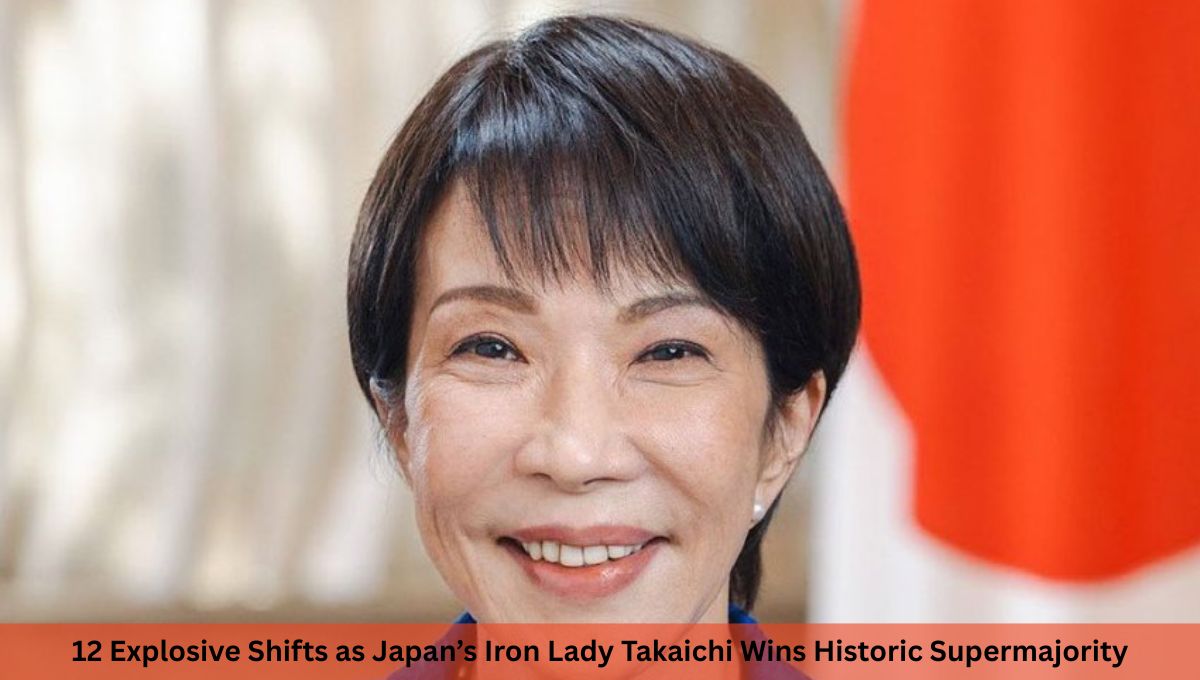
12 Explosive Shifts as Japan’s Iron Lady Takaichi Wins Historic Supermajority — LDP’s strongest mandate since World War II. Japan awoke on Monday to a dramatically altered political map. Prime Minister Sanae Takaichi and her conservative Liberal Democratic Party (LDP) swept to a decisive victory in Sunday’s snap election, securing a two‑thirds supermajority in the powerful lower house of parliament.
The result marks the strongest mandate for a single party in Japan since World War II and a remarkable turnaround for a ruling bloc that had been battered by scandals and voter fatigue only months earlier. With more than 310 of the 465 seats captured by the LDP alone—and over 340 seats when combined with coalition partners—the scale of the win gives Takaichi unprecedented legislative leverage.
It allows her government to override the upper house, dominate parliamentary committees, and pursue constitutional revisions long considered politically unattainable. For voters, the election was both a referendum on Takaichi’s short tenure and a gamble on her promise of decisive leadership in a period of economic strain and geopolitical uncertainty.
For markets, it was a green light. Japanese equities surged to record highs, the yen swung sharply, and bond yields climbed as investors recalibrated expectations for fiscal expansion.
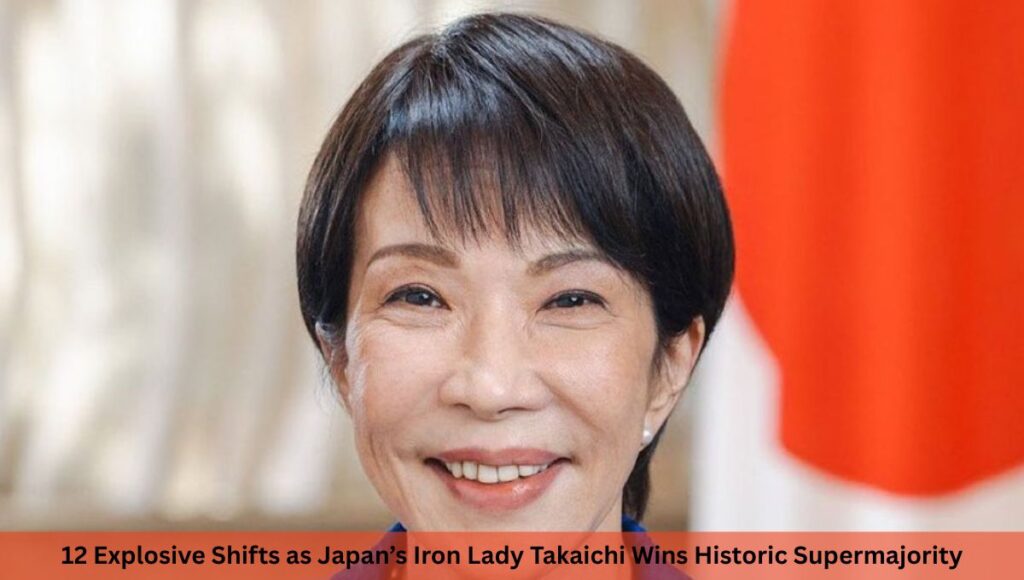
12 Explosive Shifts as Japan’s Iron Lady Takaichi Wins Historic Supermajority
From Risky Gamble to Historic Mandate
Calling a snap election barely three months after taking office was widely seen as a political risk. The LDP had suffered bruising defeats in recent cycles, weighed down by allegations of misused political funds and public frustration over rising living costs.
Yet Takaichi calculated that her personal popularity—and the opposition’s fragmentation—could translate into a decisive mandate. The calculation paid off.
Preliminary counts from public broadcaster NHK showed the LDP smashing its previous postwar record, eclipsing the 300 seats won in 1986 under former prime minister Yasuhiro Nakasone.
The party’s coalition with the Japan Innovation Party further cemented control, enabling the government to chair all lower‑house committees.
In a televised interview following the vote, Takaichi thanked citizens who turned out despite severe winter weather.
“I asked voters to give me a mandate for responsible, proactive fiscal policy,” she said, framing the election as an endorsement of a major shift in economic strategy.
Japan’s First Woman Leader Consolidates Power
Takaichi’s rise has already broken historical barriers. Elected prime minister in October after winning the LDP presidency on her third attempt, she became Japan’s first female leader in a political system long dominated by men.
Her ascent followed the resignation of Shigeru Ishiba amid internal party pressure after a string of electoral setbacks.
In just four months, Takaichi cultivated unusually high approval ratings, projecting an image of tireless work ethic, approachability, and resolve.
Viral moments—from unscripted interactions with foreign leaders to energetic campaign appearances—helped humanize a party often criticized as aloof and entrenched.
The snap election transformed that personal appeal into institutional power. With no national elections due until 2028, Takaichi now has time and political space to pursue long‑term policy goals.
What a Two‑Thirds Supermajority Means
The constitutional implications of the result are profound. A two‑thirds majority in the lower house allows the ruling bloc to override upper‑house objections and to initiate constitutional amendments, subject to a national referendum.
For decades, Japan’s postwar constitution—particularly Article 9, which renounces war—has been politically sacrosanct.
While any amendment would still face high public scrutiny, Takaichi’s mandate removes the parliamentary roadblocks that stymied previous leaders.
Beyond constitutional mechanics, the supermajority streamlines governance.
Budget bills, defense legislation, and economic reforms can now move rapidly through parliament, reducing the need for compromise with a splintered opposition.
Markets Cheer, Then Reassess
Financial markets responded instantly. The Nikkei 225 surged more than 5 percent in early trading, vaulting past 57,000 points for the first time, while the broader Topix index also hit record highs.
Real estate, industrials, healthcare, and semiconductor stocks led the rally. Investors cited political stability and the prospect of fiscal stimulus as key drivers.
Analysts described the outcome as the “best‑case scenario” for equities, clearing the path for government spending on technology, energy security, and industrial policy.
The reaction in currency and bond markets was more nuanced. The yen strengthened briefly before weakening again on expectations of higher borrowing and looser fiscal policy.
Yields on Japanese government bonds climbed to levels not seen in decades, reflecting concern over debt sustainability.
The Economy: Mandate Meets Constraints
Takaichi campaigned on a platform of “responsive and proactive” fiscal policy, echoing the growth‑first philosophy associated with her mentor, former prime minister Shinzo Abe.
Yet the economic backdrop today is starkly different from the deflationary era that gave rise to Abenomics.
Inflation has returned. Household budgets are under strain, with staple foods—most notably rice—having doubled in price over the past year.
Voters who deserted the LDP in earlier elections cited rising costs as a central grievance. At the same time, Japan’s public debt exceeds 200 percent of GDP, the highest ratio among major economies.
A massive stimulus package last year narrowed the government’s room for manoeuvre, and even modest tax proposals have rattled bond markets. During the campaign, Takaichi floated suspending consumption tax on food items.
The idea was popular with households but sent long‑term bond yields to record highs, underscoring investor sensitivity to revenue losses.
Inflation, Taxes, and the Risk of Backlash
Economists warn that expectations may now outpace reality. While equities may benefit from government spending, households are unlikely to see immediate relief from inflation.
Analysts caution that additional defense commitments could eventually require tax increases, particularly on income.
Critics argue that failure to deliver tangible cost‑of‑living improvements could leave voters feeling misled.
“There is a real risk of disappointment,” said one foreign‑policy analyst, noting that fiscal expansion alone cannot easily reverse inflation driven by currency weakness and global supply pressures.
Takaichi has sought to temper expectations, emphasizing investment over giveaways and calling for cross‑party discussions on tax reform.
Defense, Security, and a Sharper Edge
National security loomed large over the campaign. Takaichi has pledged to increase defense spending and revise security policy by year‑end, including lifting restrictions on weapons exports and enhancing Japan’s offensive capabilities.
Her stance reflects growing anxiety over regional security, particularly in relation to China and Taiwan.
In November, Takaichi broke with decades of diplomatic ambiguity by warning that a Chinese attack on Taiwan could trigger a Japanese military response—a statement that sharply escalated tensions with Beijing.
China retaliated with economic and diplomatic measures, including restrictions on Japanese imports and intensified military patrols near Japanese waters.
With a supermajority now in hand, Takaichi has the political cover to pursue a more assertive security posture, though experts caution that demographic constraints—especially Japan’s shrinking workforce—limit how quickly capabilities can be expanded.
The US‑Japan Alliance in the Spotlight
Relations with Washington featured prominently throughout the campaign. US President Donald Trump offered an unusually explicit endorsement of Takaichi, praising her leadership and decision to call an election.
Following the victory, Trump again congratulated the prime minister, describing the US‑Japan alliance as central to regional stability.
Takaichi, writing on social media, called the alliance’s potential “limitless” and confirmed plans for a White House visit later this spring.
The close rapport has reassured investors and diplomats alike, even as it raises questions about how Japan will balance alliance commitments with regional diplomacy.
China, Taiwan, and Regional Repercussions
The election outcome is being closely watched across Asia. Takaichi’s unequivocal language on Taiwan represents a departure from Japan’s traditional caution and signals a tougher line on China.
While supporters argue that clarity strengthens deterrence, critics fear prolonged economic retaliation and diplomatic isolation.
Japan’s export‑oriented economy remains sensitive to disruptions in trade with its largest regional partners.
Regional governments are also assessing how Japan’s political stability may influence broader Indo‑Pacific dynamics, particularly as US‑China tensions remain elevated.
Opposition in Disarray
The scale of the LDP’s victory owes as much to opposition weakness as to government strength. Rival parties entered the election divided, with new alliances failing to coalesce into a credible alternative.
Several opposition groups are projected to lose nearly half their pre‑election representation, leaving parliament dominated by a single conservative bloc.
Political scientists warn that such dominance risks narrowing debate, though Takaichi has pledged to seek opposition input on contentious reforms.
Governing Style: Discipline and Accessibility
Takaichi’s leadership style has become part of her political brand. Known for relentless work hours—including pre‑dawn meetings—she has drawn both admiration and concern.
Supporters praise her discipline and visibility, while critics question the sustainability of such a pace. Takaichi has brushed off the scrutiny, arguing that urgency is required to confront Japan’s challenges.
Her mix of formality and approachability—publicly relaxed interactions with foreign leaders combined with a firm domestic agenda—has resonated with younger voters previously disengaged from politics.
Constitutional Reform: From Theory to Possibility
For the first time in decades, constitutional reform has moved from abstract debate to practical possibility.
While any amendment would still require a national referendum, Takaichi’s mandate removes the parliamentary arithmetic that long stalled discussion.
The government has not yet released a detailed roadmap, but senior LDP figures have signaled interest in clarifying Japan’s military role and emergency powers.
Public opinion remains divided, suggesting that even with political dominance, reform will require careful consensus‑building.
Snowfall, Turnout, and Symbolism
Sunday’s vote took place amid heavy snowfall across much of Japan, including Tokyo. Authorities credited voter turnout despite harsh conditions as evidence of heightened public engagement.
For Takaichi, the imagery of voters braving winter weather became a metaphor for resilience—a theme she echoed repeatedly in post‑election remarks.
The Road Ahead: Opportunity and Risk
The snap election has delivered Sanae Takaichi something rare in modern Japanese politics: time. With no immediate electoral pressure, she can pursue reforms that previous leaders hesitated to attempt.
Yet the scale of her victory also raises expectations. Markets anticipate growth‑friendly policies, voters want relief from rising prices, and allies look for strategic clarity.
Balancing those demands—while managing debt, inflation, and regional tensions—will determine whether this historic mandate becomes a lasting transformation or a fleeting high point.
For now, Japan has spoken decisively. The consequences of that choice are only beginning to unfold.
Also Read: Japan 2025: Conservative Powerhouse Sanae Takaichi Wins LDP Race to Lead Nation