
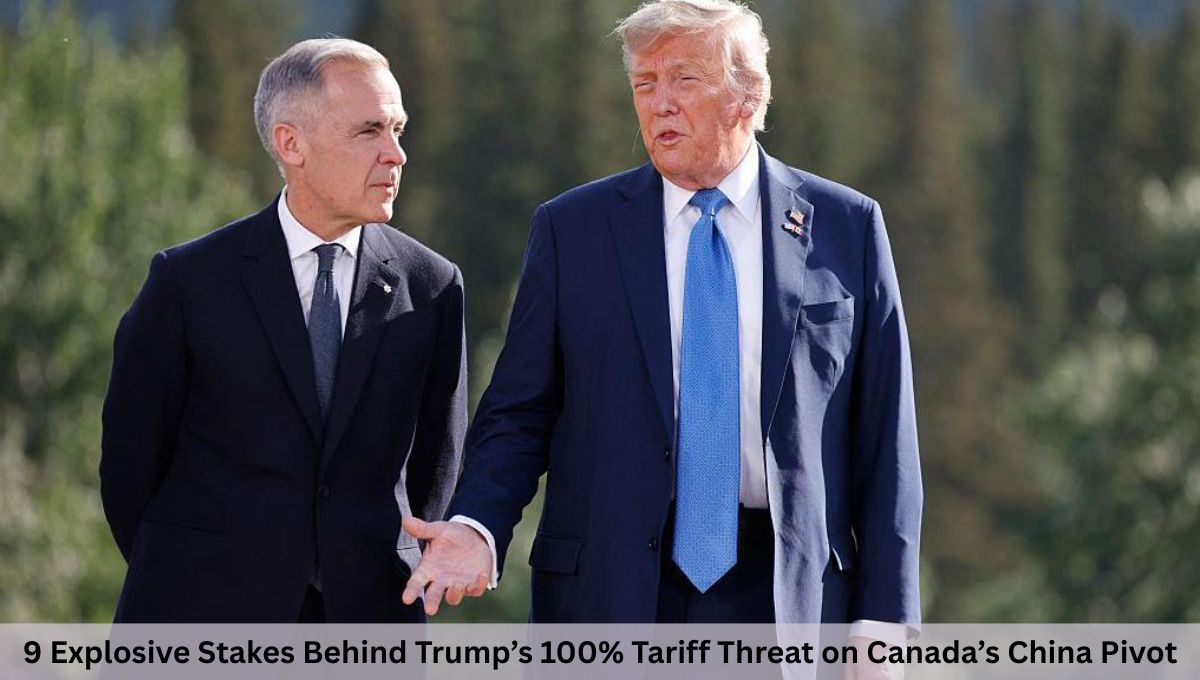
9 Explosive Stakes Behind Trump’s 100% Tariff Threat on Canada’s China Pivot — shaking North American trade. A single social media post from US President Donald Trump has sent shockwaves through North American markets, diplomatic circles, and global trade corridors.
Threatening to impose 100 percent tariffs on all Canadian imports, Trump warned Ottawa against pursuing deeper trade ties with China—casting Canada as a potential “drop-off port” for Chinese goods into the United States.
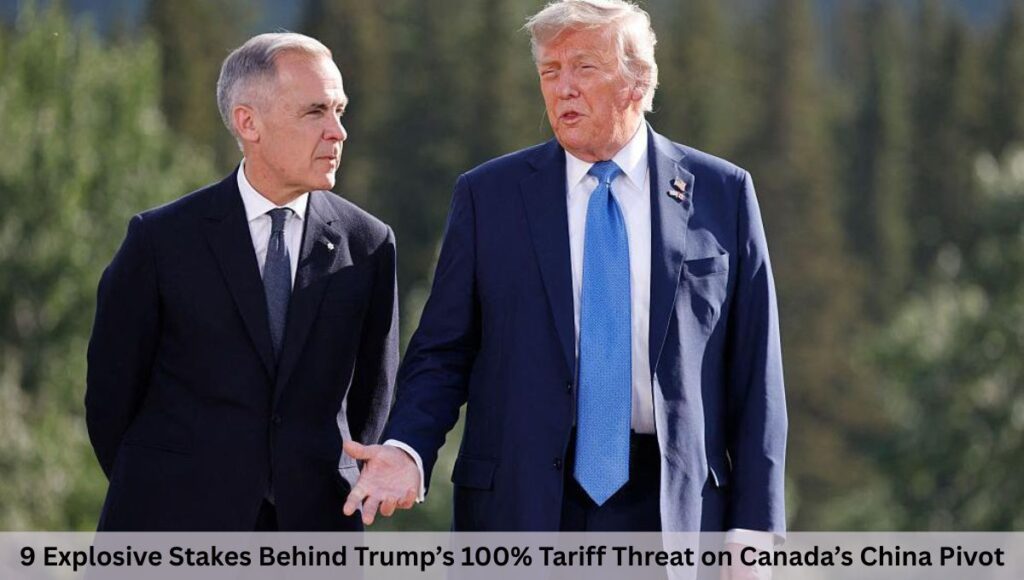
The remarks, delivered via Trump’s Truth Social platform, marked a dramatic escalation in already strained relations between Washington and Ottawa. At the center of the storm stands Canadian Prime Minister Mark Carney, whose government has pursued a cautious but deliberate diversification of Canada’s trade relationships amid rising uncertainty about US reliability.
While no tariffs have yet been imposed, the threat alone has raised urgent questions:
Is Trump serious?
Would such tariffs violate existing trade agreements?
And what does this confrontation reveal about the shifting architecture of global trade?
9 Explosive Stakes Behind Trump’s 100% Tariff Threat on Canada’s China Pivot
Trump’s Warning: “A Drop-Off Port for China”
The Statement That Sparked the Crisis
In his Truth Social post, Trump did not mince words. Referring to Carney as “governor”—a term he has repeatedly used to mock Canadian leaders—Trump warned that any trade deal between Canada and China would trigger immediate retaliation.
“If Governor Carney thinks he is going to make Canada a ‘Drop Off Port’ for China to send goods and products into the United States, he is sorely mistaken,” Trump wrote.
He went further, claiming China would “eat Canada alive” and “completely devour” its economy, businesses, and social fabric.
Trump framed the threat as defensive, portraying Canada’s engagement with Beijing as a direct risk to US economic and national security interests.
Yet the sweeping nature of the proposed tariffs—covering all Canadian goods—would represent one of the most aggressive trade measures ever taken against America’s closest ally.
Canada’s China Pivot: What the Deal Actually Includes
A ‘Landmark’ but Limited Agreement
Contrary to Trump’s framing, Canadian officials insist there is no free trade agreement with China. Instead, Ottawa and Beijing announced what Carney described as a “preliminary but landmark” trade arrangement aimed at easing specific barriers.
Key elements include:
- China reducing tariffs on Canadian canola products from 84% to about 15%
- Expanded access for Canadian agricultural exports such as peas and lobster
- Visa-free travel for Canadian visitors to China
- A quota allowing up to 49,000 Chinese electric vehicles into Canada under preferential tariffs
The agreement emerged from Carney’s visit to Beijing—the first by a Canadian leader in nearly a decade—and was framed as a pragmatic effort to stabilize relations rather than a strategic realignment.
Why Canada Is Looking Beyond the US
Canada’s motivation is rooted in necessity. Over the past year, the Trump administration has imposed or threatened tariffs on Canadian autos, steel, aluminum, lumber, and energy exports. Those measures have hit key industries hard and pushed unemployment to a nine-year high.
With the US increasingly using tariffs as leverage, Ottawa has sought to reduce its dependence on a single dominant market.
As one analyst put it, Canada is behaving like a banker—diversifying its portfolio to manage risk.
A History of Canada–China Tensions
From Crisis to Cautious Reset
Relations between Ottawa and Beijing have been strained since Canadian authorities arrested the daughter of Huawei founder Ren Zhengfei on a US extradition request. China responded by detaining two Canadians on espionage charges, plunging ties to historic lows.
Tariffs followed on both sides, particularly targeting Canadian agricultural exports. Over time, however, both governments signaled interest in stabilizing relations.
China has publicly stated its desire to get bilateral ties “back on the right track,” and Carney has argued that selective engagement is preferable to economic isolation—especially in an era of fractured global trade.
The Canada–US Spat: Davos as the Flashpoint
Carney’s ‘Rupture’ Speech
Tensions escalated sharply after Carney addressed the World Economic Forum in Davos. Without naming Trump, he warned that the world was facing a “rupture, not a transition” in the global order.
Stronger nations, he said, were using tariffs as weapons and supply chains as vulnerabilities.
The speech drew a standing ovation—and an unmistakable reaction from Washington.
Trump Fires Back
Trump responded the following day, declaring: “Canada lives because of the United States.”
He later revoked Carney’s invitation to join his self-styled “Board of Peace,” a proposed body Trump has promoted as an alternative forum for resolving global conflicts.
The exchange hardened positions on both sides and set the stage for the tariff threat that followed.
Buy Canadian: Carney’s Domestic Counteroffensive
A Message to Voters and Markets
In response to Trump’s remarks, Carney unveiled a renewed Buy Canadian policy, urging citizens to support domestic businesses and workers.
“Our economy is under threat from abroad,” Carney said in a video message. “Canadians have made a choice—to focus on what we can control.”
The policy commits the government to prioritizing Canadian materials, labor, and technology in major projects, including housing, infrastructure, and defense.
Economic Nationalism, Canadian Style
Unlike Trump’s protectionism, Carney’s approach emphasizes domestic resilience rather than punitive trade measures.
The message is clear:
Canada will not be coerced into abandoning its economic sovereignty.
USMCA Under Strain: Legal and Economic Implications
Could Trump Actually Do This?
Trade experts question whether Trump can legally impose such sweeping tariffs on Canada, particularly under the United States–Mexico–Canada Agreement (USMCA), which exempts compliant goods from many duties.
However, USMCA includes a controversial clause allowing members to withdraw if another party enters a free trade agreement with a “non-market economy” like China.
While Canada insists no such agreement exists, Trump could attempt to use the clause as leverage—or justification.
Experts Warn of Collateral Damage
Analysts note that imposing 100% tariffs on Canada could:
- Disrupt deeply integrated North American supply chains
- Hurt US manufacturers reliant on Canadian inputs
- Trigger retaliatory measures
- Undermine confidence in US trade commitments
“If Trump follows through, the US would be imposing harsher trade restrictions on Canada than on China,” said Erica York of the Tax Foundation.
Economic Fallout: Pain on Both Sides of the Border
Canada’s Exposure
Canada is uniquely vulnerable because exports to the US account for a large share of its GDP. Losing USMCA protections would push effective tariffs well above current levels, devastating key sectors.
Business confidence is already fragile, with firms delaying investment amid trade uncertainty.
The US Cost
The damage would not be one-sided. Canadian boycotts have already hurt US businesses:
- Canadian travel to the US by land is down 31%
- US spirits exports to Canada have plunged 85%
- Manufacturers face rising input costs
Trade economists warn that escalating tariffs could raise prices for American consumers and undermine competitiveness.
Trump’s Track Record: Threats vs Reality
The ‘TACO’ Theory
Investors have coined an unflattering acronym for Trump’s trade strategy: TACO—Trump Always Chickens Out.
Trump has previously threatened sweeping tariffs on European allies, only to back down after frameworks were announced. Some analysts believe the Canada threat may follow the same pattern.
Still, the uncertainty itself carries economic consequences.
“The threat alone illustrates how erratic and unreliable US trade policy is at this moment,” York said.
China’s Role: Strategic Opportunity or Convenient Villain?
For Beijing, the Canada-US dispute presents both opportunity and risk. China has welcomed Carney’s outreach as a sign of warming relations, but remains cautious not to provoke further backlash.
From Trump’s perspective, China serves as a unifying adversary—useful for rallying domestic support and pressuring allies to align with Washington’s trade agenda.
A Deeper Shift in Global Trade
From Integration to Fragmentation
This confrontation reflects a broader transformation in global economics. Trade is no longer just about efficiency; it has become a tool of power, coercion, and strategic alignment.
Carney’s Davos warning captured this shift succinctly: middle powers must act together, or risk being sidelined.
What Happens Next?
Several paths remain open:
- Trump could quietly retreat, as he has in past disputes
- Tariffs could be imposed selectively rather than universally
- The USMCA review could become a battleground
- Canada could accelerate diversification toward Europe and Asia
Much will depend on political calculations in Washington—and on how far Ottawa is willing to push back.
Conclusion: A Defining Test for North American Relations
Trump’s 100% tariff threat is more than a negotiating tactic. It is a stress test for the future of Canada–US relations, the credibility of USMCA, and the stability of global trade norms.
For Canada, the challenge is to defend sovereignty without triggering economic self-harm. For the United States, it is to balance legitimate concerns about China with the costs of alienating its closest ally.
Whether this ends in compromise or confrontation, one reality is clear:
the era of predictable North American trade is over. What replaces it will shape the region’s economic and political landscape for years to come.
Also Read: 5 Bold Signals Mark Carney’s China Pivot as Canada Rewrites Trade Strategy
Also Read: Trump threatens to impose 100% tariff if Canada makes deal with China
Related Posts:
- Can the EU and NATO Impose Tariffs on India and…

- What’s Next for Donald Trump After Court Rules His…

- 7 Crucial Insights Into Trump and Xi’s High-Stakes…
- 10 Big Takeaways from Trump’s 155% Tariff Warning to China

- 5 Key Takeaways from Trump–Carney Meet: Trade,…
- 5 Powerful Highlights as Trump Lands Second Nobel…
