10 Explosive Tariffs: Trump’s Hardball Greenland Gamble as 10% levies hit eight European nations. US President Donald Trump has once again thrust transatlantic relations into turmoil, announcing a sweeping tariff regime against key European allies for opposing his plan to bring Greenland under American control.
Thank you for reading this post, don't forget to subscribe!In a dramatic statement posted on his Truth Social platform, Trump declared that goods from eight European countries would face a 10% tariff from February 1, escalating to 25% by June 1 unless a deal is reached for what he described as the “Complete and Total purchase of Greenland” by the United States.
The move represents one of the most aggressive uses of trade policy as geopolitical leverage in modern US history, targeting not adversaries but NATO allies—Denmark, Norway, Sweden, France, Germany, the United Kingdom, the Netherlands, and Finland.
Trump framed the tariffs as both economic rebalancing and a matter of global security, arguing that Greenland is essential to US national defense and even “world peace.”
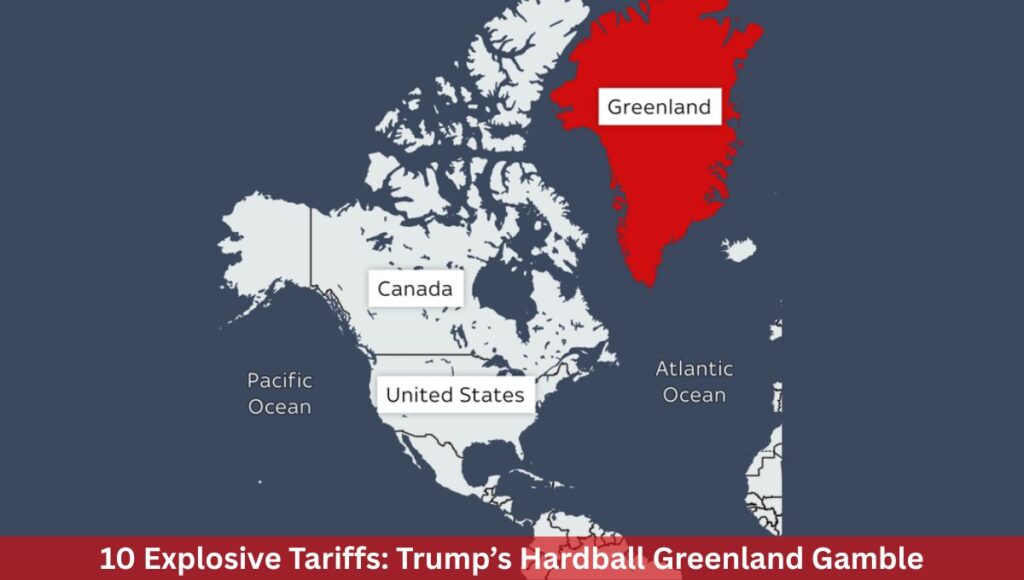
10 Explosive Tariffs: Trump’s Hardball Greenland Gamble
Why Greenland Matters to Trump
Strategic Geography and Arctic Power
Greenland’s importance lies not in its population—just over 56,000 people—but in its location. Sitting between North America and the Arctic, the island is a critical node for early-warning missile systems, Arctic shipping routes, and surveillance of Russian and Chinese activity in the High North.
The US already operates the Pituffik Space Base (formerly Thule Air Base) under a 1951 defense agreement with Denmark, giving Washington significant military access.
Trump argues that this is no longer enough. In repeated statements, he has insisted that full US control of Greenland is necessary to guarantee security, especially as China and Russia expand their Arctic ambitions. Anything short of American ownership, he has said, is “unacceptable.”
Minerals, Missiles, and the ‘Golden Dome’
Beyond military positioning, Greenland is resource-rich, holding significant reserves of rare earth elements, uranium, and other critical minerals vital to modern defense and green technologies.
Trump has explicitly linked Greenland to the success of advanced missile defense systems, including what he calls the “Golden Dome,” arguing that the island’s geography is indispensable for optimal coverage.
The Tariff Announcement: What Trump Said
In his Truth Social post, Trump accused European nations of benefiting for decades from US protection without adequate compensation.
He claimed that America had effectively subsidized Denmark and the European Union by maintaining low tariffs, and that it was now time for Europe to “give back.”
The president warned that the tariffs would remain in place—and increase—until Europe agrees to the US acquisition of Greenland.
He accused the targeted countries of playing “a very dangerous game” by sending military personnel to the island, suggesting that their actions threatened planetary security.
Which Countries Are Affected
The eight countries named by Trump are:
- Denmark
- Norway
- Sweden
- France
- Germany
- United Kingdom
- Netherlands
- Finland
For EU member states, the tariffs would effectively apply across the bloc, since trade policy is conducted centrally through Brussels.
This reality has raised alarm within European institutions, as Trump’s threat undermines the legal and political foundations of EU-US trade agreements.
Europe Pushes Back: ‘Greenland Is Not for Sale’
Denmark and Greenland Respond
Danish leaders were unequivocal in rejecting Trump’s demands. Foreign Minister Lars Løkke Rasmussen called the idea of a US takeover “out of the question,” stressing that it violates international law and infringes on sovereignty.
Greenland’s Prime Minister, Jens-Frederik Nielsen, went further, stating plainly that Greenland chooses Denmark, NATO, and the EU over the United States.
Opinion polls reinforce this stance, showing that around 85% of Greenlanders oppose joining the US.
Mass Protests Across the Danish Realm
The tariff announcement coincided with some of the largest protests Greenland has ever seen. In Nuuk, nearly a quarter of the capital’s population marched through icy streets carrying signs reading “Greenland is not for sale” and “We shape our future.”
Similar demonstrations took place in Copenhagen and other Danish cities, as well as solidarity rallies across Europe.
Protesters described Trump’s approach as bullying, warning that small nations must not be coerced into surrendering sovereignty through economic threats.
NATO Under Strain
Trump’s tariffs have placed extraordinary pressure on NATO, an alliance built on collective defense and mutual trust.
European leaders warned that using economic coercion against allies—particularly over territorial acquisition—could irreparably damage the alliance.
Several European countries have dispatched small troop contingents to Greenland at Denmark’s request, describing the move as a NATO reconnaissance and security mission in an increasingly contested Arctic. Trump, however, portrayed the deployments as hostile acts designed to block US ambitions.
EU Trade Deal in Jeopardy
European Parliament Revolts
Trump’s threat has thrown last summer’s EU-US trade agreement into doubt. While the deal has entered into force in the United States, it still awaits legal ratification in the European Union.
Leading political groups in the European Parliament—the European People’s Party, Socialists & Democrats, and Renew—have now signaled they will block approval.
EU lawmakers argue that no trade deal can proceed while the US threatens tariffs to force territorial concessions.
UK Caught in the Middle
The United Kingdom, though no longer an EU member, is also exposed. Its limited trade deal with the US is already in force, but British exports face existing tariffs on steel and other sensitive sectors.
Prime Minister Keir Starmer condemned Trump’s move, calling it “completely wrong” to penalize allies for pursuing collective security.
Legal and Economic Questions in the US
Authority to Impose Tariffs
Trump did not cite a specific legal basis for the new tariffs, but analysts believe he may rely on the International Emergency Economic Powers Act, which grants the president broad authority during extraordinary threats.
The legality of Trump’s previous tariffs under this law is currently under review by the US Supreme Court, which could rule as soon as next week. A ruling against the administration could immediately imperil the Greenland-related tariffs.
Domestic Opposition Mounts
The tariff threat has drawn criticism from across the US political spectrum. A bipartisan congressional delegation visiting Denmark sought to de-escalate tensions, emphasizing that there are no immediate security threats to Greenland that justify such measures.
Several US senators warned that tariffs on NATO allies would raise prices for American consumers while benefiting geopolitical rivals like China and Russia.
Is This Negotiation or Intimidation?
Trade experts and foreign policy analysts widely view Trump’s tariff threat as a negotiating tactic rather than a prelude to military action.
By targeting the exact countries that sent troops to Greenland, Trump appears to be signaling displeasure while avoiding direct confrontation.
Still, critics warn that normalizing economic coercion for territorial demands sets a dangerous precedent in international relations.
China, Russia, and the Bigger Picture
Ironically, European officials argue that Trump’s strategy risks achieving the opposite of its stated goal. By fracturing NATO unity and straining transatlantic ties, the tariffs could hand strategic advantages to China and Russia—precisely the rivals Trump says he wants to deter.
EU foreign policy chief Kaja Kallas summed up the concern bluntly: divisions among allies are exactly what authoritarian powers hope for.
What Happens Next
EU ambassadors are set to meet in emergency session, while European leaders coordinate a joint response. Options range from retaliatory tariffs to legal challenges at the World Trade Organization, though many hope diplomacy can still prevail.
For now, Greenland’s message remains clear and consistent:
its future is not for sale, and its people will decide their own destiny.
Conclusion: A High-Stakes Gamble
Trump’s decision to impose tariffs over Greenland marks a dramatic escalation in an already volatile geopolitical dispute.
By weaponizing trade against allies, the US president has ignited protests, endangered trade agreements, and tested the resilience of NATO.
Whether this hardball strategy forces concessions—or backfires spectacularly—will shape not only the future of Greenland but the credibility of the transatlantic alliance itself.
Also Read: 7 Explosive Reasons Greenland Keeps Resisting US Takeover
Also Read: Russia says it’s monitoring Trump’s ‘extraordinary’ push to take over Greenland