7 Stark Lessons from Venezuela’s China-Made Weapons Collapse that led to Nicolás Maduro’s capture. The United States’ military intervention in Venezuela on January 3, 2026, did more than remove President Nicolás Maduro from power.
It exposed a deeper and more uncomfortable reality for Beijing:
Chinese-made weapons failed to deter, detect, or delay the most consequential U.S. military operation in Latin America in decades.
Unlike after Operation Sindoor, when Beijing loudly celebrated Pakistan’s use of Chinese air-defense systems against India, China’s reaction to the Caracas operation has been marked by an unusual quiet. There have been condemnations of American “hegemonic behavior,” yes—but no triumphal defence of Chinese military hardware, no state-media showcases, no glowing assessments of system performance.
That silence is telling. This opinion piece examines what Venezuela’s collapse reveals about Chinese military exports, Beijing’s strategic miscalculations in Latin America, and why the U.S. raid may mark a turning point in great-power competition in the Western Hemisphere.
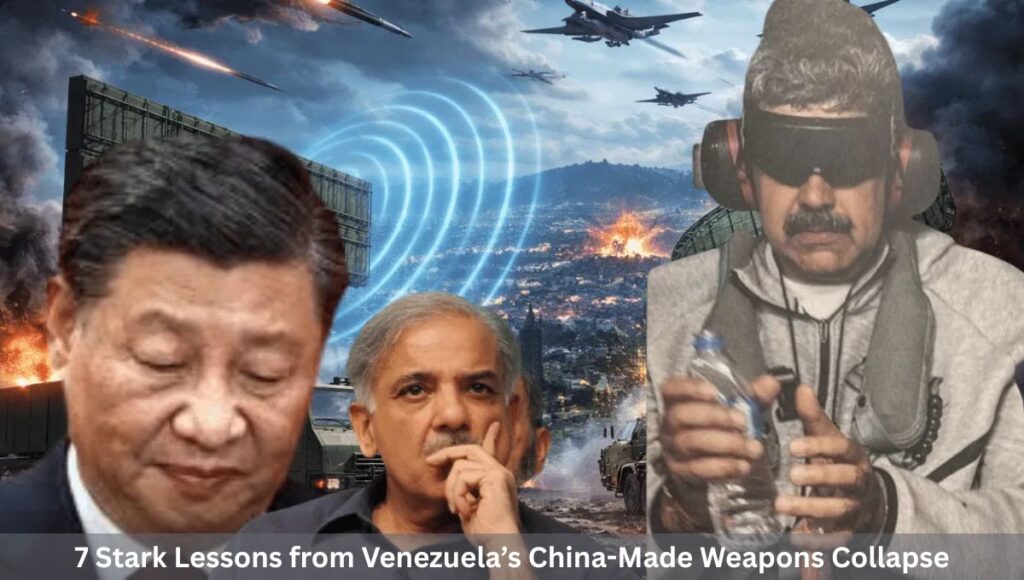
7 Stark Lessons from Venezuela’s China-Made Weapons Collapse
1. The January 3 Raid: A Shock That Was Years in the Making
While the arrest of Nicolás Maduro and his wife during Operation Absolute Resolve stunned global audiences, the operation itself did not emerge from a vacuum.
The Monroe Doctrine Returns
The November 2025 U.S. National Security Strategy made Washington’s intentions explicit:
- The Monroe Doctrine was revived as official policy
- The Western Hemisphere was reaffirmed as a U.S. sphere of influence
- “Non-Hemispheric competitors” were explicitly warned off
China was clearly one of those competitors.
The NSS also announced the creation of an interagency task force to identify strategic resources and chokepoints across Latin America—language that foreshadowed decisive action rather than diplomacy.
By January 2026, sustained sanctions, narcotics interdictions, and intelligence operations had already placed Venezuela under intense pressure. The raid itself was simply the culmination.
2. China as Venezuela’s Strategic Patron
For over two decades, Venezuela under Hugo Chávez and Nicolás Maduro cultivated deep ties with Beijing.
Military Ties
Venezuela fielded:
- VN-4 armored utility vehicles
- VN-1 and VN-18 infantry fighting vehicles
- K-8 Karakorum light attack aircraft
- JY-27 and JYL-1 Chinese radar systems
These platforms were marketed as modern, cost-effective alternatives to Western systems—especially attractive to sanctioned states.
Economic and Oil Dependence
China’s stake was even higher economically:
- Up to 90% of Venezuela’s oil exports flowed to China in 2025
- China Development Bank invested $50–60 billion via loans-for-oil deals
- Contracts were long-term and price-locked
Venezuela was not just a partner; it was one of Beijing’s most consequential overseas bets.
3. The JY-27 Radar Myth Meets Reality
At the heart of the controversy is the JY-27 “anti-stealth” radar, promoted by China as capable of detecting aircraft like the F-22 and F-35.
Marketing vs Battlefield
China had claimed:
- Detection ranges exceeding 250 km
- Ability to locate “extremely stealthy targets”
- Meter-wave superiority over low-observable designs
Yet during the U.S. operation:
- F-22s, F-35s, Growlers, drones, and helicopters entered Venezuelan airspace
- No meaningful early warning was recorded
- Radar sites were jammed, blinded, or destroyed
Observers noted that not a single U.S. aircraft was shot down.
Why the Radar Failed
Experts point to multiple factors:
- Poor angular resolution of VHF radars
- Vulnerability to modern electronic warfare
- Aging export variants
- Weak integration into a resilient IADS
- Inadequate operator training
The result was not just failure—it was irrelevance.
4. Silence in Beijing: A Strategic Tell
After Pakistan’s use of Chinese systems during Operation Sindoor, Chinese media celebrated the event as proof of “Made in China” military success.
After Caracas, that praise vanished.
What Chinese Commentators Are Saying
Instead of defending hardware performance, Chinese analysts have shifted focus to:
- U.S. electronic warfare dominance
- CIA intelligence penetration
- Possible bribery or betrayal within Venezuelan ranks
- The “money-burning” scale of U.S. special forces
What is missing is any serious public defense of Chinese equipment.
Why That Matters
This silence suggests:
- Internal concern about export-variant performance
- Fear of reputational damage in global arms markets
- Recognition that Chinese systems struggle against peer adversaries
For an arms exporter, perception matters almost as much as capability.
5. Arms Exports at Risk: A Blow to China’s Defense Industry
China has aggressively expanded arms exports across:
- Africa
- South Asia
- Latin America
- The Middle East
Many buyers are sanctioned or budget-constrained states seeking alternatives to Western systems.
The Venezuela Problem
Venezuela was meant to be a showcase:
- Chinese radars + Russian SAMs
- Layered defense architecture
- Strategic deterrence
Instead, it became a cautionary tale.
Prospective buyers now see:
- Systems overwhelmed by U.S. SEAD
- Weak command-and-control resilience
- Export variants lagging behind cutting-edge warfare
This could disrupt Chinese arms sales far beyond Latin America.
6. The Bigger Loss: China’s Oil Gamble in Jeopardy
Military embarrassment is one thing. Economic loss is another.
A $50–60 Billion Exposure
China’s loans-for-oil arrangements now face:
- Potential nullification
- Assets under U.S. physical control
- No collateral leverage
Unlike ports or railways, oil fields cannot be repossessed once seized.
A Belt and Road Disaster
This could become:
- The largest single write-off in BRI history
- A warning against overexposure to unstable regimes
- A precedent for U.S. disruption of Chinese energy supply chains
For Beijing, this is not merely a Venezuelan problem—it is a strategic vulnerability.
7. A New Kind of War China Must Study Closely
The Caracas operation showcased modern American warfare:
- Multi-domain integration
- AI-supported intelligence fusion
- Cyber and electronic warfare
- Rapid SEAD
- Special operations precision
This is Mosaic Warfare in practice.
Why It Matters for China
Chinese military doctrine emphasizes:
- Area denial
- Large sensor networks
- Platform-centric defense
Venezuela demonstrated that without:
- Robust integration
- Adaptive command structures
- Real-time resilience
Even advanced hardware collapses quickly.
For Beijing, the lesson is sobering.
Conclusion: A Silence Louder Than Any Statement
China’s condemnation of U.S. actions in Venezuela was loud—but its silence on the performance of its own weapons is far louder.
Venezuela revealed:
- Limits of Chinese export military technology
- Fragility of Beijing’s Latin America strategy
- Vulnerability of energy-centric diplomacy
- The overwhelming edge of U.S. multi-domain warfare
For Washington, January 3 was a declaration of hemispheric dominance.
For Beijing, it was a warning.
China will study Caracas carefully—not just as a diplomatic setback, but as a stress test it failed, with implications stretching from arms exports to oil security to the future of great-power competition in the Americas.
The weapons may have been made in China. But the lesson belongs to everyone watching.
Related Posts:
- India’s Operation Sindoor: IAF Bypasses & Jams…
- 3 Explosive Conditions Iran Sets to End War with US…

- 7 Explosive Facts Behind China’s ‘Bizarre’ Claim of…

- 10 Explosive Warnings as Donald Trump Calls Iran…
- 12 Shocking Revelations About Trump’s Response to…
- US Monitors India-Pakistan “Every Single Day,” says…