5 Stark Realities as Taiwan Stays Calm Amid Explosive China War Games and global concern. As China carried out its most expansive military exercises around Taiwan in years, simulating a blockade and firing live ammunition into nearby waters, daily life on the island moved forward with striking normalcy.
Hair salons stayed busy, cafes were full, and the stock market climbed — a reflection of how constant pressure from Beijing has become a familiar backdrop rather than a daily disruption for many Taiwanese.
For 70-year-old retiree Liao, the war games unfolding just offshore barely registered as she enjoyed a mahjong game with friends and prepared for the Lunar New Year. “Everyday life hasn’t been impacted,” she said from a salon in New Taipei City. “We all still have to wash our hair.”
Her sentiment captures a broader mood across Taiwan this week:
a blend of resilience, resignation, and underlying unease as China intensifies its military posture while the world watches closely.
5 Stark Realities as Taiwan Stays Calm Amid Explosive China War Games
China’s ‘Justice Mission 2025’ and the Message to Taiwan
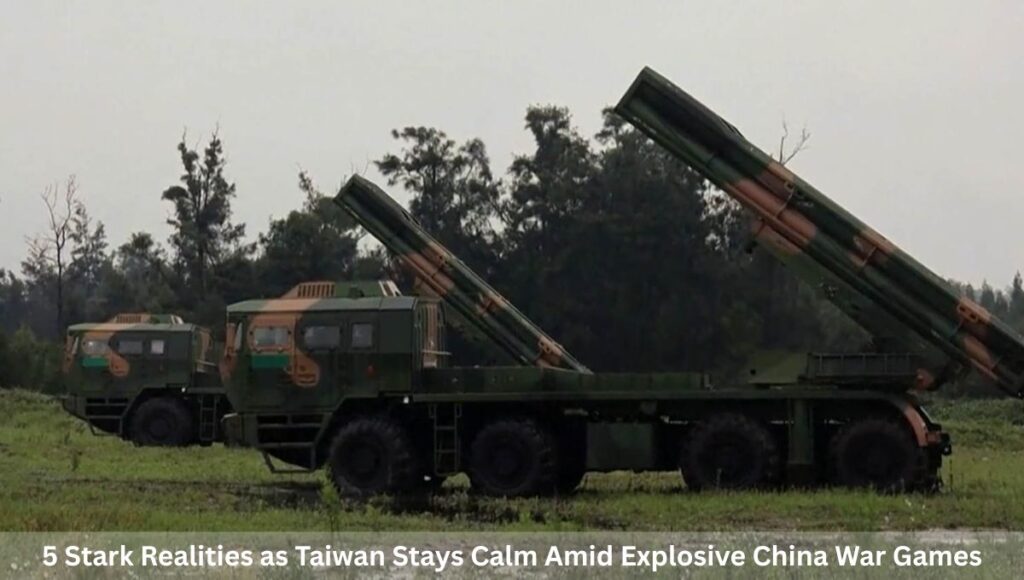
China’s People’s Liberation Army (PLA) launched a two-day series of large-scale drills dubbed “Justice Mission 2025”, encircling Taiwan across five maritime zones and adjacent airspace.
The exercises included live-fire drills, long-range projectile launches into the Taiwan Strait, and simulations of a military blockade of the island.
It marked the closest Chinese live-fire activity ever recorded near Taiwan, with Taiwan’s Ministry of National Defense reporting that 10 of 27 rockets landed within the island’s 24-nautical-mile contiguous zone.
Beijing framed the exercises as a direct response to what it called “separatist forces” in Taiwan and “external interference,” particularly following Washington’s announcement of an $11 billion arms package for Taipei.
China’s Foreign Ministry said the drills were a “punitive and deterrent action” aimed at safeguarding national sovereignty and territorial integrity.
Life Goes On Despite Military Pressure
Despite the dramatic military manoeuvres, daily routines across Taiwan remained largely unchanged. In New Taipei City, customers drifted in and out of flower shops as usual.
In cafes near university campuses, students studied quietly, scrolling through their phones as updates about the drills flashed across social media and 24-hour news channels.
“We’re not scared,” said Liao’s hairstylist. “Working people don’t have time to pay attention to these things. All they can do is work.”
This apparent calm does not reflect indifference. Rather, it underscores how deeply normalized Chinese military pressure has become in Taiwanese society after years of repeated drills, airspace violations, and diplomatic threats.
A Nation Growing ‘Numb’ to Threats
Several Taiwanese described a sense of emotional fatigue rather than fear.
“We’ve become used to it — a bit numb,” said Yeh, who runs a flower shop in New Taipei City. During the two days of Chinese war games, not a single customer mentioned the drills.
China has conducted six major military exercises around Taiwan since 2022, following then-US House Speaker Nancy Pelosi’s visit to the island. Those drills ushered in an era of near-daily Chinese military activity near Taiwan.
Violations of Taiwan’s Air Defence Identification Zone (ADIZ) have surged dramatically — from just 41 documented incursions in November 2021 to 266 by November this year, according to Taiwan’s Ministry of National Defence.
Economic Confidence as a Shield
For many Taiwanese, confidence in the island’s economy provides psychological reassurance. Liao pointed to Taiwan’s stock market performance during the drills as proof that war was unlikely.
“The market is up 200 points today,” she said. “If fighting were about to break out, everyone would be selling.”
Taiwan’s central role in the global semiconductor supply chain — dominated by Taiwan Semiconductor Manufacturing Company (TSMC) — is widely viewed as a strategic deterrent.
Often referred to locally as the “sacred mountain” or internationally as the “silicon shield,” TSMC’s importance to global technology production, including to China itself, is believed by many Taiwanese to reduce Beijing’s incentive to launch a full-scale attack.
Disinformation and the Information Battlefield
While physical life continued uninterrupted, the digital sphere told a different story.
Disinformation circulated rapidly during the drills, including a fabricated propaganda video showing a Chinese aircraft flying close to Taipei 101.
Taiwan’s government quickly dismissed the footage as fake, highlighting the growing role of psychological and information warfare in cross-strait tensions.
Social media platforms buzzed with speculation, alarmist commentary, and exaggerated claims — prompting some Taiwanese, particularly younger citizens, to feel more anxious than their outward calm might suggest.
Students Feel the Weight of Uncertainty
For younger Taiwanese, the drills felt different.
Wang, a 19-year-old university student studying at a Taipei cafe, admitted feeling unsettled. “This time feels more serious. It feels more realistic,” she said. “I even thought about writing a will.”
Her anxiety was compounded by recent events on the island. Just weeks earlier, a rare violent attack in central Taipei left three people dead. Days later, a magnitude 7.0 earthquake off Yilan’s coast shook the island.
“There are many troops stationed around major transport hubs, and the earthquakes made us even more nervous,” Wang said. “I think vigilance is necessary, but the panic online is excessive.”
Political Undercurrents and Electoral Fallout
The drills have also sharpened political divisions within Taiwan. Yeh said she has lost trust in the opposition Kuomintang (KMT), which she believes is too accommodating toward Beijing.
Once a lifelong KMT voter, she voted for Democratic Progressive Party (DPP) candidates in both 2016 and 2024.
The Chinese Communist Party has refused to engage with the DPP, which emphasizes Taiwan’s sovereignty and distinct identity.
Meanwhile, the KMT has repeatedly blocked special defence budgets proposed by the ruling party and accused President William Lai Ching-te of pushing Taiwan toward war.
KMT chairperson Cheng Li-wun has even prioritized a meeting with Chinese President Xi Jinping in 2026, further fuelling public debate over Taiwan’s political direction.
US Response: ‘Unnecessarily Raised Tensions’
The United States eventually weighed in, with the State Department stating that China’s military drills had “unnecessarily raised tensions” and urging Beijing to cease military pressure against Taiwan.
“China’s military activities and rhetoric toward Taiwan and others in the region increase tensions unnecessarily,” said State Department spokesperson Tommy Pigott.
Washington reiterated its opposition to any unilateral change to the status quo by force or coercion, while reaffirming its commitment to peace and stability across the Taiwan Strait.
President Donald Trump initially downplayed the drills, calling them a continuation of long-standing Chinese activity, though his remarks contrasted sharply with criticism from other democracies.
Global Condemnation and Diplomatic Fallout
China’s actions drew criticism from the European Union, the United Kingdom, France, Germany, Japan, Australia, New Zealand, and the Philippines, all of which expressed concern over the scale and proximity of the drills.
Taiwan’s Foreign Minister Lin Chia-lung welcomed the international support, saying Taipei would work with “like-minded countries” to uphold a rules-based international order.
Beijing rejected the criticism, insisting Taiwan is an internal matter and warning foreign governments against interference.
Quad Meeting Adds Strategic Weight
Against this backdrop, ambassadors from the Quad nations — the US, India, Australia, and Japan — held a rare publicised meeting in Beijing, signaling coordinated concern over Indo-Pacific stability.
While China has long criticized the Quad as a destabilizing bloc, the meeting underscored growing international alignment in response to Beijing’s assertive regional posture.
China’s Firm Stance on ‘One China’
China doubled down on its position through diplomatic channels, including a sharp response from its embassy in New Zealand, which rejected Wellington’s expression of concern over the drills.
Beijing reiterated that Taiwan is an “inalienable part of China’s territory” and accused Taiwan authorities and foreign powers of undermining peace through separatism and interference.
Resilience Masking Deeper Anxiety
Despite outward calm, polling suggests anxiety is growing beneath the surface. A 2023 survey by the Brookings Institution found that nearly 65 percent of Taiwanese were worried about a cross-strait war — up from 57 percent in 2021.
Nearly 58 percent believed President Xi Jinping was more likely to use force than five years earlier. Yet for many citizens, there is little they feel they can do beyond voting and carrying on with daily life.
“I think Taiwanese people are resigned to their fate,” Yeh said. “Besides voting, what else can we do?”
A Delicate Balance
China’s latest drills did not reach the intensity of the 2022 exercises that followed Nancy Pelosi’s visit, but they covered a larger combined area than any previous operation, signaling a strategic evolution rather than escalation for escalation’s sake.
For Taiwan, the challenge remains navigating deterrence without provocation, resilience without complacency, and democracy under constant pressure.
As warships circle offshore and missiles splash into nearby waters, the island’s salons stay open, markets trade, and students sip coffee — a quiet defiance shaped by decades of living under the shadow of a powerful neighbour.
For now, life goes on. But few doubt that the calm rests on an increasingly fragile equilibrium.
Also Read: 7 Alarming Signs China–Japan Tensions Are Spiraling Over Taiwan
Also Read: How are China’s new war games around Taiwan different from earlier drills?
Related Posts:
- 7 Powerful Signals from Xi’s ‘Unstoppable’ Taiwan…

- 3 Explosive Conditions Iran Sets to End War with US…

- 7 Critical Reasons Kharg Island Is Iran’s Oil “Crown…

- In 8 Moves, EU Targets China-Linked Refineries and…

- 7 Powerful Measures: Trump Sanctions Russian Oil…

- 7 Heartbreaking Facts About Venezuela's Earthquake Disaster