

11 Dangerous Signals as Thailand–Cambodia Airstrikes Threaten Trump’s Peace Deal and force mass civilian evacuations. Thailand and Cambodia have plunged back into open conflict, launching airstrikes, artillery fire, and ground assaults along their disputed border—just two months after a ceasefire brokered by U.S. President Donald Trump was hailed as a rare diplomatic success.
The renewed violence has killed soldiers and civilians, displaced more than 100,000 people, and raised fears that one of Trump’s most publicly touted peace agreements is unravelling at alarming speed.
What began as simmering tension following a landmine blast has escalated into a multi-day conflict involving fighter jets, heavy weapons, tanks, drones, and naval forces, spreading across nearly the entire Thailand–Cambodia frontier.
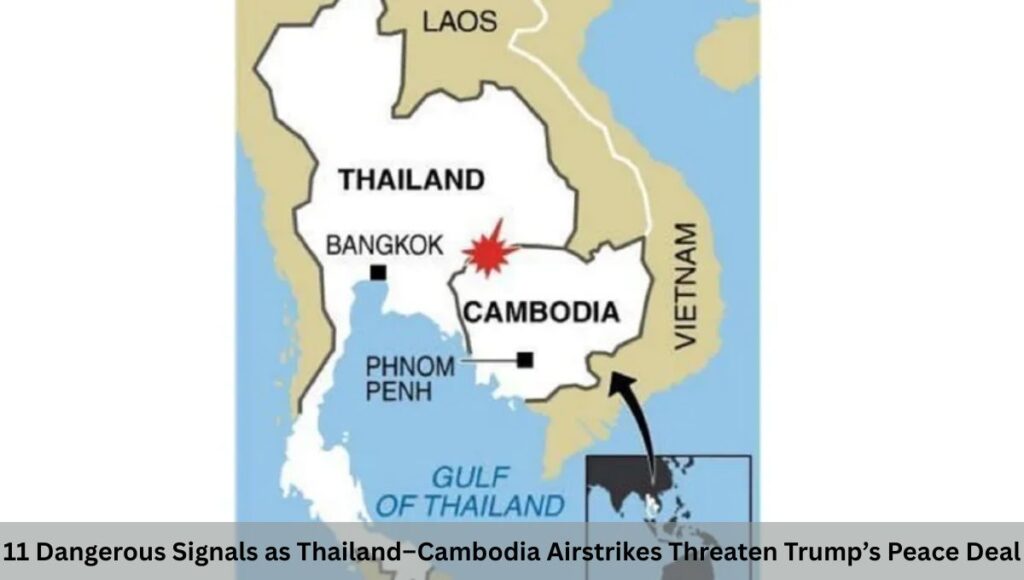
11 Dangerous Signals as Thailand–Cambodia Airstrikes Threaten Trump’s Peace Deal
Airstrikes Mark Sharp Escalation in Border Fighting
Early Monday morning, Thailand launched airstrikes against Cambodian military positions, marking the most serious escalation since the July clashes that killed dozens.
Thailand’s army said the strikes targeted Cambodian arms-support infrastructure near the Chong An Ma Pass, following an earlier Cambodian attack that:
- Killed one Thai soldier
- Injured at least seven others
Army spokesperson Maj. Gen. Winthai Suvaree said Cambodian forces had shelled Thai positions at Anupong Base using artillery and mortar fire.
“The target was Cambodia’s arms supporting positions,” Winthai said, calling the strikes a retaliatory and defensive response.
Cambodia strongly rejected Thailand’s version of events, accusing Bangkok of launching unprovoked attacks in violation of the ceasefire.
Both Sides Trade Accusations of Ceasefire Violations
Cambodia’s Ministry of National Defense said Thai forces launched an attack at 5:04 a.m. local time in Preah Vihear province, near contested border areas. “Such action is a grave violation of the Joint Declaration,” the ministry said, referring to the October ceasefire agreement witnessed by Trump and Malaysian Prime Minister Anwar Ibrahim.
Cambodian officials insisted:
- Cambodia did not retaliate initially
- Thai attacks targeted military positions and civilian areas
- Homes were burned and villages emptied
Later, former Prime Minister Hun Sen, now Cambodia’s Senate President, said Cambodia eventually retaliated after exercising restraint for over 24 hours. “Cambodia needs peace, but Cambodia is forced to fight back to defend our territory,” Hun Sen said.
Civilian Deaths and Mass Displacement Mount
The human toll is rising rapidly.
Casualty Figures So Far
- Cambodia: At least 7 civilians killed, 20 injured
- Thailand: At least 3 soldiers killed, 18 wounded
- Total displaced: Over 100,000 people on both sides
Cambodian Information Minister Neth Pheaktra said shelling in Oddar Meanchey and Preah Vihear provinces killed civilians and forced tens of thousands to flee. Thailand’s army accused Cambodia of targeting civilian areas in Thai provinces including Surin, Sa Kaeo, and Trat, prompting mass evacuations.
Thailand Evacuates Nearly 400,000 Civilians
Thailand has launched one of its largest border evacuations in recent history.
According to government figures:
- Nearly 400,000 civilians have been evacuated
- 492 temporary shelters set up
- Over 125,000 people housed as of Tuesday
Thai Foreign Ministry spokesperson Nikorndej Balankura said evacuations began Sunday, with about 70% of residents already moved from high-risk areas. Public health services, food supplies, and emergency assistance are being provided around the clock, officials said.
Fighting Spreads Across Almost Entire Border
The conflict is no longer confined to a single flashpoint. Thailand’s navy confirmed fighting had spread to Trat province, meaning clashes have been reported in six of the seven Thai provinces bordering Cambodia.
Rear Admiral Paraj Ratanajaipan said Cambodia:
- Refused repeated withdrawal requests
- Deployed special forces and snipers
- Used multiple-rocket launchers
- Dug trenches
- Conducted drone surveillance over Thai positions
Thailand said it was using “necessary and proportionate force” to prevent further escalation.
Trump-Brokered Peace Deal on the Brink
The October ceasefire—signed in Kuala Lumpur and witnessed by Trump—was portrayed by the former US president as proof of his deal-making prowess.
The agreement followed intense fighting in July that:
- Lasted five days
- Killed more than 40 people
- Displaced up to 300,000 civilians
Trump personally hosted calls between Thai and Cambodian leaders, while Malaysia acted as regional mediator. But the deal began fraying within weeks.
Thailand halted its commitments in November after a landmine blast injured Thai soldiers, accusing Cambodia of failing to uphold security provisions. Now, the agreement appears all but frozen.
Thai Foreign Minister: “The Ceasefire Is Not Working”
Thailand’s Foreign Minister Sihasak Phuangketkeow has openly questioned the viability of the ceasefire. “We’re not really convinced that the joint declaration is working according to its intention,” he told media outlets.
While stopping short of rejecting US mediation outright, Sihasak said Thailand must work directly with Cambodia to secure genuine peace. “If the Trump administration wishes to continue involvement, we need something more than peace on paper,” he added.
US, UN, and ASEAN Urge Restraint
The renewed violence has triggered alarm across the international community.
A senior US administration official said:
“President Trump is committed to the continued cessation of violence and expects both governments to fully honor their commitments.”
UN Secretary-General António Guterres urged both sides to de-escalate and return to dialogue. “The UN stands ready to support all efforts aimed at promoting peace, stability and development in the region,” he said.
Malaysian Prime Minister Anwar Ibrahim, whose country chairs ASEAN, warned renewed fighting risks undoing months of diplomatic work.
Roots of the Conflict: Colonial Maps and Sacred Ground
The Thailand–Cambodia border dispute spans decades. Both nations share a 500-mile (800-km) border, with disagreements largely rooted in French colonial-era maps drawn when Cambodia was under colonial rule—maps Thailand disputes.
The contested areas include:
- The Preah Vihear Temple, a UNESCO World Heritage site
- Temples in the Emerald Triangle, near the Laos border
- Strategic high ground with symbolic and military value
These sites hold nationalist, religious, and historical significance, making compromise politically explosive in both countries.
Schools Shut, Communities Uprooted
The conflict has disrupted daily life across border regions.
Cambodia’s Education Ministry ordered:
- Closure of all schools in Choam Ksan district
- Suspension of classes until further notice
In Thailand, border villages have emptied overnight. Residents like Sutida Pusa, a shop owner in Surin province, described living in constant fear. “We never trust the situation,” she said. “It can explode again at any moment.”
Trump’s Diplomatic Claims Under Scrutiny
The crisis comes as Trump recently claimed he had “settled eight wars in ten months”, including the Thailand–Cambodia conflict.
But the rapid collapse of the ceasefire has raised questions about:
- The durability of US-brokered deals
- Lack of enforcement mechanisms
- Overreliance on political declarations without ground-level guarantees
Critics argue the agreement lacked robust monitoring and accountability—leaving both sides free to blame the other.
What Comes Next
With active fighting ongoing and civilians paying the price, prospects for quick de-escalation appear grim.
Key unanswered questions include:
- Will ASEAN step in with stronger mediation?
- Can the US reassert diplomatic leverage?
- Will both sides agree to independent monitoring?
- Or is the region sliding toward a prolonged conflict?
What is clear is this:
The Trump-brokered peace deal now hangs by a thread, and Southeast Asia is once again confronting the dangers of unresolved borders and fragile diplomacy.
Also Read: 7 Astonishing Facts About the Thai Woman Found Alive Inside Coffin Before Cremation
Also Read: China-made rocket threat triggers Thai airstrikes on Cambodian bases
Related Posts:
- 5 Powerful Highlights as Trump Lands Second Nobel…

- 7 Powerful Takeaways from Trump’s Thai-Cambodia Peace Deal
- Dramatic Moments Behind Trump’s Gaza Peace Push and…

- 11 Explosive Revelations From Ted Cruz’s Leaked…

- Trump’s 20-Point Gaza Peace Plan Gains Urgent Global…

- Trump’s 2025 Gaza Peace Plan Signing and Historic…
