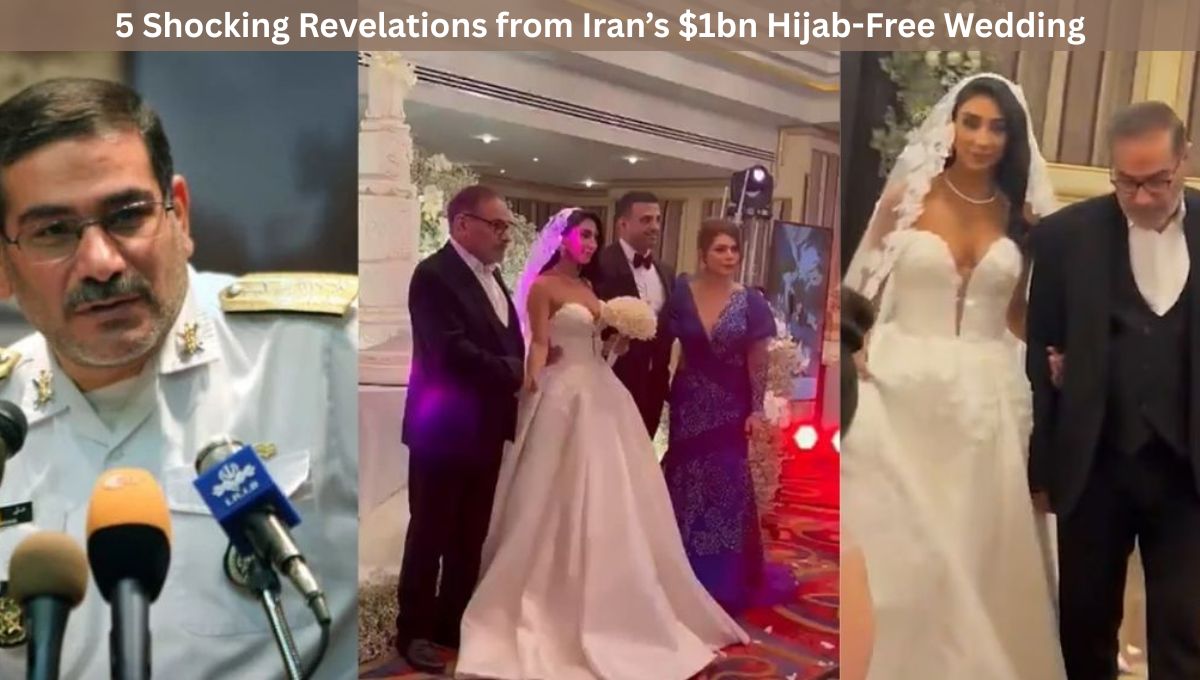
5 Shocking Revelations from Iran’s $1bn Hijab-Free Wedding that sparked outrage across Iran. A viral wedding video has thrown Iran’s ruling elite into turmoil. The footage, showing the daughter of a top aide to Supreme Leader Ayatollah Ali Khamenei celebrating her wedding without a hijab, has ignited a storm of public anger and accusations of hypocrisy against the Islamic Republic’s leadership.
5 Shocking Revelations from Iran’s $1bn Hijab-Free Wedding
A Lavish Wedding Defying the Law
The controversy centres around the 2024 wedding of Fatemeh Shamkhani, daughter of Ali Shamkhani, a powerful political and military figure who served as Iran’s defence minister and secretary of the Supreme National Security Council.
The event took place at the Espinas Palace Hotel, one of Tehran’s most luxurious venues. In the viral video, Fatemeh is seen in a strapless white wedding gown, walking beside her father through a grand hall as guests applaud.
Her mother appears in a blue lace gown without a headscarf — attire that directly violates Iran’s mandatory hijab laws. The video’s release has caused a political firestorm, as the same officials who enforce strict dress codes on ordinary women appear to flout those rules in private.
Public Anger Over Hypocrisy and Privilege
Across social media platforms, Iranians have expressed outrage. The wedding — reportedly featuring Western music, mixed-gender attendance, and luxury décor — stood in stark contrast to the modest lifestyles many citizens are forced to maintain under harsh economic sanctions and strict moral codes.
Exiled women’s rights activist Masih Alinejad condemned the event in a viral post on X (formerly Twitter):
“The daughter of Ali Shamkhani, one of the Islamic Republic’s top enforcers, had a lavish wedding in a strapless dress. Meanwhile, women in Iran are beaten for showing their hair. The rules are for you, not for them.”
Alinejad’s remarks resonated widely, drawing tens of thousands of shares and sparking a wave of debate about the double standards of Iran’s leadership.
Swedish-Iranian MP Alireza Akhondi also weighed in, calling the wedding “a display of hypocrisy, corruption, and fear,” adding,
“The daughter of one of the most repressive officials of the Islamic Republic is free because her father has power. This is no longer religion.”
A Symbol of Deep Inequality
The outrage is amplified by Iran’s worsening economic crisis. Inflation and sanctions have crippled household budgets, while unemployment among the youth remains high. Many young Iranians cannot afford to marry or hold even modest wedding celebrations.
Journalist Amir Hossein Mosalla wrote on social media,
“This video shows that regime officials do not believe in the laws they enforce — they only make people’s lives miserable.”
Meanwhile, another activist, Ali Omidvari, contrasted the elite’s privilege with the suffering of ordinary citizens:
“Their bride is in a palace, but our bride lies buried underground.”
Shamkhani’s Defence and Blame on Israel
Amid the backlash, Ali Shamkhani, 70, has claimed that the video was leaked by Israel as part of a psychological warfare campaign. He described it as “a new method of assassination through invasion of privacy.”
Former Iranian information minister Ezzatollah Zarghami defended Shamkhani, saying the wedding was a “female-only” event and that the viral footage had been edited to mislead the public.
However, observers noted that Iran’s own security agencies frequently raid private gatherings to enforce moral laws — raising further accusations of double standards.
Background: The Enforcer of Hijab Laws
Shamkhani’s involvement in enforcing Iran’s strict moral code makes the scandal particularly explosive. As head of the Supreme National Security Council (2013–2023), he oversaw many of the regime’s internal security operations, including crackdowns on anti-hijab protests.
During the 2022 “Woman, Life, Freedom” uprising, sparked by the death of 22-year-old Mahsa Amini in morality police custody, Shamkhani was among the officials accused of authorising violent suppression.
According to Human Rights Watch, over 500 protesters, including 68 children, were killed, and more than 20,000 were arrested during the unrest. A UN fact-finding mission later concluded that Iran had committed “extensive, sustained, and continuing human rights violations” against women and girls.
The Hijab Law Crackdown Returns
The scandal unfolds as the Iranian government prepares to reintroduce tens of thousands of morality police officers in Tehran to enforce the mandatory hijab rule. Officials have announced that around 80,000 new enforcers will be deployed, drawing widespread criticism from rights groups.
The timing of the wedding video’s leak could not have been worse for the regime. As authorities demand stricter dress codes, footage of a senior leader’s daughter defying those very rules has severely undermined the government’s moral authority.
Shamkhani’s Rise and Fall
Ali Shamkhani has long been one of the Islamic Republic’s most influential figures. He previously served as Iran’s Defence Minister (1997–2005) and was commander of the Islamic Revolutionary Guard Corps (IRGC) Navy before joining Khamenei’s inner circle.
In 2020, the U.S. Treasury Department sanctioned Shamkhani and his sons, accusing them of involvement in illegal oil smuggling operations between Iran, Russia, and China. Despite these allegations, he retained his senior advisory role to the Supreme Leader.
Shamkhani survived an Israeli missile strike on his Tehran residence during the Iran–Israel conflict in June 2024, a reminder of his central position within the country’s power structure.
Iranian Media Reaction: ‘Buried in Scandal’
The Iranian reformist newspaper Shargh ran a front-page headline reading “Buried in Scandal”, reflecting growing anger even among establishment supporters. Some veterans of the Iran–Iraq War called for Shamkhani to resign and apologise publicly for the embarrassment caused to the regime.
Social media has since been flooded with memes, sarcastic comments, and videos mocking Iran’s double standards on morality. Hashtags like #HijabHypocrisy and #ShamkhaniWedding have trended on Persian-language platforms.
Critics Call It a Turning Point
Analysts say this scandal could mark a turning point in public sentiment against the Islamic Republic’s leadership.
Omid Memarian, an Iran expert at Washington’s DAWN research institute, said:
“This is a prime example of hypocrisy. The regime interferes in private lives, raids parties, and arrests women for not wearing the hijab, but its own leaders live under a different set of rules.”
Others see it as evidence that Iran’s ruling elite is increasingly disconnected from the struggles of ordinary citizens.
Wider Context: The Hijab Debate
The mandatory hijab law, introduced shortly after the 1979 Islamic Revolution, has been a flashpoint for decades. Despite harsh penalties, many Iranian women continue to resist by appearing in public without headscarves.
Authorities have responded with increased surveillance, including AI-powered cameras to identify violators. The 2022 protests marked the most serious challenge to Iran’s theocracy in decades. Women openly defied the regime by burning hijabs and chanting slogans such as “Death to the Dictator.”
The movement inspired global solidarity and renewed calls for women’s rights across the Middle East. Today, the government’s renewed hijab enforcement campaign, coupled with scandals like Shamkhani’s, may deepen public resentment and erode the regime’s credibility.
International Reaction
International media outlets, including Reuters, BBC Persian, and The Independent, have covered the wedding controversy, highlighting its impact on Iran’s global image.
Human rights organisations argue that the event exposes “the moral bankruptcy” of a system that jails women for showing hair while its leaders host opulent, Western-style weddings.
Western diplomats privately say such incidents reinforce perceptions of corruption and inequality within Iran’s leadership. Meanwhile, diaspora communities have used the scandal to amplify calls for greater international pressure on Tehran.
The Regime’s Dilemma
For the Iranian government, the scandal poses a delicate dilemma. Punishing Shamkhani could divide the political elite, while ignoring the incident risks fuelling further public anger. So far, authorities have remained silent, hoping the news cycle will move on.
But for millions of Iranians, the image of a powerful official’s daughter in a sleeveless gown — while ordinary women face prison for not covering their hair — may prove impossible to forget.
Conclusion: A Mirror of Iran’s Contradictions
The viral wedding video has become more than just a scandal — it’s a symbol of the widening gap between Iran’s rulers and its people.
As the regime tightens moral policing, ordinary Iranians are questioning the foundations of a system built on religious control and political privilege. For many, the contrast is clear:
The elite celebrate in palaces, while the people struggle under oppression.
Also Read: After wedding scandal, Iranian academic accuses Shamkhani of killing father
Related Posts:
- 7 Dead in Explosive Iran Protests as Economic Anger…

- 7 Powerful Facts About Ayatollah Ali Khamenei’s…

- 3 Explosive Conditions Iran Sets to End War with US…

- 10 Explosive Warnings as Donald Trump Calls Iran…

- 11 Explosive Warnings as Trump Vows to ‘Knock the…

- 10 Explosive Signals Trump Says Iran War Could End…