9 Facts About Trump’s Drug Boat Strikes That Shook the World — from the Caribbean into the Pacific. In a stunning escalation of America’s global “war on narco-terror,” the United States military has carried out two consecutive airstrikes on boats alleged to be carrying drugs in the Pacific Ocean, killing five people in less than two days.
The strikes, directed by President Donald Trump and confirmed by Defense Secretary Pete Hegseth, mark the first known Pacific operations in the administration’s revived campaign targeting drug-smuggling vessels.
What began in the Caribbean Sea has now moved across the continent — a sign that Washington’s anti-narcotics campaign is expanding its reach and intensity.
9 Facts About Trump’s Drug Boat Strikes That Shook the World
1. Two Strikes in 48 Hours: A New Frontline in the Drug War
Defense Secretary Pete Hegseth announced on Wednesday that US forces had struck a second vessel in the eastern Pacific Ocean, killing three alleged traffickers.
The strike came just one day after another deadly attack on a similar boat in the same region, which killed two people.
Both incidents were carried out in international waters along known narco-trafficking routes — paths that experts say are used to funnel cocaine north from South America toward Central America, Mexico, and the US.
“These strikes will continue, day after day,” Hegseth said. “These are not simply drug runners—these are narco-terrorists bringing death and destruction to our cities.”
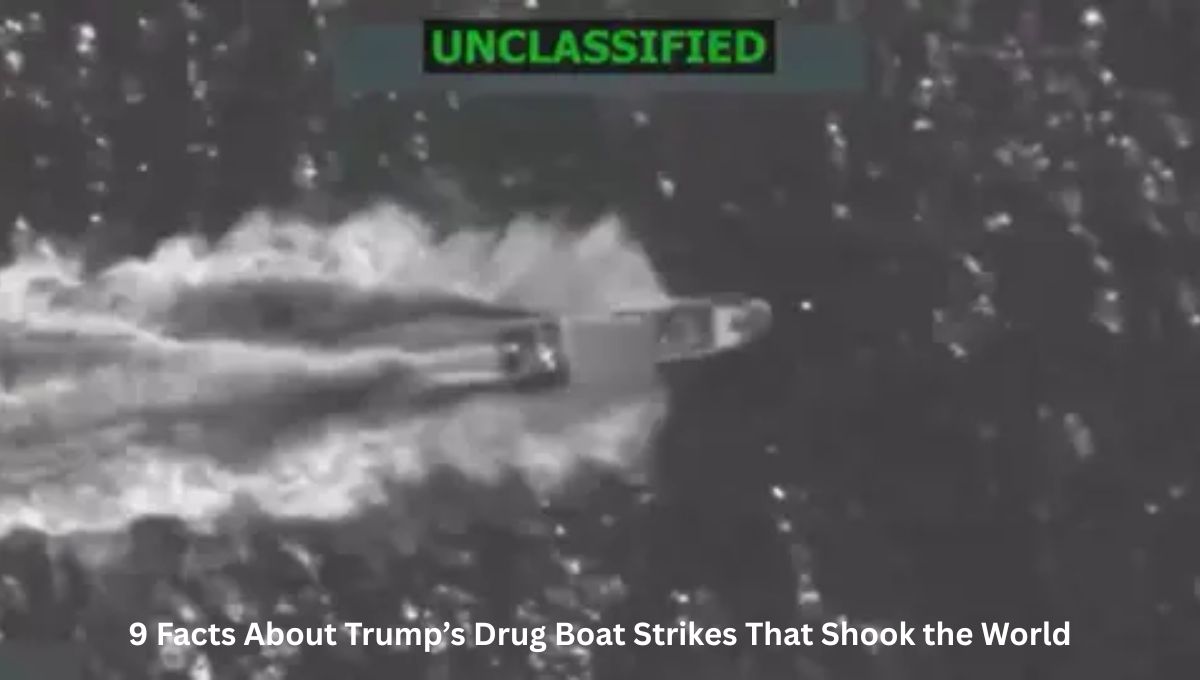
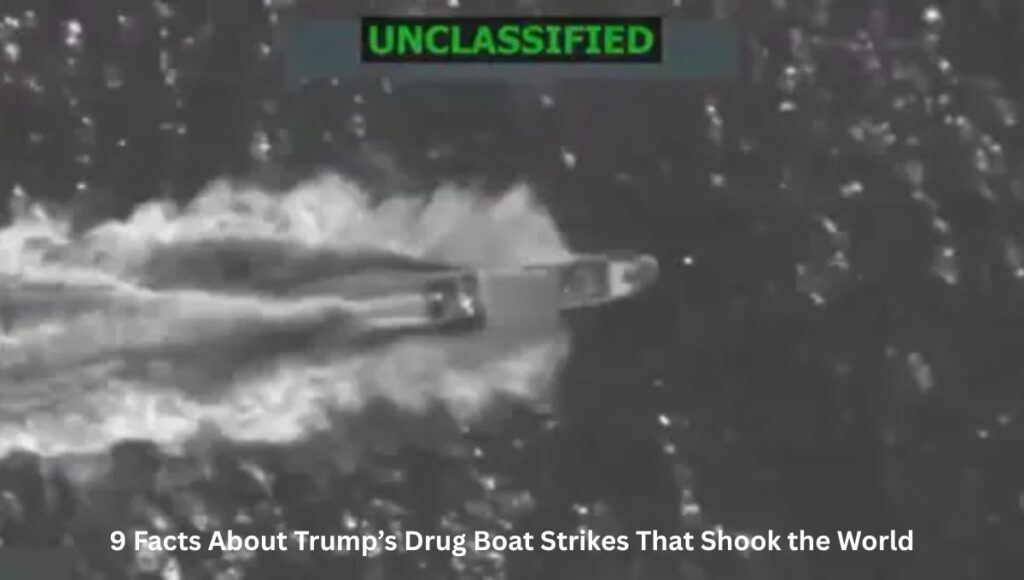
In a video shared on X (formerly Twitter), Hegseth showed a small speedboat bursting into flames after being hit by what appeared to be a precision airstrike. Floating debris could be seen in the aftermath before a second bomb hit the remains.
2. Trump’s Expanding War at Sea
President Donald Trump has repeatedly vowed to take the fight against drug cartels beyond the land borders of Mexico and Colombia.
Speaking from the Oval Office, he defended his legal authority to strike boats in international waters, saying the US is “allowed to do that” under existing counterterrorism laws.
“If we decide to do it by land, we may go back to Congress,” Trump said, hinting that an expansion to land-based targets could come next.
The President described his military offensive as an act of “self-defense against narco-terrorism.”
“We are totally prepared,” Trump declared. “These cartels are bringing poison to our streets, and they will face justice wherever they operate.”
Since September, the US has conducted nine strikes on alleged narco vessels — seven in the Caribbean Sea and now two in the Pacific — with a total death toll of 37.
3. Pete Hegseth: “This Is America’s New War on Terror”
In his statement, Defense Secretary Hegseth compared the fight against drug cartels to America’s war on terrorism in the early 2000s.
“Just as Al Qaeda waged war on our homeland, these cartels are waging war on our border and our people,” he wrote. “There will be no refuge or forgiveness—only justice.”
Hegseth emphasized that the Department of War (as it’s now branded under Trump’s direction) views the drug organizations as Designated Terrorist Organizations (DTOs).
“The vessel was operated by a DTO and was carrying narcotics,” he said. “All three narco-terrorists aboard were killed. No US forces were harmed.”
His words signaled a doctrinal shift — treating drug traffickers not as criminals, but as enemy combatants. That reclassification allows the US to use lethal military force under the same legal framework that justified drone strikes on terrorist groups.
4. A Legal Grey Zone: International Waters and Executive Power
While the strikes took place in international waters, some legal scholars have questioned whether the US has the authority to bomb suspected drug vessels without trial.
Trump maintains that his actions are legal under the Authorization for Use of Military Force (AUMF) — the same post-9/11 legislation used to justify operations against Al Qaeda and ISIS.
However, critics warn that such strikes blur the line between law enforcement and warfare.
“The US is treating drug smugglers as terrorists without evidence or due process,” one analyst told Reuters. “It sets a dangerous precedent for international maritime law.”
Still, Trump’s administration argues that the strikes are proportionate responses to a “transnational threat that kills tens of thousands of Americans annually.”
5. The Death Toll Rises to 37
With the latest two Pacific operations, at least 37 people have been killed in US military strikes on alleged drug boats since September 2.
The first seven strikes took place in the Caribbean Sea, mainly north of Venezuela. The two most recent attacks occurred in the Eastern Pacific, off the coasts of Ecuador and Colombia.
Most of the victims have not been publicly identified, and the Pentagon has provided few details about their alleged affiliations. Two survivors from a previous strike — repatriated to Ecuador and Colombia — said they were fishermen, not traffickers.
6. Human Cost: The Story of Andrés Fernando Tufiño
Among those caught in the crossfire is Andrés Fernando Tufiño Chila, a 41-year-old Ecuadorian fisherman who survived a US military strike last week.
Tufiño Chila’s family says he had gone out to fish when the boat he was on was bombed by the US military in the Caribbean. Two others on the vessel were killed.
“He’s not a criminal,” his sister told CNN. “He’s a father of six who was just trying to earn money.”
Tufiño Chila was later repatriated to Ecuador, where he was released due to lack of evidence.
However, court records reveal he has a previous drug smuggling conviction in the US from 2020.
His story highlights the blurred line between poverty-driven labor and narco-trafficking.
In Ecuador’s coastal towns, fishing wages can be as low as $100 a month, while a single smuggling trip can pay tens of thousands.
“Life is complicated,” said a fisherman from Manta. “Sometimes, the ocean offers only one kind of work.”
7. Colombia and Ecuador in Trump’s Crosshairs
Tensions between Washington and Latin American governments have escalated sharply in recent weeks. Trump has accused Colombian President Gustavo Petro of being “a thug and a bad guy” and claimed he is encouraging drug production.
“He better watch it, or we’ll take very serious action against him and his country,” Trump warned.
On Sunday, the President went further, calling Petro an “illegal drug leader” and announcing that the US would cut subsidies to Colombia — one of its long-time allies.
Both Colombia and Ecuador are vital nodes in the Pacific cocaine pipeline, with DEA estimates suggesting that over 70% of cocaine bound for the US moves through the eastern Pacific rather than the Caribbean.
8. A Military Operation Unlike Any Before
The Pentagon has deployed 10,000 troops, along with dozens of aircraft and naval assets, across the Caribbean and Pacific as part of the Trump Administration’s Operation Maritime Justice.
The campaign began as a counter-smuggling initiative, but it has increasingly taken the shape of an offensive maritime war. Drone footage released by the Pentagon shows laser-guided bombs hitting small boats, many of which ignite instantly.
US commanders insist that only vessels confirmed by intelligence and surveillance data are targeted. However, human rights groups argue that civilian verification is impossible at sea.
A senior defense analyst told The Guardian,
“This is a radical experiment — using military-grade firepower to enforce narcotics law. The collateral risks are enormous.”
9. The New War Doctrine: From Fentanyl to the Pacific
Trump has repeatedly justified the campaign by citing the fentanyl crisis ravaging American cities.
But most fentanyl is produced in Mexico and transported by land, not sea. By contrast, Pacific cocaine routes are dominated by Colombian, Ecuadorian, and Peruvian networks.
Analysts say Trump’s approach blends counterterrorism tactics with anti-drug enforcement, creating a hybrid doctrine that treats cartels as military enemies.
“Cartels are the Al Qaeda of our hemisphere,” Hegseth said. “They will not escape justice.”
Yet, critics question whether the fishermen, couriers, and low-level crewmen being killed are truly the “enemy combatants” Trump describes.
With 37 dead, mostly unnamed, and little evidence made public, the campaign has drawn scrutiny from human rights lawyers and Latin American governments alike.
Inside the Video That Shocked the Internet
The video shared by Pete Hegseth quickly went viral, showing a US targeting reticle locking onto a moving boat, followed by an explosion and plume of black smoke.
Moments later, objects floating in the water appear to be targeted again, prompting outrage among observers online.
While the Pentagon said the second strike targeted drifting fuel barrels, critics accused the US of violating the rules of engagement by attacking survivors.
The clip, viewed millions of times on social media, became a symbol of the new face of warfare — one conducted remotely, in real time, and broadcast to the world.
Trump’s Doctrine: “No Safe Harbor”
Trump’s new maritime policy has been defined by one phrase: “No safe harbor.”
In his remarks following the strikes, he said:
“Narco-terrorists intending to bring poison to our shores will find no safe harbor anywhere in our hemisphere.”
The President’s hardline stance has rallied his supporters, who see the strikes as a bold defense of American sovereignty. But critics argue it’s escalating conflict across the hemisphere and criminalizing poverty in coastal nations.
One Latin American diplomat told El País:
“This is not a war on drugs — it’s a war on fishermen.”
A Deadly Equation: Risk, Reward, and the Sea
For the men who pilot the “narco boats,” the calculus is simple: risk your life for one big payday. Drug cartels often recruit local fishermen, offering $20,000 to $50,000 for a single trip. Many see it as their only escape from poverty.
But under Trump’s expanding campaign, that risk now includes being bombed from the sky. In Ecuador’s coastal towns, families are lighting candles for the missing — not knowing whether their loved ones were smugglers, sailors, or simply in the wrong place.
The Road Ahead: Trump’s Global War on Narco-Terror
As the death toll rises, questions swirl about where Trump’s “war on narco-terror” will go next. He has hinted at expanding operations to land targets in Latin America — a move that could dramatically reshape US foreign policy.
Hegseth has confirmed that daily operations will continue and that more “kinetic strikes” are planned in both the Caribbean and Pacific.
For now, the world watches as the US military wages a shadow war at sea, one that blurs the boundary between law enforcement and combat — and leaves behind wrecked boats, grieving families, and a growing list of unanswered questions.
Quick Facts: US Strikes on Alleged Drug Boats
- First Strike: September 2, 2025 (Caribbean Sea)
- Latest Strikes: October 21–22, 2025 (Pacific Ocean)
- Total Strikes: 9
- Confirmed Deaths: 37
- Survivors: 2 (returned to Ecuador & Colombia)
- Main Officials: President Donald Trump, Secretary Pete Hegseth
- Primary Targets: Designated Terrorist Organizations (DTOs)
- Regions: Caribbean Sea, Eastern Pacific
Goal: Destroy maritime drug smuggling routes to the US
Related Posts:
- 7 Alarming Signals: Trump Threatens Strikes on…
- Trump Orders U.S. Military Strike on Venezuelan…

- 5 Explosive Revelations: U.S. Kills Four in Latest…

- 7 Shocking Reasons FIFA’s Peace Prize for Trump…

- 7 Critical Revelations in the Venezuela Boat Strike Scandal
- 9 Explosive Revelations as Trump Declares His Health…