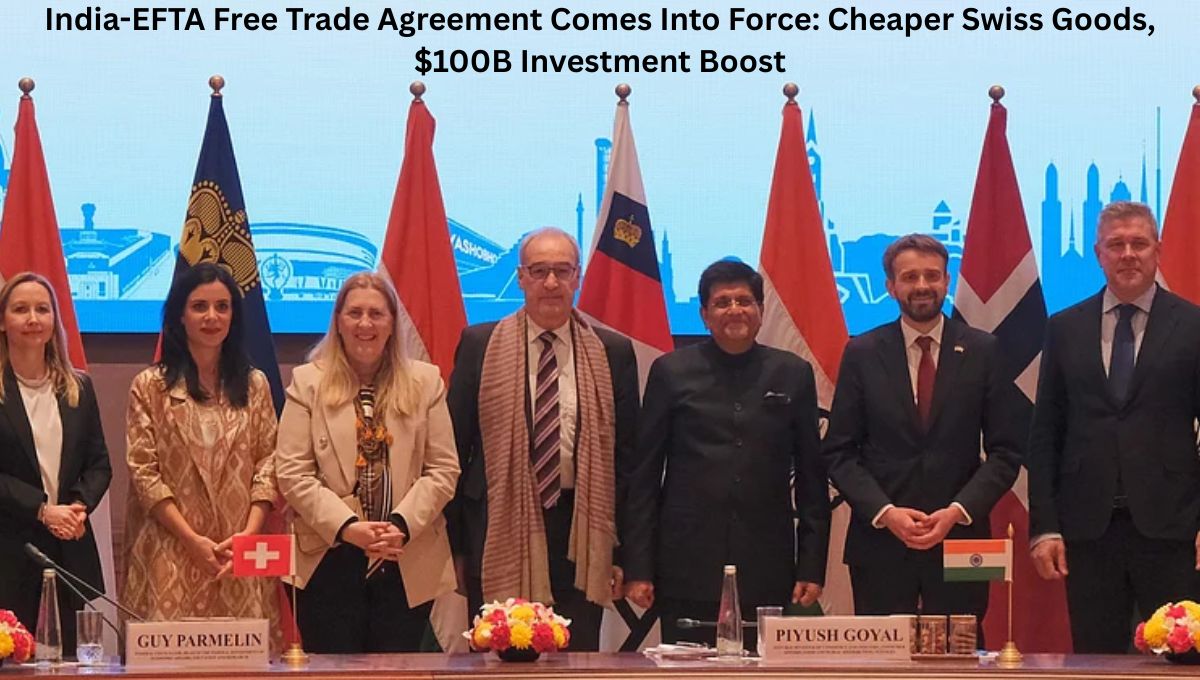
Landmark India-EFTA Free Trade Agreement Comes Into Force: Cheaper Swiss Goods, $100B Investment Boost. India has entered a new era in its trade relations with Europe. The much-anticipated Trade and Economic Partnership Agreement (TEPA) between India and the European Free Trade Association (EFTA)—a bloc of four nations including Switzerland, Norway, Iceland, and Liechtenstein—came into force on October 1, 2025.
This landmark deal is not just about tariff reductions; it is also about direct investment commitments, a first for India in its trade history. With $100 billion of investments pledged over 15 years and the creation of one million jobs, the agreement is set to reshape India’s economic and trade landscape.
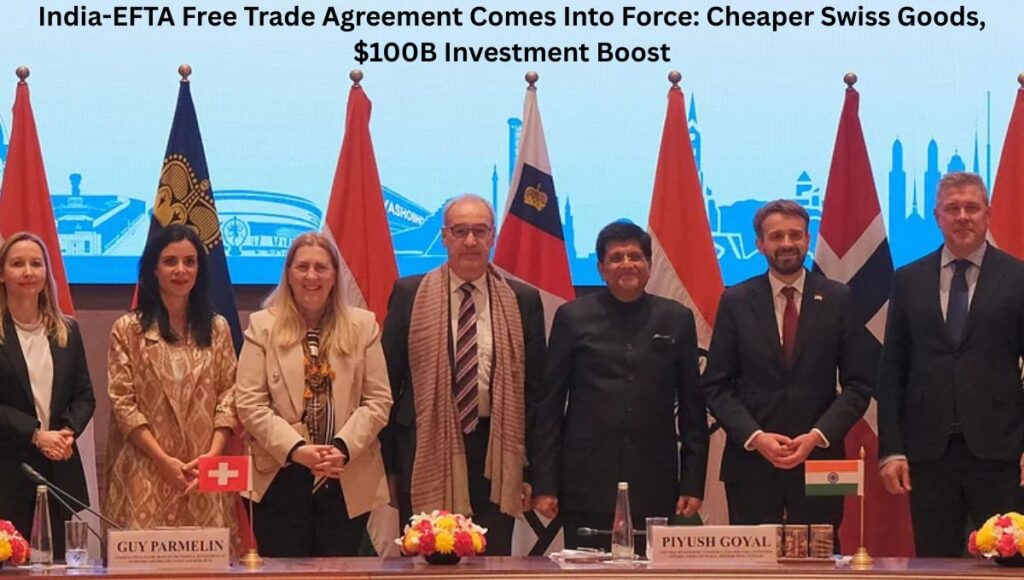
India-EFTA Free Trade Agreement Comes Into Force: Cheaper Swiss Goods, $100B Investment Boost
What the India-EFTA Trade Deal Means
The India-EFTA trade pact is a historic milestone, marking India’s first free trade agreement with a European bloc. After nearly 16 years of negotiations and 21 rounds of talks, the agreement was signed in March 2024 and has now officially come into effect.
Under the deal:
- India will cut tariffs to zero on 80–85% of goods imported from EFTA countries.
- Indian exporters will get duty-free access to 99% of goods in EFTA markets.
- EFTA has committed $100 billion in investments in India over 15 years.
- The agreement projects the creation of 1 million direct jobs in India.
- India becomes the first country to tie market access with investment commitments in its trade agreements.
This is a significant departure from traditional free trade agreements that primarily focused only on tariff reductions.
Cheaper Swiss Chocolates, Watches, and More
One of the most immediate and visible impacts of the TEPA will be seen in consumer goods. With tariff reductions kicking in:
- Swiss chocolates and wines will become more affordable for Indian buyers.
- Swiss watches, bicycles, electronics, biscuits, olive oil, and coffee will also see price cuts.
- Tariffs will be reduced gradually, with most items seeing lower import duties over the next 5 to 10 years.
However, some sensitive sectors like dairy, soya, coal, and agricultural products remain excluded to protect India’s domestic industries.
Gold imports, which form the bulk of India’s trade with Switzerland (worth $18 billion in 2024), will remain unaffected by the agreement, as duties on gold are unchanged.
What India Gains from the Deal
While the direct tariff benefits for Indian exporters are limited—since EFTA countries already impose low or zero duties—India’s big win lies in investment and perception.
Key Gains:
- $100 billion in investments, with $50 billion coming in the first decade and another $50 billion in the following five years.
- A projected one million jobs created through investment-linked industrial growth.
- Boost for “Make in India”, with strong prospects for growth in sectors like textiles, dyes, medicines, steel, and IT services.
- New opportunities in services exports such as IT, education, and audio-visual industries.
- Mutual Recognition Agreements (MRAs) in professions like nursing, architecture, and accountancy, which will enable easier mobility of Indian professionals in EFTA countries.
Commerce Minister Piyush Goyal hailed the deal as a “trusted partnership between friends”, calling it an agreement that balances market access with investment, ensuring fairness between partners.
Swiss Investment Push: Pharma, Technology, and More
The deal has already triggered investment interest from EFTA companies.
- Roche Holding, the Swiss pharmaceutical giant, has pledged $1.8 billion investment in India over the next five years.
- At least 18 other companies from EFTA countries have expressed intentions to invest in India in the next three to five years.
- The Swiss State Secretary for Economic Affairs, Helene Budliger Artieda, emphasized the need for a Bilateral Investment Treaty (BIT) to further secure and enhance these commitments.
Liechtenstein, another EFTA member, has also sought a double taxation avoidance agreement to protect cross-border investors.
Why This Deal Matters Now
The timing of this agreement is crucial. India’s relations with the United States are currently strained due to high tariffs.
- In 2025, the US imposed 50% tariffs on Indian exports due to New Delhi’s continued purchase of Russian oil.
- This has severely hit Indian exporters in textiles, gems, jewellery, seafood, and pharmaceuticals.
- With trade talks with the US still underway, India is working to diversify its export markets.
The India-EFTA deal comes as a strategic move to counterbalance the impact of US tariffs, diversify trade partnerships, and send a strong signal that India is willing to liberalize and integrate deeper with global markets.
India’s Larger Trade Strategy
The India-EFTA agreement is part of a bigger trade strategy that includes ongoing or upcoming deals with other major partners.
Current Trade Negotiations:
- India-UK Free Trade Agreement (FTA): Signed in July 2025, expected to come into effect by 2026.
- India-EU Trade Deal: Negotiations are ongoing; the EU is India’s largest trading partner with $135 billion in trade in 2022-23.
- India-US Trade Agreement: Dubbed “Mission 500”, with a goal of boosting bilateral trade to $500 billion by 2030. The deal, however, excludes contentious issues like patents and agricultural access.
By implementing the India-EFTA trade deal now, New Delhi strengthens its hand in parallel negotiations with other trade partners.
A Look at India-EFTA Trade Numbers
Trade between India and the EFTA bloc has historically been unbalanced:
- India’s imports from EFTA (FY25): $22.4 billion.
- India’s exports to EFTA (FY25): $2 billion.
- Trade is dominated by gold imports from Switzerland.
This imbalance is one reason why India insisted on tying the FTA to firm investment commitments from EFTA.
Voices From Both Sides
Helene Budliger Artieda, Swiss State Secretary for Economic Affairs:
- Called the deal a “booster” for bilateral relations.
- Emphasized that the $100 billion investment pledge is realistic and achievable within 15 years.
- Highlighted the presence of over 330 Swiss companies in India already, in sectors like engineering, precision instruments, and pharmaceuticals.
Piyush Goyal, India’s Commerce Minister:
- Called the agreement a vote of confidence in India’s growth story.
- Said EFTA countries may even raise investments by another $150 billion, depending on India’s progress in IP laws.
- Highlighted “Make in India” benefits, job creation, and professional mobility opportunities.
Challenges Ahead
While the TEPA is ambitious and groundbreaking, challenges remain:
- Bilateral Investment Treaty (BIT): EFTA countries want stronger protections before committing fully.
- IP Laws: EFTA is pushing for data exclusivity provisions in intellectual property laws.
- Trade Balance: India must ensure that imports do not far outweigh exports.
- Implementation: Ensuring that investments actually flow into India as pledged will be crucial.
India has inserted a claw-back provision—if EFTA fails to deliver on investment promotion, India can withdraw its tariff concessions.
Broader Geopolitical Context
The India-EFTA trade pact also comes at a time of global trade turbulence.
- Rising protectionism in the US and EU.
- Supply chain disruptions due to wars and energy crises.
- Competition with China for foreign investment.
By securing this deal, India positions itself as a stable, predictable, and reliable partner in global trade—a message that resonates with international businesses seeking diversification.
Looking Ahead
The India-EFTA trade agreement is a transformational moment for India’s trade policy.
- It provides Indian consumers with cheaper access to premium European goods like Swiss chocolates, watches, and wines.
- It secures massive investment inflows, with a direct link to job creation.
- It enhances India’s image as a pro-liberalization, investment-friendly economy.
- It strengthens India’s negotiating position in ongoing trade talks with the US, EU, and other partners.
With its implementation, India has signaled that it is ready to embrace a new model of trade agreements—one that goes beyond tariffs and addresses investments, jobs, services, and professional mobility.
As Commerce Minister Piyush Goyal put it, this deal is about more than trade. It is about building a “trusted partnership between friends”, at a time when global trade is under severe stress.
Conclusion
The India-EFTA Trade and Economic Partnership Agreement (TEPA) marks a bold new chapter in India’s global trade journey. By linking tariff cuts with investment commitments, it sets a new benchmark for future agreements.
For Indian consumers, it means affordable Swiss chocolates, wines, and watches. For businesses, it opens new avenues in services, exports, and global partnerships. For the economy, it promises billions in investments and a million jobs.
Most importantly, it reflects a strategic shift in India’s trade diplomacy—positioning the country as a rising economic power that is not only protecting domestic interests but also actively shaping global trade rules.
Related Posts:
- 11 Explosive Revelations From Ted Cruz’s Leaked…

- In 8 Moves, EU Targets China-Linked Refineries and…

- 5 Major Takeaways from the US Supreme Court's…

- 7 Heartbreaking Facts About Venezuela's Earthquake Disaster

- Can the EU and NATO Impose Tariffs on India and…

- 9 Shocking Facts About Switzerland’s Deadliest New Year Fire