

Ahead of October 10, Trump’s Nobel Peace Prize Bid: Gaza Peace Plan, 8 Wars Claim, and Global Reactions. As the Nobel Peace Prize announcement on October 10, 2025 draws near, US President Donald Trump has once again brought the global spotlight onto himself with fresh claims that his administration deserves the world’s most prestigious peace award.
Trump, who has long been vocal about his frustration over being overlooked for the prize, declared this week that denying him the Nobel would be a “big insult” to America. He insists that his self-proclaimed role in ending seven international conflicts—and his latest 20-point Gaza peace plan—set him apart as a contender for the award.
But while Trump boasts that “no one has ever done what I’ve done,” experts argue his chances remain slim. Still, with high-stakes diplomacy, Arab backing, and a rare Israeli apology to Qatar, the conversation around a possible Trump Nobel Peace Prize has gained unprecedented momentum.
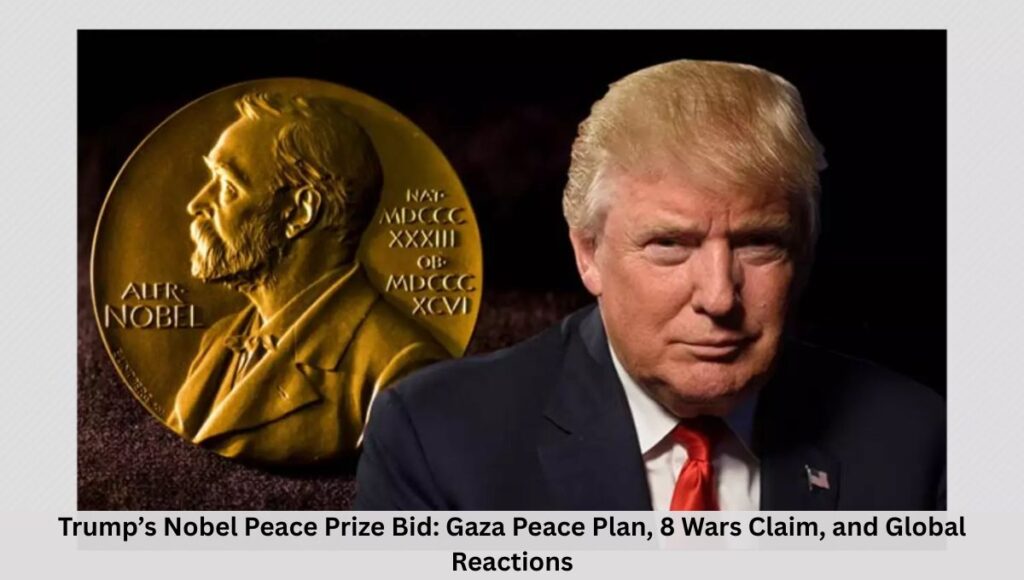
Trump’s Nobel Peace Prize Bid: Gaza Peace Plan, 8 Wars Claim, and Global Reactions
Trump’s Claim: “Eight Wars in Eight Months”
At a meeting with US military leaders, Trump reiterated his belief that he has ended or mediated conflicts around the world.
“I ended seven wars, and if the Gaza plan works out, that makes eight in eight months. That’s pretty good. Nobody’s ever done that,” Trump told senior US Army officials.
The President listed conflicts he claims to have mediated:
- Israel and Iran
- India and Pakistan
- Rwanda and Congo
- Thailand and Cambodia
- Armenia and Azerbaijan
- Egypt and Ethiopia
- Serbia and Kosovo
He added that his Gaza plan, unveiled during Israeli Prime Minister Benjamin Netanyahu’s White House visit, could soon be counted as the eighth.
However, some governments—most notably India—have rejected his claims outright, denying Trump’s involvement in the ceasefire during Operation Sindoor against Pakistan.
The Gaza 20-Point Peace Plan
The centerpiece of Trump’s latest peace push is his 20-point Gaza peace plan, announced late Monday after orchestrating an unusual diplomatic breakthrough.
Key provisions of the plan include:
- Immediate ceasefire between Israel and Hamas.
- Hostage releases within 72 hours, whether alive or deceased.
- Amnesty for Hamas fighters in exchange for disarmament.
- Full humanitarian aid into Gaza without restrictions.
- International oversight of Gaza governance through a technocratic Palestinian committee.
- Israeli withdrawal from Gaza and no West Bank annexation.
- Gaza reconstruction of hospitals, schools, and roads under the January 2025 aid agreement.
Trump called it a “path to eternal peace in the Middle East.” Netanyahu cautiously endorsed it, warning that Israel would “finish the job” if Hamas rejected the terms.
Hamas has yet to agree, but Arab mediators say the group is conducting a “responsible review.”
The Israeli Strike in Qatar: A Turning Point
The road to Trump’s Gaza breakthrough was paved by an unexpected crisis.
On September 9, Israel carried out an airstrike in Doha, Qatar, targeting Hamas leaders during ceasefire talks. The attack—code-named “Judgment Day”—killed a Qatari security officer and five Hamas operatives.
The strike drew global condemnation:
- Qatar called it a “blatant violation of sovereignty.”
- UN Secretary-General António Guterres labeled it a “flagrant violation.”
- Saudi Arabia and Egypt called it “brutal aggression.”
- French President Emmanuel Macron deemed it “unacceptable.”
Facing mounting diplomatic pressure, Trump used Netanyahu’s White House visit on September 29 to broker a crucial phone call. In a rare move, Netanyahu apologized directly to Qatari Prime Minister Sheikh Mohammed bin Abdulrahman Al Thani.
“Israel regrets that one of your citizens was killed in our strike,” Netanyahu reportedly said.
Trump hailed the apology as a “heart-to-heart” moment that opened the door to peace.
Arab and Islamic Nations Rally Behind Trump
The Gaza plan received a significant diplomatic boost when several Arab and Islamic nations—including the UAE, Saudi Arabia, Qatar, Egypt, Jordan, Turkey, Indonesia, and Pakistan—issued a joint statement endorsing Trump’s initiative.
“We welcome President Donald J. Trump’s leadership and sincere efforts to end the war in Gaza,” the foreign ministers declared.
For Trump, the statement was the validation he craved. He declared it “an historic day for peace,” while Israeli President Isaac Herzog said the plan offered “real hope.”
Even traditionally skeptical voices acknowledged the breakthrough. Israeli journalist Haviv Rettig Gur commented:
“If true, and if it’s really feasible, then this is an astonishing reconfiguration of the region. And Trump will have earned that Nobel Peace Prize more than most of its actual recipients.”
Trump: “Nobel Snub Would Be an Insult to America”
Despite his optimism, Trump predicted he would be denied the Nobel yet again.
“Will you get the Nobel Prize? Absolutely not. They’ll give it to some guy that didn’t do a damn thing,” Trump told military officers.
He added: “It would be a big insult to our country. I don’t want it for myself. I want the country to get it.”
Trump has often pointed to former President Barack Obama’s Nobel win in 2009 as a sore point, insisting Obama was honored without achieving any real results.
Also Read: Trump Deserves Nobel Peace Prize, Says White House, After Brokering Six Global Ceasefires
Who Decides the Nobel Peace Prize?
The Nobel Peace Prize is awarded by the Norwegian Nobel Committee, a five-member body appointed by Norway’s parliament.
According to Alfred Nobel’s will, the prize goes to the person or organization that has done “the most or the best work for fraternity between nations, for the abolition or reduction of standing armies and for the holding and promotion of peace congresses.”
Committee members have stressed they are not influenced by lobbying or public campaigning. “Of course, we notice media attention, but that has no impact on our discussions,” Secretary Kristian Berg Harpviken said.
Trump’s Growing List of Nominations
While critics dismiss his claims, Trump has secured multiple nominations for the 2025 Nobel Peace Prize.
Countries and leaders backing his bid include:
- Israel – Netanyahu personally nominated Trump.
- Pakistan – Shehbaz Sharif endorsed his efforts.
- Cambodia, Rwanda, Gabon, Armenia, Azerbaijan, and the Democratic Republic of Congo – formally supported his candidacy.
However, Nobel experts remain unconvinced. Historian Oeivind Stenersen, who co-wrote a book on the Peace Prize, described Trump’s chances as “completely unthinkable.”
Also Read: Trump was nominated for the Nobel Peace Prize before. Experts say he’s unlikely to win this year
Critics vs. Supporters: The Global Divide
The debate over Trump’s Nobel Peace Prize claim reflects wider political divisions.
- Supporters argue his peace deals, Arab-Israeli diplomacy, and willingness to pressure Netanyahu mark him as a historic mediator.
- Critics accuse him of exaggerating, pointing out that most of his so-called “wars ended” were either dormant conflicts or resolved without his direct involvement.
Australian political activist Drew Pavlou summed up the divide:
“This is unironically a really good plan. If it actually ends the war in Gaza and leads to rebuilding without Hamas, it would legit merit a Trump Nobel. He’s obsessed with getting a Nobel, but if that makes him do good things, that’s a benefit to the world.”
Nobel Peace Prize 2025: The Road Ahead
With 338 nominees for this year’s Nobel Peace Prize, Trump faces stiff competition. Past recipients include Nelson Mandela, Malala Yousafzai, and the UN’s World Food Programme.
Even if Trump’s Gaza plan proves successful, experts suggest the Nobel Committee is unlikely to reward him this year due to the prize’s long vetting process and skepticism of lobbying.
Still, if his plan leads to real peace and humanitarian relief, Trump could emerge as a contender for the 2026 award.
Conclusion: Trump’s Nobel Fixation Remains Alive
Donald Trump’s fixation with the Nobel Peace Prize is no secret. From the Abraham Accords to the latest Gaza peace plan, he has repeatedly positioned himself as a global peacemaker.
With Arab states backing him, Israel apologizing to Qatar, and a bold new framework for Gaza, Trump has made his strongest case yet for the Nobel.
But as experts remind, the prize is not awarded on rhetoric, but on results. The world now waits to see if his ambitious Gaza deal translates into lasting peace—or remains another unfulfilled promise.
For now, one thing is certain: as October 10 approaches, Trump has succeeded in putting himself—and his Nobel ambitions—back at the center of global attention.
Related Posts:
- 7 Shocking Reasons FIFA’s Peace Prize for Trump…

- Trump’s 2025 Nobel Peace Prize Snub: Politics Over…

- Trump’s 2025 Gaza Peace Plan Signing and Historic…

- Trump Says He Deserves Nobel Peace Prize for Ending…
- Dramatic Moments Behind Trump’s Gaza Peace Push and…

- 5 Powerful Highlights as Trump Lands Second Nobel…
