

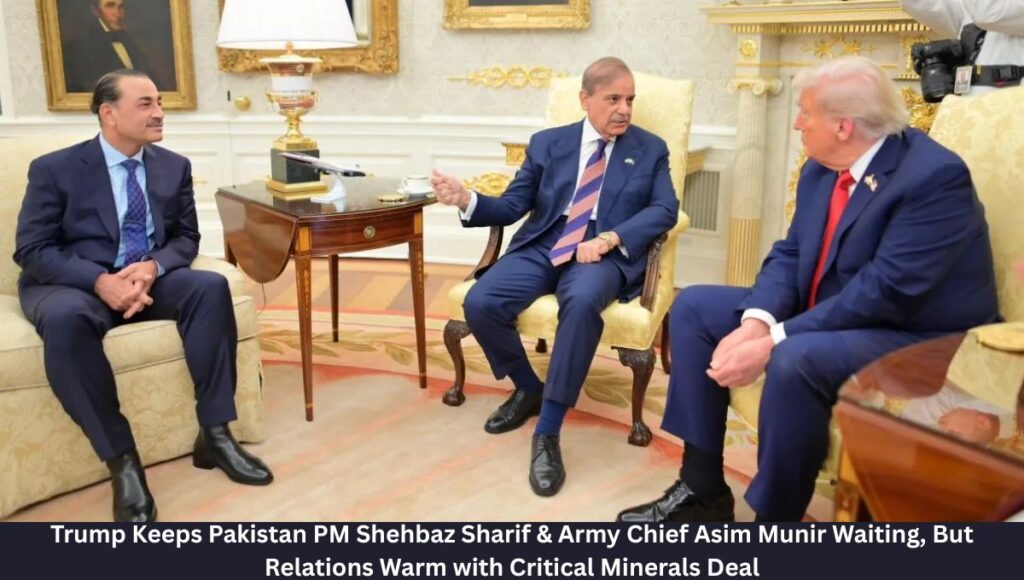
In the Oval Office, Trump Keeps Pakistan PM Shehbaz Sharif & Army Chief Asim Munir Waiting, But Relations Warm with Critical Minerals Deal. The Oval Office carried its usual blend of grandeur and unpredictability when US President Donald Trump welcomed Pakistan’s Prime Minister Shehbaz Sharif and Army Chief Field Marshal Asim Munir this week.
But in trademark Trump fashion, the Pakistani leaders were reportedly left waiting — nearly an hour — before their official meeting began. “They may be in this room right now. I don’t know, because we’re late,” Trump quipped to reporters, before praising both Sharif and Munir as “great guys” and “great leaders.”
While the optics of keeping visiting dignitaries waiting might once have stirred outrage in Islamabad, this meeting carried a different tone. Behind the scenes, a “strategic handshake” was taking shape — a critical minerals deal that could reshape Pakistan’s economic future and reframe its relations with Washington.
Trump Keeps Pakistan PM Shehbaz Sharif & Army Chief Asim Munir Waiting, But Relations Warm with Critical Minerals Deal
A Meeting Marked by Delay, Humor, and Symbolism
According to the Associated Press, Sharif’s motorcade arrived at the White House shortly before 5:00 p.m. Trump, however, was still signing executive orders and chatting with reporters. The Pakistani delegation, including Asim Munir, was ushered into the Oval Office only around 6:18 p.m.
The Pakistani Prime Minister’s Office later confirmed that the meeting was delayed by nearly 30 minutes. Whether Trump’s lighthearted remark — “they may be somewhere in the beautiful Oval Office” — was an attempt at humor or simply absentmindedness, it set the stage for talks that would prove more consequential than ceremonial.
This was Sharif’s first official meeting with a US president since taking office, and for Pakistan, the moment was historic. No prime minister had set foot in the Oval Office since Imran Khan’s visit in July 2019.
Also Read: ‘Great leader…’: Donald Trump lauds Shehbaz Sharif as he meets Pakistan PM, army chief Asim Munir
From “Nothing But Lies and Deceit” to “Great Leaders”
The sharp shift in tone is unmistakable. In 2018, Trump accused Pakistan of giving Washington “nothing but lies and deceit” and cut military aid. Today, the same Trump calls Sharif and Munir “great leaders.”
What changed?
The answer lies in Pakistan’s recalibrated strategic offer: critical minerals and rare earth elements. These resources are fast becoming the “building blocks of the future,” essential to industries ranging from clean energy to defense.
For the US, diversifying supply chains away from China has become urgent. For Pakistan, sitting on potentially vast but underdeveloped reserves, the minerals card is a high-stakes bet to revive its economy and reset ties with Washington.
The “Strategic Handshake”: Pakistan’s Critical Minerals Pitch
Earlier this month, Islamabad hosted a high-profile signing ceremony. Prime Minister Sharif and Field Marshal Munir oversaw the signing of two MoUs between Pakistan’s Frontier Works Organisation (FWO) — a military-run engineering powerhouse — and United States Strategic Metals (USSM), a Missouri-based company.
The headline deal promises an initial $500 million investment in Pakistan’s mineral sector, with the export of antimony, copper, gold, tungsten, and rare earth elements to begin immediately. Plans for a refinery in Pakistan to process intermediate and finished mineral products are also on the table.
Analysts dubbed it a “strategic handshake wrapped in economic opportunity, resource diplomacy, and symbolic recalibration.”
For Pakistan, this isn’t just about minerals. It’s about securing economic leverage, national pride, and international legitimacy. For Washington, it’s about strategic positioning in the global resource race against China.
Minerals, Oil, and Tariffs: The Economic Reset
Trump has sweetened the pitch for Pakistan by offering lower tariffs. Pakistan’s exports now face a 19% tariff — the lowest among South Asian nations. India, by contrast, has been slapped with tariffs as high as 50%, largely due to its deepening purchases of Russian oil.
In July, Trump also declared that the US would work with Pakistan to develop its “massive oil reserves.” While experts question whether those reserves are as vast as claimed, the announcement signals Washington’s intent to deepen economic engagement.
This matters for Islamabad, whose economy is burdened with $130 billion in external debt and where fuel imports eat up 31% of the import bill.
A Nobel Prize, a Ceasefire, and Trump’s Role
Pakistan’s government has gone beyond economics to flatter Trump personally. After a US-brokered ceasefire between India and Pakistan in May, Islamabad nominated Trump for the Nobel Peace Prize.
Sharif echoed that sentiment during his White House visit, praising Trump as “a man of peace engaged in sincere efforts to end conflicts around the globe.”
The move plays into Trump’s own penchant for grand recognition, further cementing the growing warmth between the two sides.
The India Factor: Strains and Shifts
The backdrop to this newfound warmth is strained US-India relations.
Since Russia’s invasion of Ukraine in 2022, India has dramatically increased purchases of discounted Russian oil. In response, Trump has ratcheted up tariffs on Indian goods, a move he openly described as an indirect way to cut into Moscow’s wartime revenues.
At the same time, Trump has kept channels open with Modi, calling him a “very good friend” and insisting trade disputes could be resolved. But the contrast is clear: Pakistan is being courted while India is being pressured.
Security, Geopolitics, and the China Question
Pakistan’s minerals play doesn’t just affect Washington — it also impacts Beijing.
For years, China has invested heavily in Pakistan’s resource-rich Balochistan province through the $62 billion China-Pakistan Economic Corridor (CPEC). Chinese projects have faced violent backlash, with local insurgents targeting Chinese workers and infrastructure.
Now, with US firms entering the same terrain, Pakistan finds itself in a delicate balancing act. Analysts note that American involvement could bring added protection, as insurgents would risk angering not just Pakistan and China, but the US as well.
From Waiting Room to World Stage: Why This Meeting Mattered
In the end, whether Sharif and Munir were kept waiting 30 minutes or a full hour may matter less than the symbolism of the Oval Office meeting itself.
- For Pakistan, it marks the return of high-level engagement with Washington after years of diplomatic chill.
- For Trump, it reinforces his self-styled role as a dealmaker and peacemaker on the world stage.
- For India, it signals a recalibration in Washington’s South Asia strategy.
Conclusion: A New Chapter in US-Pakistan Relations?
From “lies and deceit” to “great leaders,” the trajectory of Trump’s Pakistan policy is nothing short of dramatic.
The critical minerals MoU, the tariff reprieve, the Nobel Prize nomination, and the Oval Office optics together paint a picture of a relationship undergoing rapid reset.
But questions remain:
- Can Pakistan deliver on its minerals promise, given security, infrastructure, and exploration challenges?
- Will US investors move beyond MoUs to actual mining and refining projects?
- And can Islamabad balance US engagement without alienating China, its longtime partner?
For now, what’s clear is that Pakistan has found a new strategic card to play — and Trump, ever the showman, is willing to deal.
Related Posts:
- Trump Stole the Show at 2025 Gaza Peace Summit in Egypt
- Donald Trump’s Lavish UK State Visit: From Kate…

- 5 Powerful Highlights as Trump Lands Second Nobel…

- Trump’s 2025 Gaza Peace Plan Signing and Historic…

- Donald Trump’s 24-Karat Gold White House Makeover:…

- Trump’s Historic Gaza Ceasefire Deal 2025 - Powerful…
