Committed to protecting national interests, India Reacts to Pakistan-Saudi Arabia Defence Pact: Strategic Implications and Regional Security Risks. Pakistan and Saudi Arabia have signed a landmark Strategic Mutual Defence Agreement, a pact that declares any attack on one nation as an attack on both.
The deal, signed in Riyadh during Prime Minister Shehbaz Sharif’s state visit, signals a major geopolitical shift in South Asia and the Middle East. India, which has had strained ties with Pakistan, responded with caution. The Ministry of External Affairs (MEA) said it will “study the implications” of the defence pact on India’s national security and regional stability.
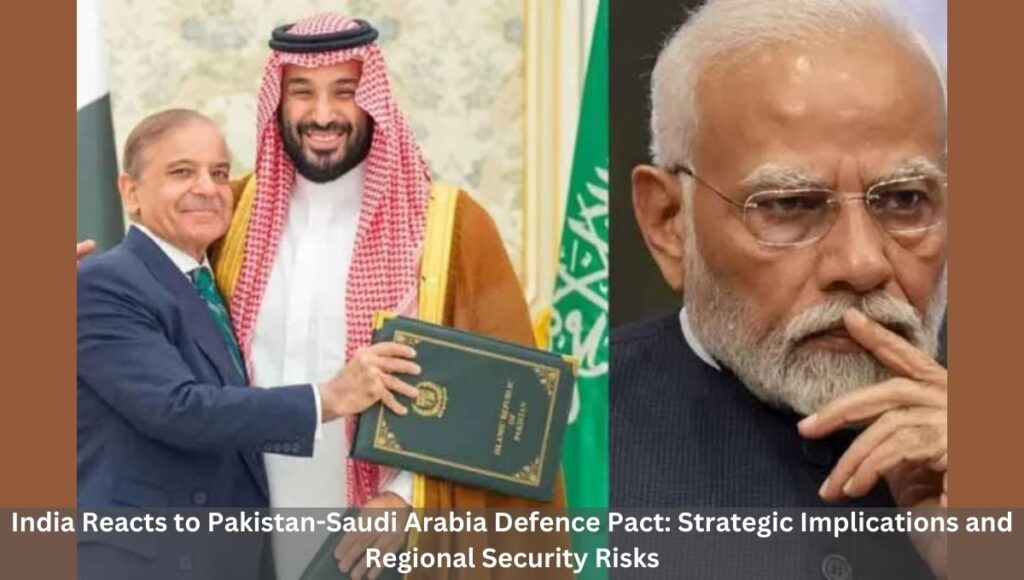
India Reacts to Pakistan-Saudi Arabia Defence Pact: Strategic Implications and Regional Security Risks
India’s Response: “We Will Study the Implications”
India’s official reaction came through MEA spokesperson Randhir Jaiswal, who stated that New Delhi was already aware that such a pact had been under discussion for some time.
“We have seen reports of the signing of a strategic mutual defence pact between Saudi Arabia and Pakistan. The Government was aware that this development, which formalises a long-standing arrangement between the two countries, had been under consideration. We will study the implications of this development for our national security, as well as for regional and global stability. The Government remains committed to protecting India’s national interests and ensuring comprehensive national security in all domains.”
India’s carefully worded response reflects the sensitivity of this new development, particularly since the agreement could potentially involve Pakistan’s nuclear arsenal.
What the Defence Pact Entails
The “Strategic Mutual Defence Agreement” was signed by Saudi Crown Prince Mohammed bin Salman and Pakistani Prime Minister Shehbaz Sharif.
According to a joint statement released by the Saudi Press Agency:
- Any aggression against either country will be considered aggression against both.
- The pact aims to strengthen joint deterrence and develop defence cooperation.
- The agreement covers “all military means,” raising questions about nuclear security guarantees.
Pakistani state television broadcast images of Sharif and MBS embracing after the signing, alongside Pakistan’s powerful Army Chief, Field Marshal Asim Munir, underscoring the military weight of the deal.
Nuclear Angle: Saudi Access to Pakistan’s Arsenal?
Some media reports have suggested that the pact could open Pakistan’s nuclear arsenal to Saudi Arabia, raising deep concerns in New Delhi and Washington.
A senior Saudi official, speaking to Reuters on condition of anonymity, clarified that:
“This is a comprehensive defensive agreement that encompasses all military means.”
However, the official did not rule out the possibility of nuclear protection, fueling speculation about whether Pakistan’s nuclear umbrella could extend to Saudi Arabia.
For India, which has fought several wars with Pakistan and continues to face cross-border terrorism, the possibility of a Saudi-backed Pakistani nuclear posture could pose a direct security challenge.
Also Read: Pakistan-Saudi Arabia Defense Pact: Nuclear Umbrella and Regional Implications
Timing: A Pact Amid Rising Middle East Tensions
The signing of the pact comes amid heightened turmoil in the Middle East.
- Just days earlier, Israel carried out an airstrike in Doha, Qatar, killing Hamas leaders who were meeting to discuss a US-backed ceasefire.
- Qatar accused Israel of “state terrorism,” while the US expressed dissatisfaction with Israel’s unilateral action.
- The attack triggered calls from 40 Islamic nations, including Pakistan, for a NATO-like Islamic defence alliance.
The Saudi-Pakistani pact appears to be part of this collective Islamic security push.
Also Read: Pakistan Minister On Whether Saudi Arabia Will Get Involved If There Is War With India
India-Pakistan Tensions: The Operation Sindoor Factor
The agreement also comes against the backdrop of renewed India-Pakistan tensions.
- On April 22, terrorists linked to Pakistan killed 26 people in a Pahalgam terror attack in Jammu & Kashmir.
- In retaliation, Indian armed forces launched Operation Sindoor on May 7, striking terror infrastructure in Pakistan and Pakistan-occupied Kashmir.
- The strikes triggered a four-day military conflict between India and Pakistan, involving drone and missile exchanges.
The conflict ended after Pakistan’s DGMO reached out to India for a ceasefire.
This recent history makes the Saudi-Pakistan pact particularly significant, as it could embolden Pakistan in future confrontations with India.
Saudi Arabia’s Balancing Act with India
Interestingly, Saudi Arabia was quick to reassure India that its relationship with New Delhi remains strong.
A senior Saudi official stated:
“Our relationship with India is more robust than it has ever been. We will continue to grow this relationship and seek to contribute to regional peace whichever way we can.”
This statement underscores Riyadh’s attempt to balance ties between Islamabad and New Delhi.
India and Saudi Arabia have been strengthening ties in trade, energy, and investment, with Crown Prince MBS previously describing India as a “strategic partner.”
The US Angle: Waning Gulf Confidence
The pact also reflects Gulf Arab states’ waning confidence in the United States as a security guarantor.
- For decades, Washington has been the primary protector of Gulf states.
- But recent events, including the Israeli strike on Qatar, have left Arab nations questioning America’s reliability.
- Saudi Arabia, therefore, appears to be diversifying its defence partnerships, with Pakistan—a nuclear-armed nation and long-time ally—becoming a central pillar.
Meanwhile, Qatar and the United States are negotiating an enhanced defence cooperation agreement, highlighting the shifting security dynamics in the Gulf.
Historical Saudi-Pakistan Military Ties
The new defence pact builds on decades of close security cooperation between Riyadh and Islamabad.
- Since 1967, over 8,200 Saudi soldiers have been trained by Pakistan.
- The two countries have conducted joint military exercises regularly.
- Pakistan has historically provided security support to Saudi Arabia, including during the Gulf War.
This long-standing relationship now has a formal treaty backbone, potentially altering the regional balance of power.
Implications for India
For India, the pact raises three key concerns:
- Security Risk on Two Fronts – India already faces a volatile border with Pakistan and a tense Himalayan standoff with China. The Saudi-Pakistani defence pact could complicate India’s regional security calculus.
- Nuclear Dimension – If the agreement implicitly extends a nuclear umbrella to Saudi Arabia, it raises the stakes for India’s deterrence strategy.
- Geopolitical Isolation Risks – With Pakistan rallying Islamic nations under a collective defence framework, India may need to strengthen ties with the US, Israel, and Gulf monarchies to avoid strategic encirclement.
Regional Reactions and Next Steps
- Qatar: Outraged by Israel’s strike, pushing for stronger Islamic defence cooperation.
- Israel: Defending its Doha strike as a “wholly independent operation” targeting Hamas leaders.
- United States: Caught off guard by Israel’s action, while trying to maintain ties with Gulf states.
- India: Adopting a cautious wait-and-watch approach, while reaffirming its commitment to national security.
India’s next moves could involve:
- Deepening strategic ties with Saudi Arabia to balance Pakistan’s influence.
- Strengthening defence and intelligence cooperation with Israel and the US.
- Expanding outreach to Gulf monarchies like the UAE and Oman, where ties are already strong.
Conclusion: A New Security Architecture Emerging
The Pakistan-Saudi Arabia defence pact is not just a bilateral agreement—it is part of a larger realignment of security alliances in South Asia and the Middle East.
For Pakistan, it is a diplomatic win, boosting its international relevance and leveraging its nuclear status.
For Saudi Arabia, it is a hedging strategy, reducing dependence on the US and building Islamic solidarity amid regional turmoil. For India, however, it presents a new challenge—one that requires careful diplomacy, military preparedness, and stronger partnerships to ensure its national security and regional influence remain intact.
Related Posts:
- 7 Powerful Facts About Ayatollah Ali Khamenei’s…

- 5 Major Takeaways from the US Supreme Court's…

- Pakistan PM Shehbaz Sharif Offers Peace Talks to…
- 7 Heartbreaking Facts About Venezuela's Earthquake Disaster

- Pakistan-Saudi Arabia Defense Pact: Nuclear Umbrella…

- 5 Shocking Facts About the Kidnapping of Indian…