

Escalating tensions with Moscow, Poland Invokes NATO Article 4 After Russian Drone Breaches: What It Means for Europe and Global Security. Poland has triggered Article 4 of the North Atlantic Treaty Organization (NATO) after reporting that 19 Russian drones breached its airspace during Moscow’s latest wave of attacks against Ukraine. The incident has escalated concerns about NATO’s preparedness, the risks of direct confrontation with Russia, and the need for stronger European air defense.
In an unprecedented moment, NATO fighter jets, including Polish F-16s, Dutch F-35s, and Italian surveillance planes, scrambled to shoot down the drones, marking the first time the alliance has engaged hostile aircraft since Russia launched its full-scale invasion of Ukraine in 2022. Debris from at least 16 drones has since been recovered across Poland.
The breach, which Warsaw has described as a deliberate “Russian provocation,” has triggered intense diplomatic consultations within NATO, an emergency UN Security Council meeting, and renewed calls across Europe for sanctions and a “drone wall” defense system along the EU’s eastern border.
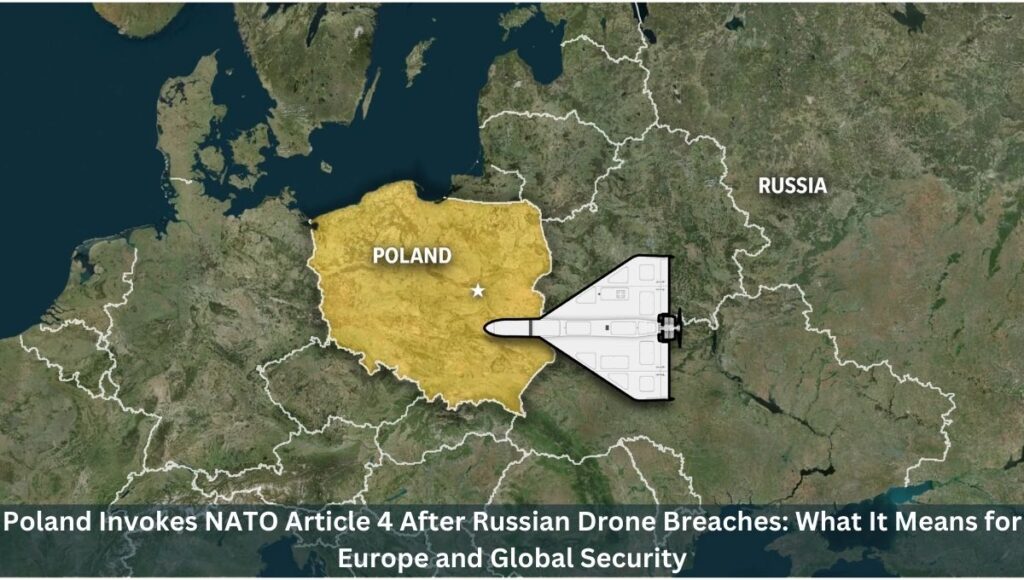
Poland Invokes NATO Article 4 After Russian Drone Breaches: What It Means for Europe and Global Security
What Is NATO Article 4?
While often overshadowed by NATO’s famous Article 5, which declares that an armed attack on one ally is an attack on all, Article 4 is a crucial mechanism that allows member states to raise urgent security concerns.
Article 4 states:
“The Parties will consult together whenever, in the opinion of any of them, the territorial integrity, political independence or security of any of the Parties is threatened.”
By invoking Article 4, Poland ensured that the issue of Russian drone incursions was formally placed before the North Atlantic Council, NATO’s principal decision-making body.
While Article 4 does not guarantee collective military action, it forces the alliance to hold immediate consultations and consider coordinated responses, ranging from military deployments to political or economic measures.
The distinction is important: Article 4 is a warning bell, not a declaration of war. It signals grave concern without yet triggering NATO’s mutual defense clause under Article 5.
Poland’s Response: “An Unprecedented Violation”
Polish Prime Minister Donald Tusk confirmed that the airspace incursions originated largely from Belarus and described them as an “unprecedented violation.”
Addressing parliament, Tusk struck a stark tone:
“While there is no reason to say that we are in a state of war, Poland is closer to conflict than at any time since World War II. We are facing an enemy that does not hide its hostile intentions.”
Polish President Karol Nawrocki went further, framing the drones as a deliberate stress test by Moscow:
“The Russian provocation was nothing more than an attempt to test our capabilities and response. It was an attempt to check the mechanism of operation within NATO and our ability to react. We passed the test.”
In response, Poland has:
- Restricted air traffic in its eastern regions until December 9.
- Banned drones along borders with Belarus and Ukraine.
- Called for an emergency UN Security Council meeting.
- Demanded additional NATO air defense systems to strengthen its eastern flank.
Russia Denies, Calls It “Escalation Myth”
Moscow has denied any intentional violation of Polish airspace. The Russian Defense Ministry insisted its drones had been targeting Ukraine and claimed that the range of its uncrewed aerial vehicles (UAVs) made it impossible for them to strike Poland.
Without providing evidence, Russia accused Warsaw of manufacturing a crisis:
“This is a myth repeatedly spread by Poland in order to escalate the Ukrainian crisis further.”
Despite this, Western analysts argue that the scale of the incursion — 19 drones in one night — points to a deliberate move by Russia to probe NATO’s defenses and political resolve.
Why Article 4 Matters Now
Poland’s move marks the eighth invocation of Article 4 in NATO’s history. The last time was in February 2022, when several Eastern European states — including Poland, Bulgaria, the Czech Republic, Estonia, Latvia, Lithuania, Romania, and Slovakia — demanded consultations in the immediate aftermath of Russia’s invasion of Ukraine.
Earlier, Poland had triggered Article 4 in March 2014, following Russia’s annexation of Crimea.
Most of the other invocations have come from Turkey, in response to threats from Iraq and Syria.
But this week’s invocation is unique:
- It is the first time NATO has shot down Russian drones during the war in Ukraine.
- It tests the limits of NATO’s defensive posture without escalating into full-scale conflict.
- It forces NATO to confront the challenge of drone warfare, where cheap UAVs can provoke expensive defensive responses.
NATO’s Reaction: “Solidarity With Poland”
Following emergency consultations, NATO Secretary General Mark Rutte confirmed that allies stood united behind Poland:
“Allies expressed solidarity with Poland and denounced Russia’s reckless behavior. A full assessment of the incident is ongoing. What is clear is that the violation last night is not an isolated incident.”
NATO’s Supreme Allied Commander Europe, U.S. General Alexus Grynkewich, said it was unclear whether the incursion was intentional.
Meanwhile, the United States emphasized support for its ally. Around 10,000 U.S. troops are currently stationed in Poland, underscoring the country’s central role in NATO’s eastern defense.
Trump’s Ambiguous Response
U.S. President Donald Trump struck a mixed tone on the incident.
Speaking to reporters, he suggested the breach may have been accidental:
“Could have been a mistake. Could have been a mistake, but regardless, I’m not happy about anything having to do with that whole situation.”
On social media, however, Trump reacted more bluntly:
“What’s with Russia violating Poland’s airspace with drones? Here we go!”
Trump’s comments came as European leaders urged him to back tougher sanctions on Russia and additional support for Ukraine. His reluctance raised fresh questions about U.S. commitment to NATO solidarity in the face of Russian provocations.
European Union: Sanctions and a “Drone Wall”
In Brussels, European leaders responded with calls for both new sanctions and strengthened defenses.
- Germany pledged to intensify its support for Ukraine and expand NATO air policing over Poland.
- The Netherlands announced it would send 300 soldiers and accelerate the deployment of Patriot missile batteries.
- The Czech Republic offered helicopters and troops to reinforce Poland.
European Commission President Ursula von der Leyen reiterated the EU’s determination to phase out Russian fossil fuels and clamp down on Moscow’s shadow oil trade.
Meanwhile, Lithuanian officials called for an urgent investment in a “drone wall” — a layered air defense shield stretching across the EU’s eastern flank.
“This is the most important flagship project right now,” said Andrius Kubilius, Europe’s defense commissioner.
A Costly Defense Problem
Experts warn that drone incursions expose a strategic vulnerability. Shooting down cheap drones with advanced fighter jets and high-value missiles creates an unsustainable mismatch.
Guntram Wolff, senior fellow at the Bruegel think tank, explained:
“They were shot down by really high-value equipment. An F-35 jet worth hundreds of millions had to destroy a drone worth perhaps $100,000. This is not sustainable in case of long-term, massive intrusions.”
The incident has intensified pressure on Europe to invest in affordable counter-drone systems, including electronic jamming, laser defense, and integrated radar networks.
UN Security Council Emergency Meeting
At Poland’s request, the United Nations Security Council convened an emergency session to address the drone incursions.
Council members including France, Britain, Slovenia, Denmark, and Greece demanded accountability from Moscow and reiterated support for NATO’s defensive actions.
Russia, a permanent member of the Security Council, dismissed the meeting as political theater.
Poland’s Strategic Role in NATO
Poland is increasingly seen as NATO’s frontline bulwark against Russian aggression. With most Western aid to Ukraine transiting through Polish territory, Warsaw has become both a logistical hub and a symbolic target.
In 2024, Poland was projected to spend 4.1% of its GDP on defense — the highest among NATO allies, outpacing both the United States and Estonia.
Prime Minister Tusk warned lawmakers:
“This confrontation that Russia has declared is not only against Poland, but against the entire free world. And this must finally be understood by everyone, without exception.”
A Test of NATO’s Unity
Analysts see the drone incursion as a deliberate test of NATO solidarity.
Former U.S. deputy secretary of defense Ian Brzezinski argued:
“Russia’s drone incursion into Poland was an intentional barrage intended to provoke Poland and test the solidarity of the NATO alliance. If the West doesn’t respond forcefully, Putin will have achieved a double strategic hit.”
For NATO, the challenge lies in balancing deterrence with restraint — showing Moscow that violations will be met with consequences, without triggering uncontrolled escalation.
Looking Ahead: Escalation or Containment?
The coming weeks will reveal how NATO and the EU intend to respond. Options under discussion include:
- Expanding sanctions on Russia.
- Accelerating air defense deployments to Poland and the Baltics.
- Developing a long-term “drone wall” strategy.
- Enhancing intelligence sharing to detect incursions earlier.
But questions remain:
- Was the drone incursion intentional or accidental?
- How far is NATO willing to go without invoking Article 5?
- Can Europe afford to keep scrambling expensive aircraft against cheap drones?
For now, Poland’s Article 4 invocation has forced NATO and the world to confront these dilemmas head-on.
Conclusion: A Dangerous Turning Point
Poland’s invocation of NATO Article 4 after Russian drones breached its airspace represents a dangerous escalation in Europe’s security crisis. It has tested NATO’s readiness, forced a rare collective military response, and highlighted the urgent need for affordable air defense solutions.
While Russia denies intent, many in Warsaw and Brussels see the incursion as a calculated probe of NATO’s defenses. The alliance now faces a critical choice: reinforce deterrence without stumbling into direct war with Moscow. As Prime Minister Tusk warned, Poland is now closer to conflict than at any time since World War II.
What happens next — whether through sanctions, defense upgrades, or diplomacy — will shape the future of European security and the credibility of NATO itself.
Also Read: Estonia Invokes NATO Article 4 After Russian Fighter Jets Violate Airspace for 12 Minutes
Also Read: Romania becomes second Nato country to report Russian drone in its airspace
Related Posts:
- Estonia Invokes NATO Article 4 After Russian Fighter…
- Poland Shoots Down Russian Drones in Its Airspace,…
- 7 Powerful Facts About Ayatollah Ali Khamenei’s…

- 7 Heartbreaking Facts About Venezuela's Earthquake Disaster
- 5 Major Takeaways from the US Supreme Court's…

- 7 Powerful Measures: Trump Sanctions Russian Oil…
